
Table of Contents
The Role of E-Commerce and Digital Marketing in Business Growth (2026 Guide)
In today’s competitive online world, businesses that invest in e-commerce and digital marketing gain a significant advantage over traditional businesses. The quick advancements in technology are causing consumers to adopt new purchasing habits. So organizations need to be online. These days, customers do a lot of research on the Internet before making any purchases. They look for the product. They evaluate the alternative. And then they make the buying decision using the Internet. Thus, there are huge opportunities for organizations, but at the same time, there is tough competition too.
We will discover how e-commerce and digital marketing work in this session. We will find out why they are important for the growth of our business. We shall learn methods that can be applied for successful expansion. E-commerce and digital marketing are crucial elements of profitable business operations. You cannot survive without marketing because it is what will make your products noticeable. E-commerce and digital marketing are related in every way possible. They assist in reaching customers, and they help the growth of your business. Digital marketing ensures that your products are noticed on the internet. E-commerce allows you to sell to them.
What is E-Commerce?
E-commerce, which is commonly referred to as electronic commerce, is the process by which individuals carry out transactions via the internet. It means companies can offer services globally since they will not be limited by geographical locations. Companies can offer services 24/7 since there is no physical location for conducting business, hence it is always open.
You can acquire almost any commodity online from sites offering every kind of commodity to even sites that are only focused on one product. E-commerce has brought about an innovative shift in the mode of operations of most firms. The process in which firms are offering their commodities online through e-commerce is beneficial to the firm’s growth and development and modification of the business.
Types of E-commerce
There are various types of e-commerce models. Every e-commerce model caters to a particular group of individuals.
The different e-commerce models include:
1. Business-to-Consumer(B2C): Business-to-consumer (B2C) transactions are those that take place between businesses and people who will directly use their goods or services, like retail stores that sell things to customers.
2. Business-to-Business(B2B): Businesses that offer their goods or services to other businesses are referred to as business-to-business, or B2B.
3. Consumer-to-Consumer: Consumer-to-consumer (C2C) is an e-commerce model in which transactions are those in which customers buy items from one another, such as when you sell a buyer your personal item.
4. Direct-to-Consumer (D2C): Using the D2C marketing strategy, brands sell their goods and services directly to customers.
Why E-Commerce is Important
E-commerce has become an essential element of today’s economic landscape for various reasons:
- It allows global outreach
- Minimizes operational costs
- Provides insights for informed decision-making
- It enhances customer experience.
From the perspective of organizations based in places like Kerala or India, online commerce allows for global/national expansion without substantial infrastructural expenditure.
What Is Digital Marketing?
Promoting products and services is the aim of digital marketing. It makes use of websites, social media, email, and search engines. Reaching the appropriate individuals with the right message at the right time is the aim. Digital marketing facilitates communication between companies and their target market. In the modern digital age, it is a means of expanding a firm. Businesses utilize digital marketing to advertise their goods and services. Businesses use digital marketing to promote their products or services.
The following are some key components of digital marketing:
- Search engine optimization (SEO): Increases visibility on search engines
- Social media marketing(SMM): Connects with audiences via social networks such as Instagram and Facebook
- Content marketing: Attracts and educates users through blogs, videos, and guides
- Email marketing: Encourages repeat purchases and nurtures leads
- Pay-per-click (PPC): Boosts immediate traffic through advertising
Digital marketing could thus be considered the fuel that keeps traffic, engagement, and ultimately sales flowing in an online business.
The Connection Between E-Commerce and Digital Marketing
To some extent, it can be said that e-commerce and digital marketing are connected terms. In that context, while digital marketing is about creating traffic and product promotion, e-commerce deals with business transactions carried out via the internet. Both contribute significantly to helping businesses to go online successfully.
Here are ways these two operate hand in hand:
- Digital marketing identifies customers.
- The e-commerce website converts visitors into customers.
- Marketing tools are used for attracting visitors again.
- Digital marketing strategies should be applied to promote an e-commerce website.
Why E-Commerce and Digital Marketing Go Hand in Hand
The success of your online business depends on its openness and interactivity with clients. Opening the online store itself isn’t everything you need to do; you should have a constant traffic flow. This is one of the main reasons why these two spheres of e-commerce and digital marketing are different from each other:
1. The Visibility Creates Conversions
Without digital marketing, your website may go unnoticed among the crowd of others. The purpose of SEO and paid ads is to make your website visible to customers while looking for it.
2. Bringing Customers
Digital marketing helps with customer acquisition from different sources such as Google, Instagram, and emails.
3. Branding
Your brand needs to build a reputation to establish credibility in the future.
4. Getting Useful Information
It is necessary for you to have information regarding your campaign’s performance if you need to enhance it.
5. Customer Retention
Firms implement email marketing, advertising, and promotional offers to maintain the loyalty of their customers.
Importance of Digital Marketing in E-Commerce
Digital marketing is extremely important in all stages of consumer buying behavior, from awareness to purchase.
1. Improved Online Visibility
There are millions of online users searching the internet daily. Using digital marketing, it will ensure that your business gets noticed by consumers searching for your products/services.
2. Accessing the Right Demographics
Contrary to traditional marketing, which relies on conventional techniques, digital marketing offers precise targeting according to demographic specifications and other criteria.
3. Better Conversion Rates
Optimized landing pages, appealing content, and effective marketing campaigns turn visitors into consumers.
4. Budget-Friendly Marketing Techniques
Marketing strategies can be modified according to available budgets; they suit all sorts of companies, big and small.
5. Real-Time Monitoring
It is possible to keep a check on website performance, including conversions, click-through rate, return on investment, etc.
Key Digital Marketing Strategies for E-Commerce
Businesses must employ a variety of strategies to thrive in the fiercely competitive online marketplace. Here is a quick summary of some of the best methods.
Search Engine Optimization (SEO)
SEO is definitely one of the best strategies to boost e-commerce development in the long run. You will make it possible to attract organic traffic using appropriate keywords for your site.
Main techniques for SEO:
- Keywords research
- On-page optimization
- Technical SEO
- Building backlinks
If done right, an optimized e-store will get stable traffic even without any further promotion.
Social Media Marketing
The power of social networks as an effective means of branding and engagement cannot be underestimated. It is possible to showcase products being sold, create advertisements, and communicate with your clients in person. Social commerce through Instagram or Facebook allows people to make purchases right from the application.
Content Marketing
Creating valuable and educational content is the main concept of content marketing. This content will attract your clients and keep them engaged.
Examples of content marketing:
- Blog posts
- Product guides
- How-to videos
- Infographics
Apart from SEO, the high quality of your content will positively impact your authority and credibility in the sphere.
Email Marketing
It is an extremely efficient medium for retaining customers. With automatic marketing, businesses can:
- Provide individual offers
- Retrieve abandoned items
- Advertise fresh offers
It ensures long-term relationships with customers and enhances their lifetime value.
Paid Promotion (PPC)
They can quickly generate leads since paid ads place your product in front of potential buyers. Popular media include:
- Google Ads
- Facebook Ads
- Instagram Ads
While paying for ads is indeed costly, it is quite effective for immediate sales generation.
Latest Trends in E-Commerce and Digital Marketing
The digital universe is ever-changing. Businesses must be at the forefront of all developments.
1. AI-Powered Marketing
The emergence of artificial intelligence technology is revolutionizing the ways in which data is processed, managed, and customized.
2. Personalization
Consumers demand tailored recommendations and experiences. They significantly increase engagement and conversions.
3. Mobile Optimization
As most individuals use mobile phones to browse online, mobile optimization is not an option anymore.
4. Influencer Marketing
It enables brands to expand their reach and build credibility through working with social media influencers.
5. Omnichannel Approach
Companies are integrating different channels to offer customers a seamless experience across multiple platforms.
Common Challenges in E-Commerce Digital Marketing
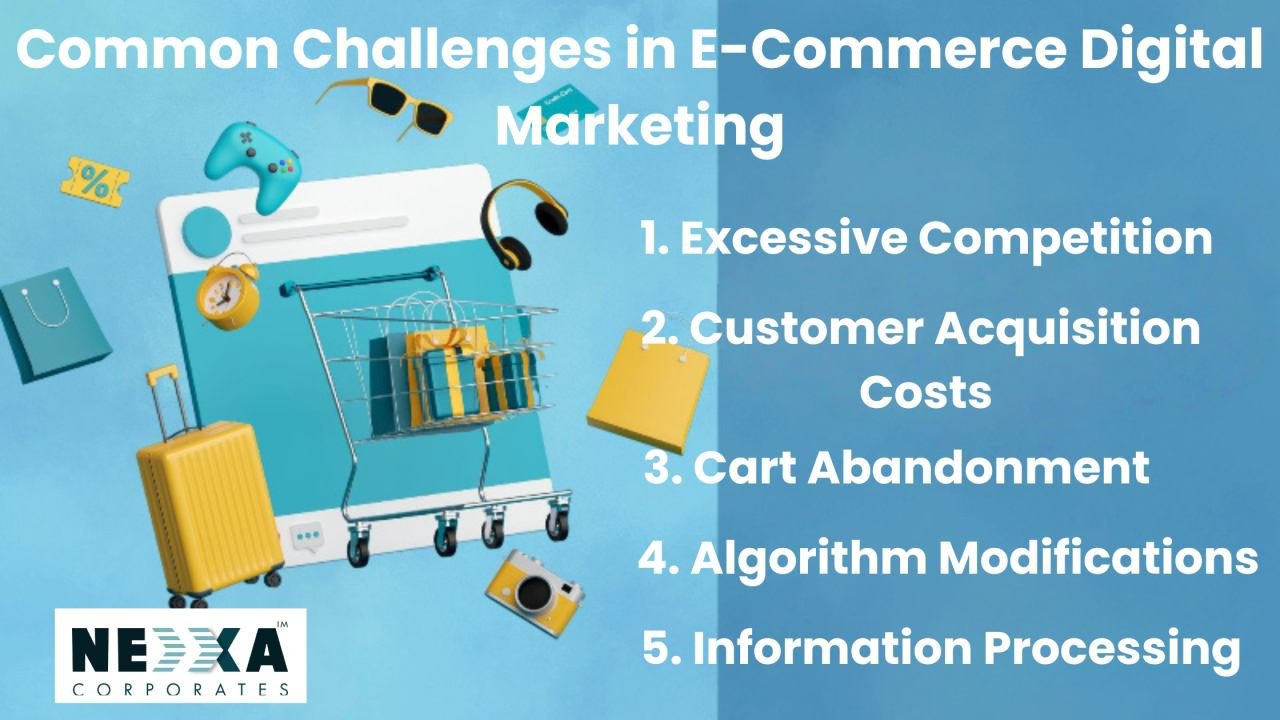
However, there are many problems that organizations must deal with:
1. Excessive Competition
It is hard to stand out in an already saturated space.
2. Customer Acquisition Costs
It is expensive to advertise on the internet when you do not use the correct tools.
3. Cart Abandonment
Many customers abandon their shopping carts without completing transactions.
4. Algorithm Modifications
There are constant modifications in the algorithms of social media platforms and search engines that might affect your ranking.
5. Information Processing
Working with vast amounts of data could become challenging.
How to Build a Successful Strategy
However, a sound strategy is essential for profiting from e-commerce and digital marketing
Step 1: Identify Your Customers
Know their qualities, preferences, and internet habits.
Step 2: Create an Effective Website
Your website should be easy, fast, and safe to use.
Step 3: Concentrate on SEO
Create campaigns that will pay off in the future and boost traffic.
Step 4: Allocate Funds Wisely to Advertising Campaigns
Ensure that the advertising campaigns you spend money on produce results.
Step 5: Create Email Marketing Campaigns
Connect with customers in various stages of the purchasing process.
Step 6: Analyze and Adapt Strategies
Use analytics tools for evaluation and improvement of strategies.
Why Businesses Need Experts
It is no secret that running e-commerce and digital marketing campaigns requires great effort from enterprises. This is why most companies resort to the expertise of professionals.
The advantages of collaborating with such experts as Nexxa Corporates include:
- Industry-related knowledge and experience
- Tailored data-driven strategies
- Effective campaign management
- Growth scaling services
Because of the knowledge of specialists, businesses are able to achieve rapid results without having to experiment with e-commerce and digital marketing initiatives.
Conclusion
The future of business depends heavily on how effectively companies use e-commerce and digital marketing to connect with modern consumers. Both e-commerce and digital marketing are still vibrant areas. Digital marketing operates as an integrated process that assists the firm in positioning itself internationally. The firm can reach out to the customers and earn revenue because of its international presence. It should be wise enough to utilize data in order to create a successful company. Using the best strategy for online marketing is crucial in creating your brand company. Those firms that will employ digital marketing methods, innovations, and customer data will succeed in the future.
FAQ
1. What is e-commerce and digital marketing?
E-commerce involves the sale of goods. Digital marketing involves marketing products online. The strategies used in such cases include SEO, social media, and paid advertising.
2. What importance does digital marketing hold for e-commerce?
Digital marketing makes customers aware of the products offered. It increases the chances of bringing traffic to one’s website.
3. Which strategy is better for achieving success in e-commerce?
SEO, PPC, and social media, combined with email marketing, will work effectively in such cases. They need to be combined in order to achieve success.
4. Would the firm survive in e-commerce?
Yes, because of the opportunity that small firms also have of competing with large firms in this case, because of digital marketing.
5. Would it take time or happen instantly?
SEO would require months to generate success, whereas paid ads will produce instant results. One needs to wait patiently for success from SEO; however, paid ads come in handy in such cases.