
Top 7 Functions of Marketing That Drive Real Results

Nowadays, marketing is more than just making advertisements and promoting a product to consumers. It also defines a data-driven and strategic process that directs how a company positions its products, comprehends its clients, and achieves long-term success. For this reason, every firm, regardless of size, has to understand the functions of marketing.
Basically, marketing determines the needs of customers by producing value and then outperforming competitors. Businesses make more informed decisions by analysing each functions of marketing which directly promote growth. These features help businesses focus in order to attract the correct audience. This enables us to compete more successfully on both online and offline platforms, which are the basis of the evolution of digital marketing.
What are the 7 functions of marketing?
To understand the concept of functions of marketing, first, we need to know ‘What is Marketing?’ The key tasks that direct how companies find opportunities to interact with clients and track results are referred to as functions of marketing. They ensure that marketing is a planned, deliberate process.
What is Marketing?
Marketing can be defined as the strategic process of finding the needs of customers and creating a solution by communicating with them. Thus, helps us to build continuous and long customer relationships. In short, marketing ensures that at the right time, the product reaches the right audience
In today’s world, consumers already know about their product even before buying. They compare brands, research products online, read reviews, and look for brands that offer more than just a product — they look for trust and value. Thus the modern marketing helps businesses:
- Understand customer behavior
- Compete in highly saturated markets
- Build a strong brand identity
- Improve customer experience
Thus, we can see the importance of the functions of marketing. They act as a connection that helps in understanding the needs of the customer to provide unforgettable experiences. Now, let us explore these 7 functions of marketing –
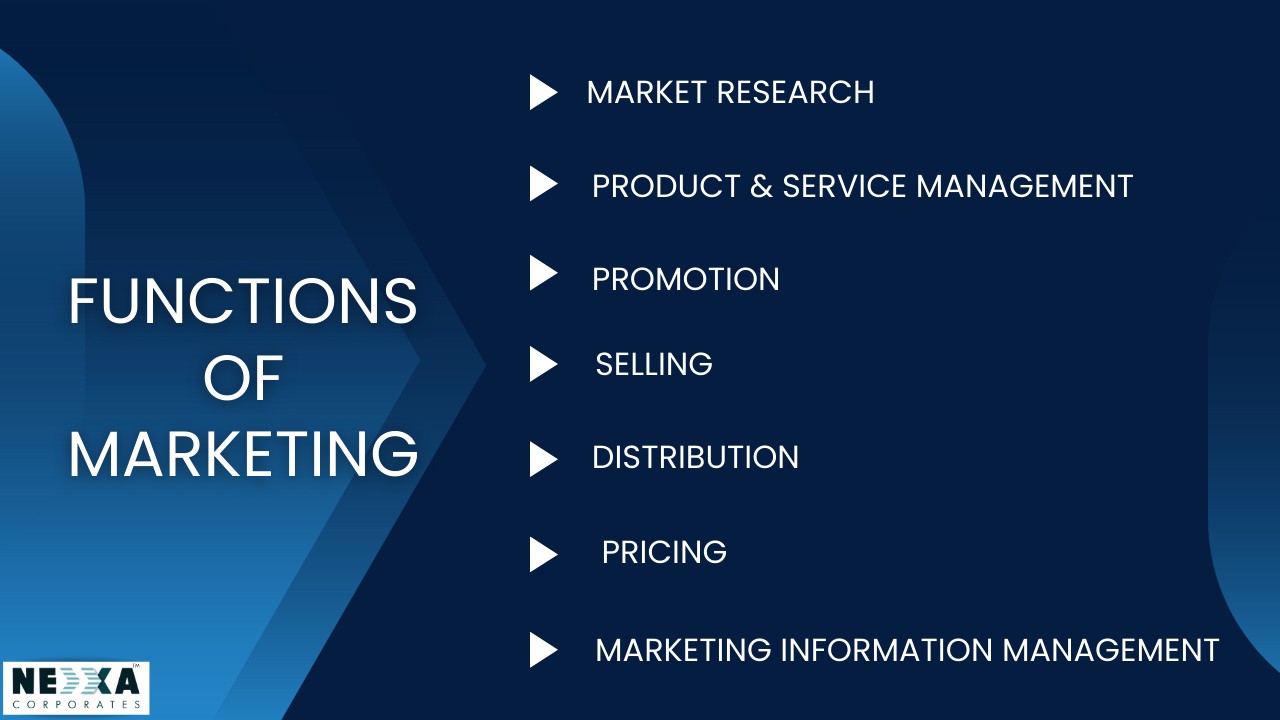
1. Market Research – The First Essential Function of Marketing
Market research is the first and foundation of all marketing activities. Without understanding certain factors like the needs of customers, market demands, etc, businesses cannot make effective decisions. An important part of market research is keyword research. It helps to understand what customers are searching online, revealing their search demand and intent, which in turn helps in providing new market opportunities.
Competitor analysis is another important part that further strengthens marketing decisions by providing current competitor status and their relevance in the market. Studying competitors not only ensures that your brand stays competitive, but it also gives details on the strategic position for growth.
2. Product & Service Management
The product and service management ensure that the products always meet customer expectations by maintaining their competitiveness in the market and changing according to the increasing and the decreasing demands. We can see successful companies always collect feedback from customers through several ways that include writing reviews (let it be good or bad), giving ratings in apps, other social media interactions, and also giving feedback through emails. This is usually done to improve their products or services.
The key to getting a good brand experience across channels is Consistency. Customers expect the same level of service when they interact with a brand through an online platform, which has highly increased nowadays, or an offline store, in the traditional way. In short, these products and service management help in achieving a high-quality brand experience.
3. Promotion – A Major Component in the Functions of Marketing
Promotion plays a vital role in helping communicate and raising awareness among potential customers. This led to Online promotions that have become essential to reach different customer segments effectively. These methods allow brands to deliver targeted messages and maintain consistent visibility. Some of the online promotions include:
- Email marketing
- Google ads
- Video marketing
- Display advertising
Each channel helps brands reach different segments of customers.
A major part of modern promotion also relies on:
1. SEO: It boosts organic visibility in a company. Simply, SEO (Search Engine Optimization) helps customers come to you automatically without much difficulty.
2. Social media: It strengthens engagement, brings customers with the same interests from different parts of the world together to build communities, which helps in enhancing brand personality.
3. Paid ads: Paid ads are used as a marketing tool to provide an immediate reach on content to a certain audience who are browsing in internet.
These tools work together to increase brand visibility and drive traffic.
4. Selling – Digital Sales Channels That Increase Conversions
One of the important functions of marketing is selling. It turns potential customers to paying customers. So in order to do so, we need to know that selling is not only just making someone buy, but it is also about guiding them to make the right purchase. Sales funnel and landing page help to achieve this.
A well-structured sales funnel helps to lead customers through different stages and buy the right product. Each stage has to be clear in terms of communication; only then can customers be engaged to improve the chances of conversion. Landing pages help in converting visitors into leads or customers. A strong landing page should offer a clear platform for messaging or contacting, and highlight everything that leads to customer benefits.
5. Distribution – Delivering Value Through Digital Channels
Ensuring that buyers may obtain your goods at the appropriate time and via the most convenient channel is the main goal of distribution. Online marketing and the increase in delivery-friendly platforms helps to reach out to wider audience. Customers can choose and buy things from any location with the help of e-commerce websites and mobile apps.
Being easily found is also essential for local enterprises to have effective distribution. Tools like location-based advertising, Google Business Profiles, and local SEO are useful in this situation. They guarantee that anyone looking in the area can locate the company fast and obtain what they require without any hassles. When combined, these local and internet distribution channels improve the customer’s purchasing experience and increase accessibility.
6. Pricing in Marketing
Pricing has an important role in marketing. It helps a customer to decide if they actually want to buy something. If the pricing of a product is so attractive, it makes the customer buy it irrespective of their need. It also influences the overall demand and profit, which is why it is considered one of the most important functions of marketing. Pricing means how much value in terms of money a product has by considering certain factors like its making charges, whether it has high or low demand in the market, and also revolves around competitor prices.
It is also one of the four elements of marketing, which is commonly known as “4 Ps” (Product, Price, Place, and Promotion). Another key point to consider about pricing is – it is the only one that directly generates revenue.
7. Marketing Information Management – Data-Driven Decision Making
Marketing Information Management is another function of marketing that helps in Data-Driven decision-making. Today’s marketing is based on insights rather than presumptions. In order to understand the demands of clients and make decisions accordingly, businesses rely on data. Customer Relationship Management, or simply CRM systems, is an essential feature because it saves crucial consumer information, including past interactions, behavior patterns, and purchase history, which enables firms to provide more individualized service and communication.
Analytics solutions make it easier to monitor how customers connect, visit, or buy from a firm. These insights highlight areas that are doing well and those that need development. And thus Marketing Information Management helps companies in delivering relevant messages.
Features of Marketing
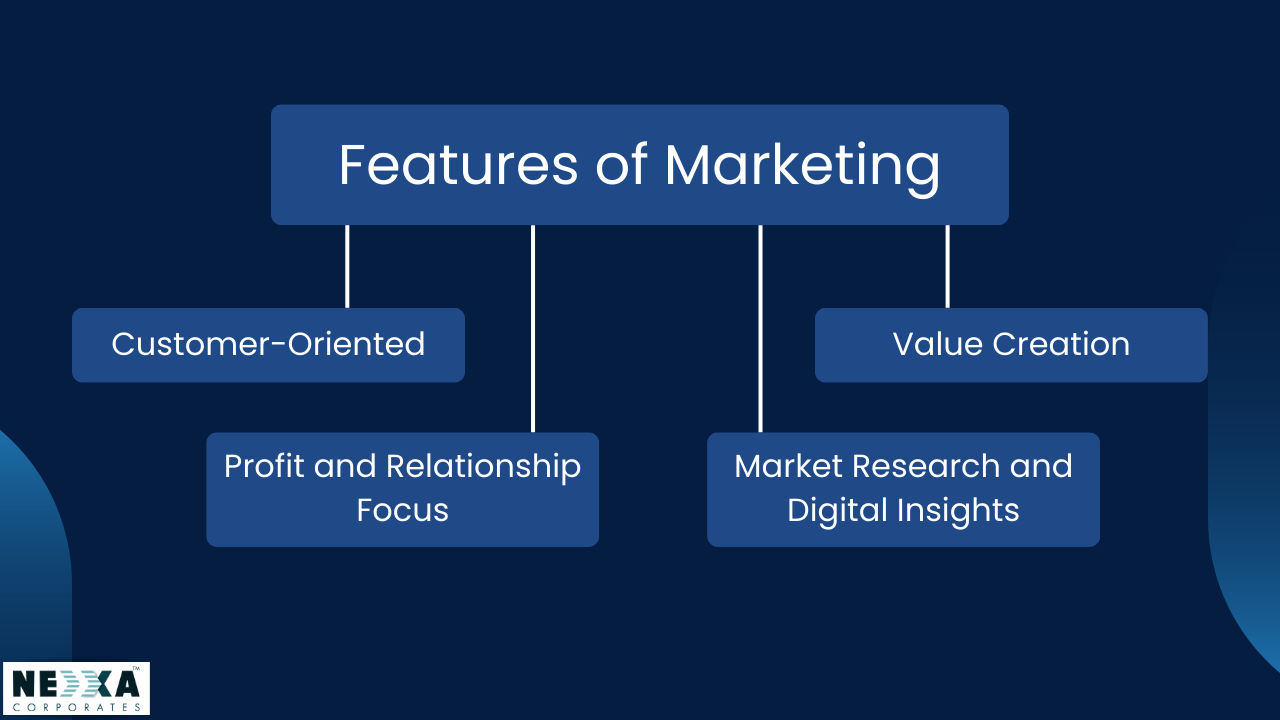
Features of Marketing help us to understand how each functions of marketing work effectively. These features show the importance of focusing on the needs of customers by creating real value and building long-term relationships. It is done by making decisions using research-backed insights essential for achieving sustainable business growth. Now, let us explore these features. –
1. Customer-Oriented
Customer needs are the foundation of all marketing decisions.
2. Value Creation
Marketing helps in ensuring that products are priced correctly according to the customer expectations.
3. Profit and Relationship Focus
Nowadays, people rely on the same item for the long term. This creates a profit and enables a continuous relationship rather than one-time sales.
4. Market Research and Digital Insights
As we know, marketing strategy begins with research, which then leads to customer insights and finally, makes decisions based on the available data and insights data-driven decisions.
What is Selling in Marketing?
Selling is the process of making people buy something. It is done by providing a clear value for the product or service. We know that the concept of marketing is to make people aware of a product, even if they want it or not. But selling is actually converting that awareness into an actual purchase.
Marketing vs Selling
Even though both these terms – Marketing and selling may seem similar, they play very different roles in general. Marketing is all about understanding what customers want, what problems they face while choosing, and how a product can fit into their lives. It focuses on different functions like research, communication, and building trust so that people become interested in the brand.
Selling, on the other hand, comes after this stage. Once we know what the customer needs are, selling becomes effective. It includes guiding the customer to help them make a final decision.
Both of these ensure a business attracts the right audience and converts them into paying customers. As we learned earlier, selling is an essential part of the functions of marketing and how it ensures that the product reaches the right customers and generates revenue.
CONCLUSION
The functions of marketing form the foundation for the success of any business. It helps in understanding what people want and demand the most. This helps in ensuring a steady growth in the market. While we know clearly ‘what is marketing’, it is actually more than promoting a product. It is a complete process that begins with identifying the needs of a customer to delivering it effectively. Each functions of marketing- whether it is research or pricing, or promotion, etc, has to work together to help businesses stay organised and successful. These features aid in our comprehension of the marketing concept of what is selling. Even though they have apparent similarities, marketing and selling are very distinct from one another. When these components come together, a long-term relationship is maintained, increasing the digital marketing scope.
FAQ
1. What are the functions of marketing?
The functions of marketing are those elements that help to identify the needs of a customer and provide service.
2. What is marketing?
It is the process of finding the needs of customers by communicating with them.
3. What is the first function of marketing?
Market research is considered the first function because it helps to understand the needs of a customer.
4. What is selling in marketing?
Selling is the process of making people buy something. It is done by providing a clear value for the product or service.
5. Can small businesses use the functions of marketing effectively?
Yes, even small businesses can apply them using simple digital tools and strategies.