
Table of Contents
What Is the Main Goal of Generative AI? How It Works and Why It Matters
What is generative AI? Generative AI is a type of artificial intelligence designed to help people create new content faster and more efficiently. As digital work continues to grow, relying only on manual creation becomes time-consuming and difficult to scale. What is the main goal of generative AI? The answer is simple: the main goal of generative AI is to generate original content by learning patterns from existing data. By understanding how text, images, code, and audio are structured, generative AI systems can produce new outputs that support creativity, reduce effort, and improve productivity while still requiring human guidance.
Generative AI is a creation-based system, as opposed to traditional AI systems, which are primarily concerned with the analysis or classification of information. This is not to say that the primary goal of generative AI models is to supersede human cognition, but to complement it by eliminating the need to repeat actions and simplifying the process of testing out ideas in a variety of sectors, such as education, business, design, and software development.
What Is Generative AI?
Generative AI is a sub-category of artificial intelligence that produces novel and original work by following trends that are observed in huge volumes of existing data. As compared to the traditional AI systems which engage themselves in information analysis, trend identification, or prediction, generative AI generates outputs like text, images, audio, video, and computer code, in response to user input. Simply, the main goal of generative AI is not classification but creation.
The primary goal of generative AI models is to create content that is very similar to the one made by humans and has the logical structure, context, and relevance. These models function on the premise that they examine how data are organized and thereafter apply that knowledge to generate new outputs rather than duplicating content. Generative AI is not able to think, reason, or perceive information in the same way that humans do, but instead it functions as a prediction of probable results based on acquired patterns. The future of AI lies in assisting people with smarter decision making, faster problem solving, and more efficient everyday work across industries.
Such capability renders generative AI applicable to education, business, marketing strategies, design, and software development where speed, scalability, and creative assistance are necessary but human supervision is also required to ensure high accuracy and responsible usage.
What Is the Main Goal of Generative AI?
What is the main goal of generative AI? The main goal of generative AI is to produce original and content-rich works using learning models of patterns based on the available data and applying the acquired skills to generate meaningful content in the form of text, images, audio, or code. Instead of duplicating information, the generative systems produce new outputs that are based on the structure, context and style of the training data.
Fundamentally, the primary goal of generative AI models is to create content. These are the models which are aimed at facilitating human creativity by generating drafts, ideas and variations which can be further refined. This capability aids in lessening the redundancy of work and enhancing efficiency as well as creative work in industrial fields becomes more effective.
In order to do this, generative AI systems are trained in large datasets where they gain patterns, relationships and probabilities of the data. The system can forecast and create new combinations of words, images, or code elements by learning the general occurrence of word, image, or code elements and how the same elements tend to coexist and be relevant. This pattern-based learning explains what is the main goal of generative AI, not intelligence or decision-making, but the controlled creation of new content under human guidance.
How Generative AI Achieves Its Goal
Generative AI reaches its goal with the help of a systematic learning process that enables systems to generate new material correctly and consistently. Models are initially trained on large datasets which contain examples of text, images, audio or code to support the main goal of generative AI. These datasets assist the system to comprehend the structure of information, flow of language, and also the relationship of elements with each other under various situations.
The pattern recognition is incorporated in the system during the process of training. It does not memorize information, rather it learns the recurring relationships, sequences and probabilities in the data. This style of learning patterns allows the primary goal of generative AI models, to produce new work that is not only sensible, applicable, but also stylistically akin to human work without necessarily mirroring it.
Generative AI relies on prompt-based generation to produce results after being trained on data. A prompt is a clear instruction or input given by the user that guides the system on what to generate. The model combines learned patterns with user prompts to create new content that fits the requested context. This approach supports key functions of marketing, such as content creation, audience targeting, and campaign optimization, by enabling faster and more data-driven outputs. This process clearly explains what is the main goal of generative AI—to generate useful and original data by learning from existing information and operating under human guidance.
The Goals of Generative AI
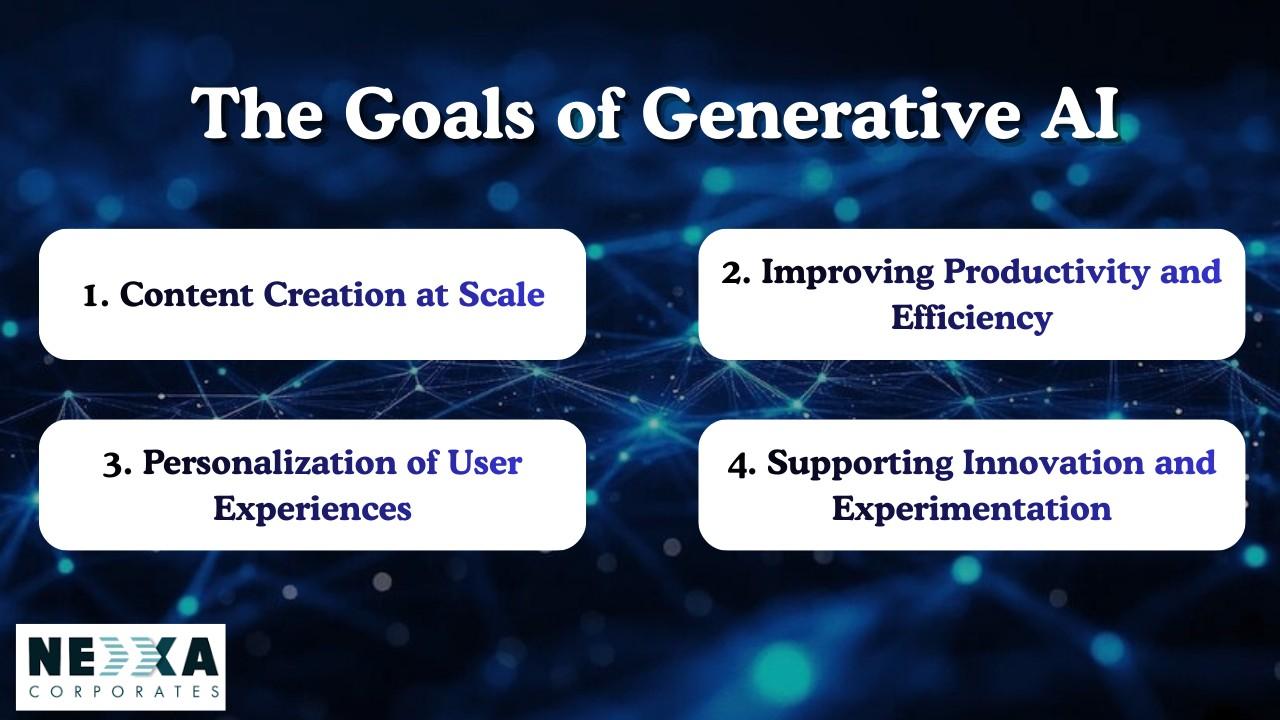
1. Content Creation at Scale
Among the objectives that promote the main goal of generative AI is the creation of high volumes of content in an efficient way is the feature to produce large amounts of content through generative AI. The generative AI, through creation of text, images, code, and media saves time wasted on repetitive creativity work yet quality and accuracy has to be checked by a human.
2. Improving Productivity and Efficiency
Generative artificial intelligence can enable people and companies to work more efficiently because it can automate the standard procedures. This helps to support the primary goal of generative AI models and enables people to do more planning, decision-making, and problem solving rather than manual labor.
3. Personalization of User Experiences
The other critical objective is to provide a more relevant and personalized output. Generative AI integrates the input and context of the user to produce content that feels more personalized and enhances usability and engagement across apps, making it more user friendly.
4. Supporting Innovation and Experimentation
Generative AI allows users to test concepts, experiment with designs and solutions within a short period of time. This is what is the main goal of generative AI, as it can assist individuals to create new possibilities, which might not readily be created using simply manual means.
Conclusion
Generative AI has a distinct mission, which is to produce new and original content through the learning of patterns in available data. In this paper, we have observed that the main goal of generative AI is not to substitute human intelligence but to aid creativity, productivity, and innovation in various industries. Through training on a large scale, identifying patterns, and responding to prompts, generative AI systems can generate useful results though they require human assistance to ensure accuracy and responsible usage.
Being utilized properly, generative AI can serve to scale the content creation process, enhance efficiency, make experiences individual, and stimulate experimentation. Knowing its purpose and restrictions will also enable people and companies to utilize this technology in a more efficient and considerate manner so that generative AI can be an effective and valuable tool that brings about the actual value, and not bewilderment or over-reliance.
Frequently Asked Questions (FAQs)
1. What is the main goal of generative AI?
The main goal of generative AI is to create new and original content—such as text, images, audio, or code by learning patterns from existing data. It focuses on producing outputs that feel human-made while supporting productivity and creativity.
2. How is generative AI different from traditional AI?
Traditional AI mainly analyzes data to classify, predict, or make decisions, while generative AI creates new content. Instead of only recognizing patterns, generative AI uses those patterns to generate original outputs.
3. Why is generative AI important today?
Generative AI is important because it helps people and businesses save time, automate creative tasks, and scale content creation. It is widely used in writing, design, education, software development, and research.
4. Does generative AI think or understand like humans?
No, generative AI does not think or understand like humans. It works by predicting patterns based on data and probabilities, not by reasoning, emotions, or real understanding.
5. What are the limitations of generative AI?
Generative AI can produce incorrect or biased information and relies heavily on the data it is trained on. It requires human review to ensure accuracy, ethics, and responsible use.