
How to Improve Website Traffic: 10 Proven Strategies That Actually Work
We know that if we want to build a business, having a website is mandatory. But despite having quality content, it’s hard to bring organic traffic to your website. However, simply owning a website is not enough. Many businesses struggle to attract visitors even after publishing quality content, investing time in design, and offering valuable products or services. Driving consistent organic traffic has become increasingly challenging due to rising competition and constantly evolving search engine algorithms. This is why people find it hard to answer the question ‘how to improve website traffic?’. Without the right strategies, even well-designed websites with great content can remain invisible in search results. This is why a structured, proven approach to traffic growth is essential. In this guide, we’ll explore 10 proven strategies that actually work to improve your website traffic, helping you reach the right audience, increase visibility, and achieve sustainable online growth. So, here are the 10 proven strategies that actually improve your website traffic.
Why Website Traffic Matters More Than Ever
If you want to grow your business, a website is essential. The more website traffic increases, the more chances for more leads, enquiries, and sales. High website traffic signals credibility and authority in your niche. More visitors mean more potential customers, which improves the conversion rate and brings users who are ready to take action. This is why people seek answer for the question ‘how to improve traffic to my website’ When doing seo for business, Google’s algorithm focuses not just on keywords but also on user experience, E-E-A-T (Experience, Expertise, Authoritativeness, Trustworthiness) matters.
10 proven strategies for Optimizing Your Website for Search Engines
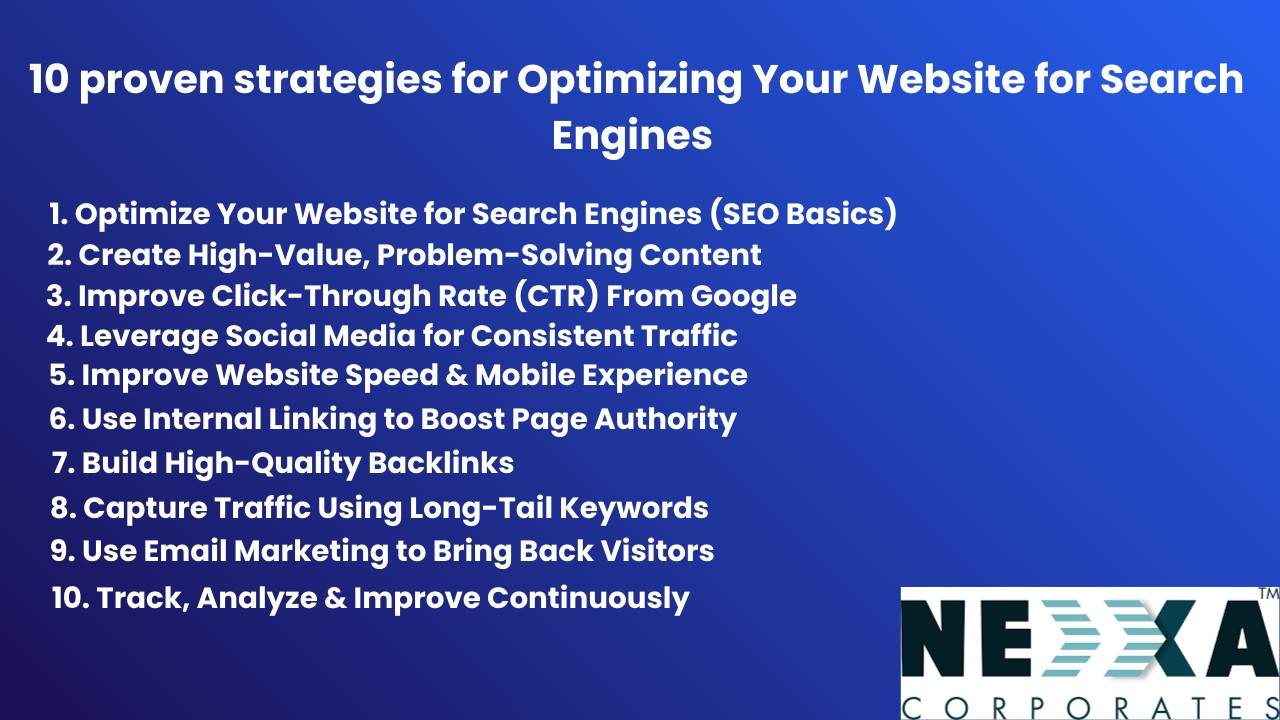
1. Optimize Your Website for Search Engines (SEO Basics)
SEO is the most important part of improving traffic organically. this is why people ask the quesion ‘how to improve organic traffic to my website’. Without proper optimization, no matter how good your content is, your search engine marketing doesn’t rank or get clicks. The Google search engine algorithm prioritizes intent relevance and user experience. Choosing your keywords with relevant search intent is the first step of SEO. Do off page seo & on-page SEO that drives more clicks, add internal links to the relevant pages, and use proper H1, H2, and H3 structures for readability.
2. Create High-Value, Problem-Solving Content
Content quality is very important; it directly impacts the traffic growth of your website. Google prefers helpful original content, but you have to write the content for humans, not just for the algorithm. Use simple language in simple short paragraphs that a normal person can easily understand. Update the old content with new content which losed traffic over time, update outdated information and statistics, and improve the images, videos, and charts of the content.
3. Improve Click-Through Rate (CTR) From Google
Click-through rate is a very important aspect of websites; a high ctr means more traffic without higher rankings. Writing eye catching-seo title is an essential part of increasing ctr, adding numbers and power words like “simple” or “effective.”For example:-“How to improve organic traffic to my website”, “How to improve traffic to my website”. Create curiosity and encourage people to click your blogs. Use rich snippets for seo title and use FAQ to increase SERP, these strategies will make you stand out from the competitors on Google.
4. Leverage Social Media for Consistent Traffic
Use social media to share your blogs strategically, which will identify platforms where your audience is more active. Schedule a specific time according to your audience’s active time, and try to post consistently. Focus on organic social media reach by engaging with your audience through comments and messages, collaborating with creators or brands, and building trust before promoting links.
5. Improve Website Speed & Mobile Experience
Page roles play a huge role in your website ranking, google use core web vitals as ranking factors. A better site speed improves user satisfaction, and generally optimizes the site rank higher organically. Same with mobile optimization, most people use mobile to browse the internet, so making your website mobile responsive is mandatory for website traffic.
6. Use Internal Linking to Boost Page Authority
Internal links help the search engine to understand the site structure; they distribute link authority across pages. Find internal links that are relevant to your content naturally. Use good descriptive anchor text that clearly and accurately describes the content of the linkable page, helping both users and search engines to understand the topic’s destination. These methods will improve the site’s crawlability and indexing, which increase the time spent on the site
7. Build High-Quality Backlinks
Build high-quality backlinks; this will improve the domain authority of your website. When building backlinks. Building backlinks is essential for a high website ranking. After creating quality content, backlinks are the way to rank your website in the SERP. submit niche based citations and directories, avoid spammy or paid links. Earn your backlinks through valuable content.
8. Capture Traffic Using Long-Tail Keywords
When doing keyword research, try to find long tail keywords, because longtail keywords are more likely to attract your target audience. Most of the time, long keywords tend to have less competition than the broad keywords, which will eveatually leads to a high conversion rate, which is ideal for blogs, guides, and FAQs.
9. Use Email Marketing to Bring Back Visitors
Using email is a clever strategy that is used for retaining your visitors who you lost. Sending an email to the visitor drones repeat traffic, and it build long term audience relationships. Email marketing turns visitors into repeat traffic. Send regular newsletters, offer leadmagnets like lead guides, and share new content updates. This will keep the consistent returning traffic.
10. Track, Analyze & Improve Continuously
The SEO success depends on the ongoing optimization of the website. Data-driven decisions will improve the website traffic growth. Use tools like Google Analytics & Search Console to track your organic traffic performance. Monitor the impressions and CTR and identify low-performing pages, and finally fix drop-offs and improve user flow.
Common Mistakes That Kill Website Traffic
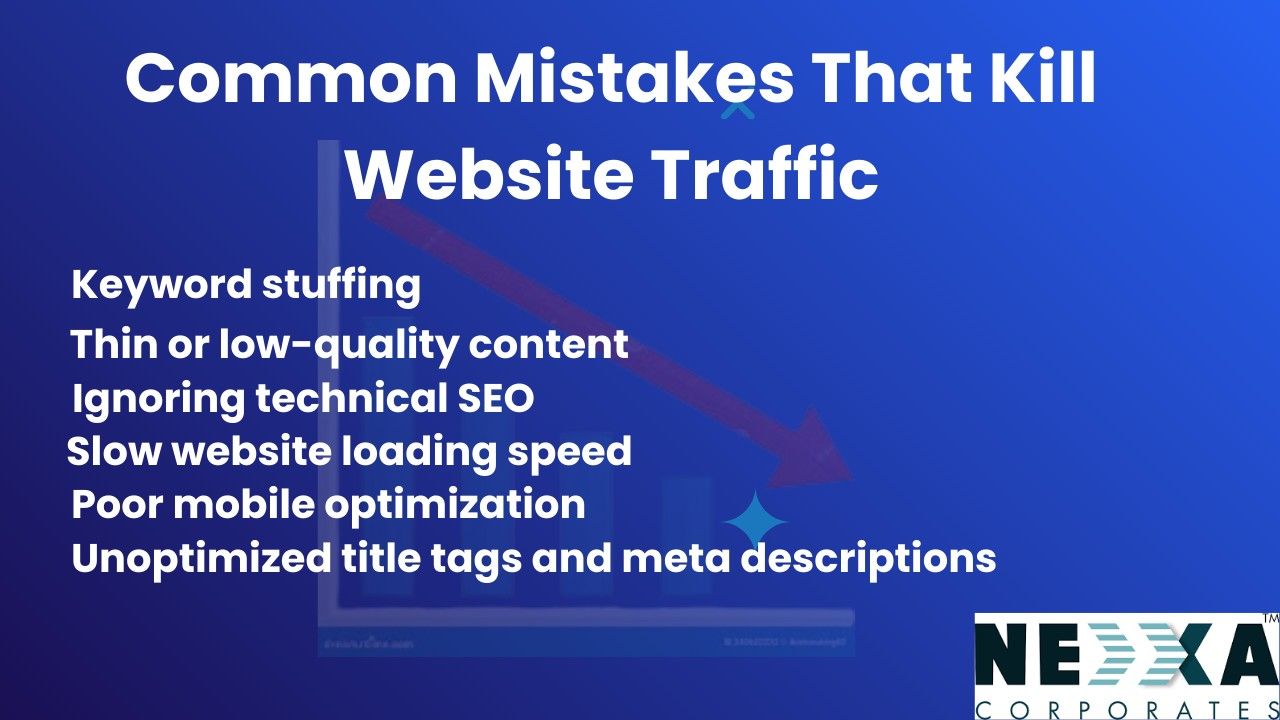
Keyword stuffing is one of the most common mistakes that people make. Stuffing and overusing the same keywords decreases the content quality and makes your content unreadable. Google’s algorithm does not prefer low-quality shallow content. Pages that load slowly and have poor mobile optimization will increase bounce rates and reduce rankings, and unoptimized meta tags and meta descriptions will affect the click-through rate. Another major factor that harms website traffic is poor website performance. Pages that load slowly frustrate users and lead to higher bounce rates, signaling to search engines that the page does not provide a good experience. With mobile devices accounting for a large portion of web traffic, a lack of mobile optimization can further reduce visibility and rankings. Websites that are not responsive or mobile-friendly risk losing both users and search engine trust. Additionally, unoptimized meta titles and meta descriptions can significantly affect click-through rate, even if a page ranks well. If your metadata is unclear, too long, or not compelling, users are less likely to click on your link in search results. This results in missed opportunities for organic traffic. Paying attention to technical SEO, content quality, and user experience together is essential for maintaining and growing sustainable website traffic.
Conclusion
Website traffic growth takes time, so patience is key. Stick to strong SEO fundamentals and avoid looking for quick wins. Be consistent with publishing high-quality, updated content on a regular schedule, as this helps search engines trust your site. Track your ad and campaign performance carefully, analyze user behavior, and optimize your strategies based on real data and measurable results. Over time, these consistent efforts will lead to sustainable and long-term traffic growth.
FAQ
1. How to improve my website traffic without paid ads?
You can improve traffic to your website without paid ads by leveraging SEO, social media sharing, long-tail keywords, email marketing, internal linking, and content promotion. Organic strategies may take time but deliver sustainable and cost-effective results.
2. How long does it take to see results from website traffic optimization?
Website traffic improvement usually takes time. Small changes like on-page SEO, content updates, and speed optimization can show results in a few weeks, while long-term strategies such as content marketing and backlink building may take several months to deliver consistent growth.
3. How to improve traffic to my website organically in the long term?
The most effective way to increase website traffic in the long term is by combining SEO, high-quality content creation, regular updates, and a strong user experience. Consistency, data analysis, and continuous optimization are key to sustaining traffic growth over time.