
7 Voice Search Optimization Tips for Conversational Search in 2026
A client once asked me, half-joking, “What happens when nobody types anymore?” That was a while back. Voice search still felt like a novelty then, the kind of thing you’d bring up at a marketing meetup and get a few polite nods for. It isn’t a novelty anymore. It’s just part of how people find businesses, products, and answers now. Fifteen-plus years into SEO, local search, and Google Business Profile work, and I’m still adjusting to how often the rules move underneath us.
Voice search optimization isn’t sprinkling a few conversational keywords into a page and calling it a day — you actually have to understand how people talk, answer their questions plainly, build authority that holds up under scrutiny, and structure the information so machines can parse it without guessing. Below are seven strategies I keep coming back to with clients, plus some thoughts on where this is all heading. “That’s the heart of voice search optimization — and it’s fast becoming the backbone of modern voice search marketing.”
What Is Voice Search Optimization, Really?
At its core, it’s shaping your content, your technical setup, and your local listings so that Siri, Alexa, or Google Assistant can confidently pick your answer and speak it out loud. It’s not old-school SEO wearing a new hat, either — it leans on natural phrasing, direct answers, structured data. Makes sense when you think about it: nobody’s flipping to page two of results while they’re talking to their car. That’s really the whole game. One answer gets picked. Everything else just doesn’t exist, as far as the person asking is concerned. Local intent matters more here than almost anywhere else. A huge share of voice queries are “near me” searches.
That means your Google Business Profile, NAP consistency (name, address, phone), and local schema markup carry real weight — arguably more than they do for typed search. Put together voice search optimization isn’t a separate discipline bolted onto SEO — it’s regular SEO fundamentals, just pushed further toward clarity, speed, and structure, because the format only allows for one winner. That’s the essence of voice search optimization in one line
How Do You Write for the Way People Actually Talk?
This one took me longer to really absorb than I’d like to admit. Voice queries don’t read like keyword lists — they sound like conversation. Nobody says “best pizza NYC” out loud. They say something closer to “hey, where’s a good pizza place near me that’s still open.” Build your content around the typed-out version and you’re already a step behind.
A few things that have consistently worked with clients:
1. Digging through “People Also Ask” boxes and autocomplete for how people really phrase things, not how we assume they do
2. Building FAQ sections around genuine 5W1H questions (who, what, when, where, why, how)
3. Writing answers the way you’d explain them to a friend across a table, not the way you’d type them into a search box
4. Pulling long-tail, conversational phrasing from tools like AnswerThePublic or SEMrush’s Keyword Magic Tool — the stuff you’d otherwise miss entirely
Once your content matches the actual rhythm of spoken questions, voice search marketing stops feeling abstract. You start turning up in places that typed, keyword-first content just can’t reach.
Roughly half of all voice searches carry some local intent — “near me,” “open now,” “closest one,” that kind of thing. I learned this one the hard way, early in my career, watching a client lose out to a weaker competitor purely because their Google Business Profile was half-finished. Outdated hours. No service area listed. Maybe three photos, total.
What a properly maintained local presence actually needs:
1. A complete, accurate Google Business Profile: categories, hours, service areas, the whole thing filled in
2. Consistent NAP (Name, Address, Phone) across every directory and citation you appear on
3. Regular Google posts, quick responses to Q&A, and real engagement with reviews, not copy-pasted replies
4. Location-specific landing pages with embedded maps and local schema markup
Assistants lean heavily on Google Business Profile data for “near me” questions, answering in real time off whatever’s there. If your listing is thin, or doesn’t match your website, you’re simply not in the running, regardless of how good your content is elsewhere. It’s why I tell clients local optimization isn’t some side task tacked onto voice search marketing. It’s the foundation everything else has to sit on.
What Role Does E-E-A-T Play in Getting Chosen by Voice Assistants?
Google’s assistants are cautious by design — deliberately so. They only read aloud the single answer they trust most, and that trust comes almost entirely from E-E-A-T: Experience, Expertise, Authoritativeness, Trustworthiness. It matters more still in YMYL territory (healthcare, finance) where a poorly sourced answer isn’t just an awkward miss. It can genuinely put the person asking at risk. I’ve watched finance clients lose voice visibility for no reason other than their content reading like it came from nobody in particular. Assistants pick up on that. Honestly, so do readers, if you ask me.
What this looks like in practice:
1. Healthcare content with author bios showing real medical credentials, citations to peer-reviewed research, and visible disclaimers
2. Finance content from named, licensed advisors, with clear regulatory disclosures and information that’s actually kept current, not stale
3. Real bylines instead of “admin” or “staff,” ideally linked to verified professional profiles
4. Genuine case studies and first-hand experience rather than recycled, generic advice
How Do You Structure an Answer That Actually Wins Position Zero?
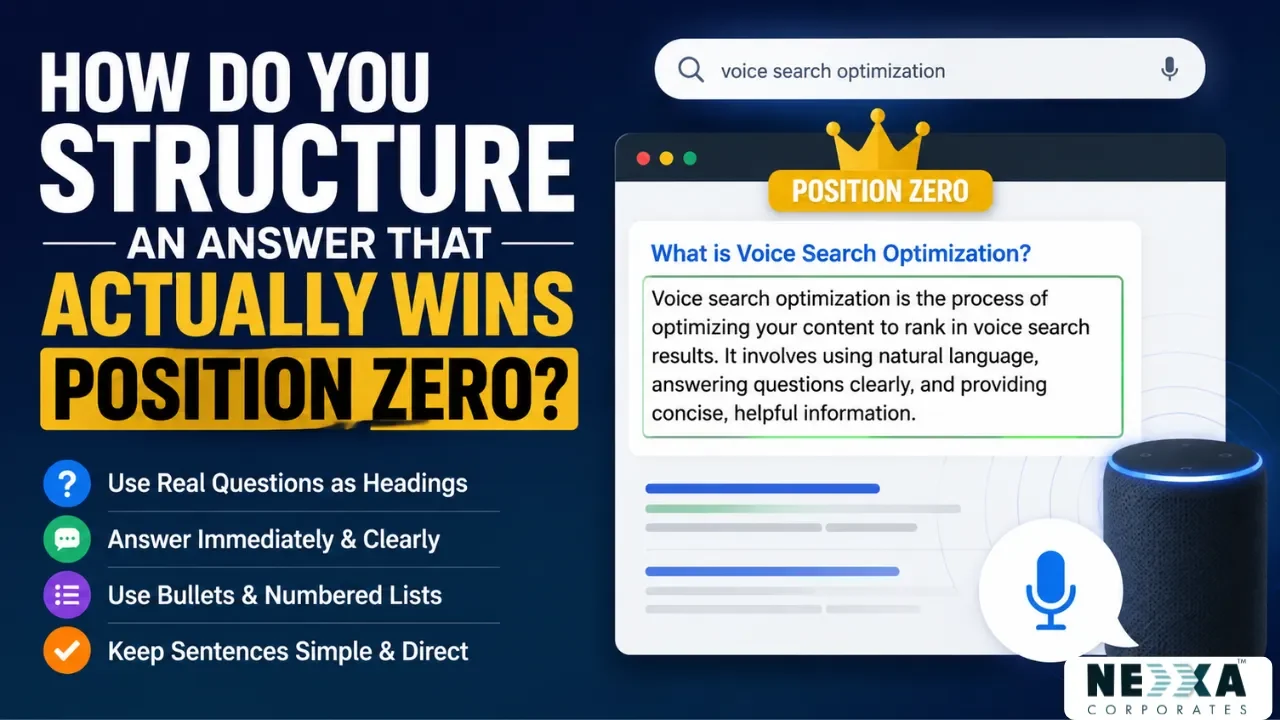
Assistants usually read straight off the featured snippet, otherwise known as Position Zero. Getting there means keeping your core answers tight — somewhere around 40 to 50 words, complete enough to stand on its own, short enough to say out loud in one breath without sounding like you’re rushing through it. That’s basically the whole idea behind AEO, Answer Engine Optimization. You’re not writing for a person scrolling a page. You’re writing for a machine about to say your words out loud to someone who’s driving, or cooking, or has their hands full of groceries.
A few habits that help:
1. Phrase each H2 or H3 as a real question, the kind someone would actually ask out loud
2. Answer right away, in the first sentence or two, then expand below that
3. Lean on bullets and numbered lists so it’s easy to scan (and easy for machines to extract)
4. Keep sentences simple — subject, verb, object, skip the detours
What Technical Basics Will Quietly Sink Your Rankings If You Ignore Them?
Doesn’t matter how well-written your content is if the site behind it loads slowly or isn’t secure. Voice results demand near-instant retrieval — Google just won’t surface a page that can’t keep pace.Think of all this as the plumbing behind your voice search work. Nobody thinks about it while it’s working fine. Everyone notices the second it isn’t.
The non-negotiables, no way around these:
1. Site speed under 5 seconds, though honestly aim for under 2.5 if Core Web Vitals matter to you
2. HTTPS everywhere, no exceptions, full stop
3. Speakable schema markup so assistants know exactly which sections are meant to be read aloud
4. FAQ Schema and Article Schema, so search engines can actually parse your Q&A structure properly
5. Mobile-first, responsive design, since most voice queries start on a phone anyway
How Do You Build the Kind of Authority That Matters for the Future of Voice Search?
Beyond the page itself, assistants weigh off-site authority pretty heavily — backlinks, mentions, structured citations from sources that already have earned trust. This part is slower, and it’s really where long-term brand-building and SEO start to overlap. The businesses dominating voice results today almost always spent years quietly building toward it, long before it paid off. And as the future of voice search leans harder into AI-generated, synthesized answers, that earned authority is what decides whether your brand gets mentioned at all, or skipped over entirely.
What compounds over time:
1. Backlinks from actual industry publications and local news, not link farms
2. Listings in niche, high-authority directories tied to your specific industry
3. Original research or expert commentary that other sites genuinely want to reference
4. Clean, consistent structured data (Organization schema, sameAs links to your social profiles)
So What Does the Future of Voice Search Actually Look Like?
Voice search is moving well past simple spoken questions now, into something more layered — voice paired with images, voice paired with buying, voice paired with whatever device happens to be nearby. Getting ahead of this now beats scrambling to catch up eighteen months from now, which is basically always the trade-off in this field.
Where is multimodal search taking voice queries?
Multimodal search — voice combined with images and camera input — is already here, through things like Google Lens paired with spoken commands. Someone snaps a photo of a product and asks, in the same breath, “where can I get this cheaper nearby.” Getting ready for that means pairing rich, descriptive alt text and structured product data with content that actually sounds conversational.
How is voice commerce quietly reshaping the future of voice search marketing?
Voice commerce, or V-commerce, lets people research, compare, and buy through spoken interaction alone — “reorder my usual,” “add this to my cart.” For a brand to actually benefit, product data needs clean schema, real-time pricing that’s accurate, and checkout that integrates smoothly with platforms like Alexa Shopping and Google Assistant. It’s fast becoming one of the more important pieces of modern voice search marketing, particularly for anyone selling direct to consumers.
What does IoT integration mean for smart homes and connected cars?
As voice search marketing extends into smart homes and cars, queries start becoming ambient — a car assistant suggesting a coffee stop based on your calendar, a smart speaker reordering supplies before you’ve even noticed you’re running low. Brands with clean, structured local and product data now will be the ones surfaced automatically later, often without anyone asking outright at all. That’s the real shift worth watching. The future of voice search isn’t just about being found when someone asks something. It’s about getting quietly woven into routines that don’t require asking in the first place.
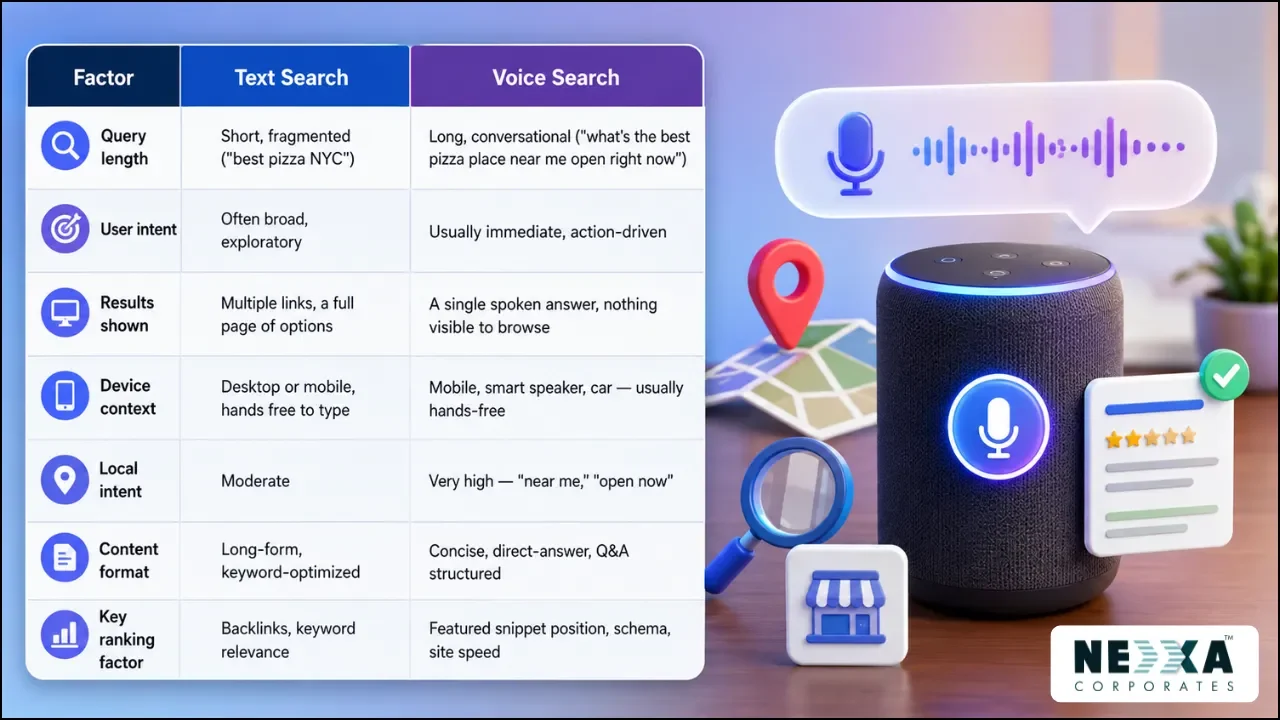
Text Search vs. Voice Search: A Quick Comparison
Conclusion
Voice search optimization isn’t a box you check once and move on from. It’s ongoing — conversational content, technical SEO, local search, structured data, and real expertise, all working together. The businesses that actually benefit aren’t stuffing voice-related keywords into every other paragraph. They’re just answering real questions clearly, accurately, and in a way that sounds like a person wrote them. If local customers matter to your business, start with your Google Business Profile. Check your site’s mobile performance, technical SEO, and structured data next. Then go back through your content and figure out what your audience is genuinely asking.
Make your experience visible, back up the claims that matter with sources people can trust, and keep everything current. Where this is all heading is beyond simple voice queries — toward AI-assisted answers, multimodal search, connected devices, conversational commerce. Getting ready for that now puts your brand on firmer ground when it arrives Good voice search marketing was never about chasing every new trend. It’s about becoming the answer people, and the systems reading answers to them, can actually trust.
FAQ
1. What is voice search optimization?
It’s the process of structuring website content, technical infrastructure, and local listings so digital assistants like Siri, Alexa, and Google Assistant can find your content and read it aloud as the best answer to a spoken query.
2. What is Speakable schema markup?
Structured data that flags specific sections of a page as suitable for text-to-speech playback. It helps voice assistants pick out and read the most relevant content aloud, with a bit more confidence than they’d otherwise have.
3. How fast should my website load for voice search?
Under 5 seconds is the baseline, but under 2.5 is really where you want to land if Core Web Vitals matter to you and you’re chasing that featured snippet most assistants read from.
4. What is voice commerce, and why does it matter for voice search marketing?
Voice commerce, or V-commerce, covers purchasing or managing transactions through spoken commands alone — reordering a product, adding something to your cart, no screen involved. It’s quickly turning into one of the more commercially significant parts of modern voice search marketing.
5. What does the future of voice search look like?
It’s heading toward multimodal experiences that blend voice with images, voice commerce built right into shopping platforms, and ambient IoT integration across smart homes and connected cars — voice becoming an always-available layer of daily life rather than a standalone search channel.