8 Powerful Features of Digital Marketing Worth Trusting
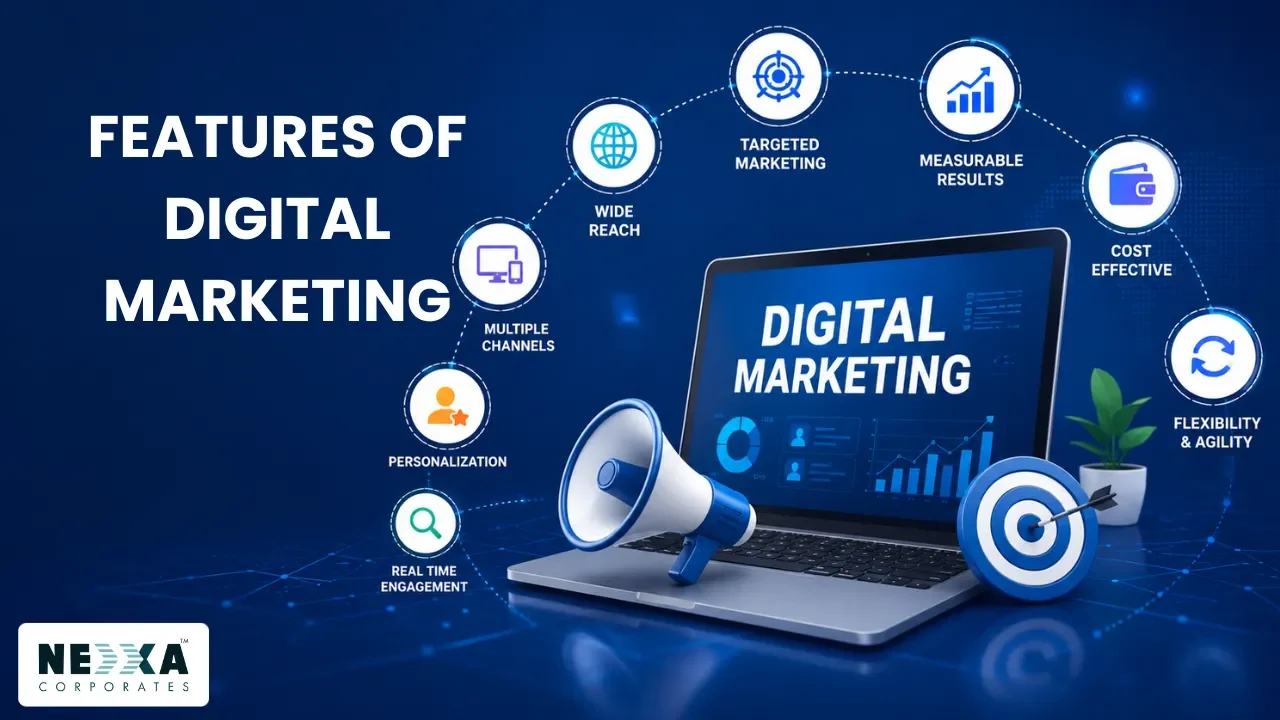
How do brands actually grow online without throwing money at guesswork? That’s usually the real question behind “should we do digital marketing.” The short answer comes down to a handful of specific traits — measurable, targeted, results-driven — in a way a newspaper ad or a hoarding never really was. We run Nexxa Corporates out of Thrissur, Kerala, and over the years we’ve built strategies for clients including Microtec, Herbalife, and CAD Build, across healthcare, education, e-commerce, and manufacturing.
Every one of those industries behaves differently online — a hospital’s audience doesn’t think like a manufacturer’s buyer, and pretending otherwise wastes budget — and that’s the experience this guide is written from. Not a textbook. A client list. This piece covers the core features of digital marketing, the types worth knowing, the benefits that genuinely matter to a business owner, and its broader role in growth.
What is Digital Marketing, Really?
Strip away the jargon and it’s just this: using internet-based channels (search engines, social media, email, websites, mobile apps) to promote a product, service, or brand. Traditional marketing puts a message out and hopes the right people are watching. Digital marketing doesn’t have to hope. It reaches specific people, at a specific time, with a message built for them, and it can prove that it worked, because every click and conversion leaves a trail behind it. Those channels are exactly what show up later as the types of digital marketing worth knowing, and the payoff from using them well is what shows up as the benefits of digital marketing further down this guide.
We run Nexxa Corporates out of Thrissur, Kerala, and over the years we’ve built strategies for clients including Microtec, Herbalife, and CAD Build, across healthcare, education, e-commerce, and manufacturing. Every one of those industries behaves differently online (a hospital’s audience doesn’t think like a manufacturer’s buyer, and pretending otherwise wastes budget), and that’s the experience this article is written from. Not a textbook. A client list.
Key Features of Digital Marketing
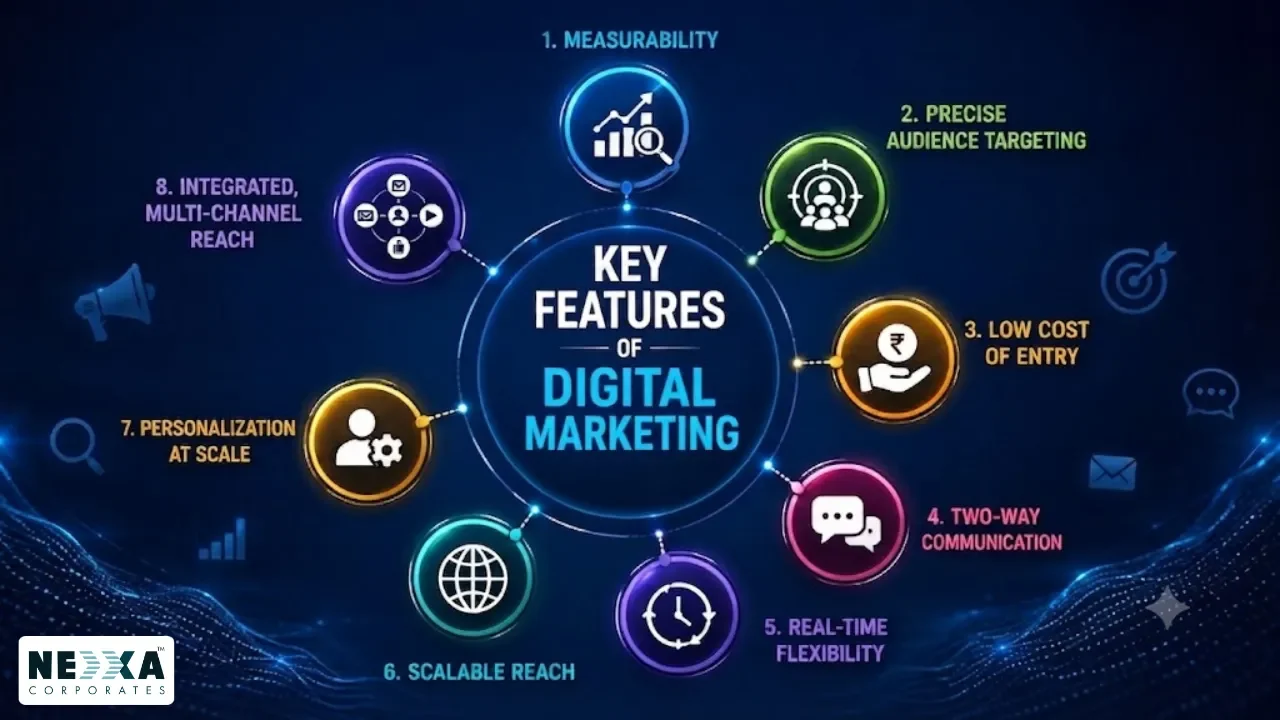
Knowing these traits helps a business figure out where to put its money and what to really expect once a campaign goes live. That’s really the whole point of walking through the features of digital marketing one at a time before looking at channels or budgets. Here’s what sets it apart from the old way of advertising.
1. Measurable Results
Probably the biggest one on this list. Full stop. Run a Google Ads campaign or post something on Instagram and you get numbers back — clicks, impressions, bounce rate, time on page, conversions. A hoarding on the highway can’t tell you how many people glanced at it twice. A digital ad can.
2. Precise Audience Targeting
Age, location, interests, browsing habits, device, even what someone bought last month, all of it can shape who sees an ad. This precision is one of the more underrated features of digital marketing on this list, because it cuts down on paying to show an ad to people who were never going to buy anyway.
3. Low Cost of Entry
A national TV spot needs money most small businesses don’t have lying around. Digital marketing lets someone start with a few hundred rupees a day and scale up once something’s working. That’s the trait that genuinely levels the field for smaller teams.
4. Real-Time Feedback
Old advertising was one-way. Social media and email aren’t. Comments, reviews, DMs, live chat, people respond. And that feedback often tells a business what’s actually wrong with a product long before a bigger problem shows up. Cheaper to hear it in a comment section than a lost contract.
5. Real-Time Flexibility
Pause it, tweak it, kill it, sometimes within minutes. Nobody’s stuck waiting for a print run to finish if an ad isn’t pulling its weight. The money just moves.
6. Scalable Reach
Target one neighbourhood, or forty countries, from the same dashboard, sometimes both in the same afternoon. Practical if you’re thinking about growing beyond your current city without opening an office there. A local business testing a new city doesn’t need a distributor or a storefront first. Just a campaign and a landing page.
7. Personalized Ads
Automation and AI now tailor content for thousands of people at once. Different product picks, different subject lines, different homepage content, depending on who’s looking.
8. Integrated, Multi-Channel Reach
Search, social, email, mobile: treated as separate silos, they underperform. Tied together, they show up consistently wherever an audience happens to be that week. That’s really the last of the features of digital marketing worth naming on its own, and it sets up everything in the role of the digital marketing section further down.
Types of Digital Marketing
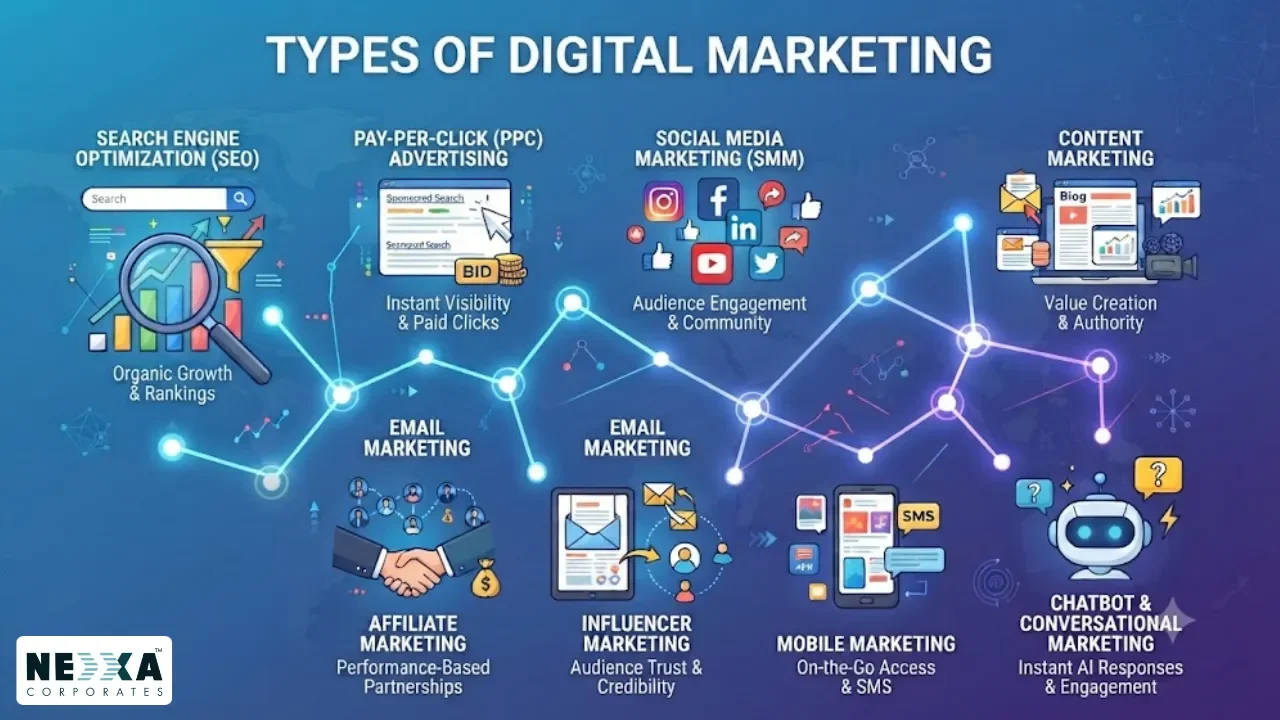
There’s a fair number of types of digital marketing to choose from, and picking the right mix matters more than trying to run all of them at once.
Once the features of digital marketing make sense on their own, the next question is which channels genuinely fit a given business.
1. Search Engine Optimization (SEO) – Improving how a website ranks organically. Slower than paid ads, but one of the more sustainable options; the traffic keeps arriving even during the weeks nobody’s actively working on it.
2. Pay-Per-Click Advertising (PPC) – Ads on Google or similar, paid only per click. Need visibility this week, not this quarter? This is usually the fastest option on the list.
3. Social Media Marketing (SMM) – SMM is the presence and paid campaigns across Instagram, Facebook, LinkedIn, YouTube, wherever the audience really spends its time.
4. Content Marketing – Blog posts, videos, guides, infographics. Slower to build trust, but it tends to stick once it’s there.
5. Email Marketing – Newsletters and offers straight into someone’s inbox. Still one of the better-performing channels for ROI, provided the list is actually segmented and not just blasted at everyone at once.
6. Affiliate Marketing – Other people promote a product and earn a cut of what they sell.
7. Influencer Marketing – Influencer marketing is borrowing someone else’s audience and, more importantly, their trust.
8. Mobile Marketing – SMS, app notifications, mobile-optimised ads; more important every year as browsing shifts from desktops to phones.
9. Chatbot and Conversational Marketing – AI-driven chat that responds instantly instead of making a visitor wait for a human to log on. This one keeps growing.
Most businesses don’t stick to just one of these types of digital marketing. They mix a couple depending on budget, industry, and what customers genuinely respond to, which usually takes some trial and error to figure out.
Benefits of Digital Marketing
The benefits of digital marketing tend to matter more once the types of digital marketing above are actually running together instead of in isolation. Here’s where it gets concrete. Businesses that commit to this tend to see things traditional advertising simply doesn’t offer. Start with the obvious one: ROI that’s actually calculable. Every rupee spent traces back to a click or a conversion, which is probably the clearest benefit when someone’s trying to justify a budget line to a founder.
Brand awareness works differently here too, compounding over months rather than living and dying with one campaign, and the engagement runs both directions, polls, videos, live sessions, people actually participating instead of just scrolling past.A few more benefits of digital marketing worth naming directly:
1. A wider net without a bigger office – A small local business can reach customers three states over.
2. Feedback that shows up in days – Not after a quarterly survey nobody fills out properly.
3. Room to keep improving – A/B testing means a campaign gets better with time instead of staying frozen the way a print ad does.
And maybe the most underrated one: a fairer fight. Because campaigns can start small, a two-person startup can genuinely compete in the same search results as a company twenty times its size, something that was never really true in the print or broadcast era.
Put together, these benefits of digital marketing are why almost every growing business now sets aside part of its budget for digital channels. Not because it’s trendy. Because the numbers back it up. When CAD Build came to us for a stronger digital presence, a targeted branding and marketing strategy helped push their sales up by roughly 30%, a result their own team credits to the strategy itself, not just higher ad spend.
Role of Digital Marketing in Business Growth
The role of digital marketing goes beyond any single campaign; it’s really about tying a business’s growth plan to how customers really behave online. Most purchase decisions start with a search or a scroll now, not a flyer in a mailbox, and that shift alone explains why this moved from “nice to have” to something closer to essential over the last decade.
It builds credibility before a customer ever picks up the phone — a decent website, an active social presence, honest reviews, all of it shapes whether a first-time visitor trusts a brand enough to buy. And it brings in leads who are already somewhat interested rather than shouting at everyone equally; a search, a retargeted ad, time spent reading a blog post, these all signal intent before a sale ever happens.Two things worth calling out separately:
1. It shows up at every stage of the buying journey, not just at checkout. The blog post read on day one and the retargeting ad that brings someone back on day twelve are both doing work.
2. It lets a single-location business compete well outside its own neighbourhood. Local SEO, geo-targeted ads, a properly filled-out Google Business Profile: these can do what once needed a much bigger budget.
There’s a quieter part of the role of digital marketing too, one that has nothing to do with ads directly: campaign data reveals which products or messages actually resonate, and that insight often shapes business strategy well beyond just ad spend.
For an agency, the role of digital marketing in client work usually means stitching a few of these types of digital marketing together — SEO for the long game, social for engagement, paid ads when leads are needed sooner rather than later. That’s the pattern that holds up across very different accounts: a hospital chain, an FMCG brand, a construction supplier — each needing a different channel mix, but all needing the channels to work together rather than as separate islands. AI-driven tools like chatbots have increasingly become part of that mix too, cutting response times and catching leads that would otherwise slip away overnight.
How Nexxa Corporates Approaches This
We’re based in Thrissur, Kerala, and over the years we’ve worked with clients in healthcare, travel and tourism, e-commerce, education, and manufacturing, industries that don’t behave the same way online, which is exactly why we don’t run every client through the same template. Our work usually covers SEO, social media, email marketing, and, more and more, AI-driven tools like chatbots to cut down response times and catch leads that would otherwise slip away overnight. What matters to us isn’t ticking every box across every channel.
It’s building around what a specific business is genuinely trying to get done: more leads, better rankings, more sales by month’s end. That’s ultimately what the types of digital marketing and the benefits of digital marketing covered above are supposed to add up to, and it’s the same lens we apply to the role of digital marketing in every strategy we build.
Conclusion
Digital marketing stopped being a side tactic a while ago. It’s now one of the main ways businesses grow, compete, and stay in touch with the people who buy from them. What separates it from traditional advertising comes down to the features of digital marketing covered above: measurable, precisely targeted, affordable to start, quick to change course when something isn’t working. Knowing the types of digital marketing on offer makes it easier to pick the right mix, and understanding the real benefits of digital marketing makes the case for sticking with it past the first quarter.
The role of digital marketing, in the end, goes well past running ads; it shapes how much a customer trusts a brand, how that relationship develops, and decisions a business makes long after one campaign has wrapped up. Whether it’s a small local shop or a company with national plans, building a proper digital marketing strategy, with the right partner if one’s needed, remains one of the more dependable ways to grow in a market that isn’t getting any less crowded.
FAQ
1. What are the main features of digital marketing?
Measurability, precise targeting, affordability, real-time flexibility, two-way communication, and reach that works locally and globally at the same time.
2. Is digital marketing suitable for small businesses?
Yes, arguably more so than for large ones. One of the clearer benefits of digital marketing is that a business can start small and scale as results come in, instead of committing a big budget upfront and hoping.
3. How does digital marketing support business growth?
The role of digital marketing here covers building credibility, generating leads that are already somewhat warm, guiding people through the buying journey, and handing over data that shapes decisions well beyond the marketing team.
4. What's the single biggest advantage among the benefits of digital marketing?
Most businesses would say measurable ROI, since it’s the one that makes budget conversations with founders and stakeholders far easier.
5. Do all types of digital marketing need equal investment?
No. Most businesses weight their spend toward two or three channels that fit their audience and budget, rather than splitting it evenly across all of them.