Features of digital marketing

8 Powerful Features of Digital Marketing Worth Trusting
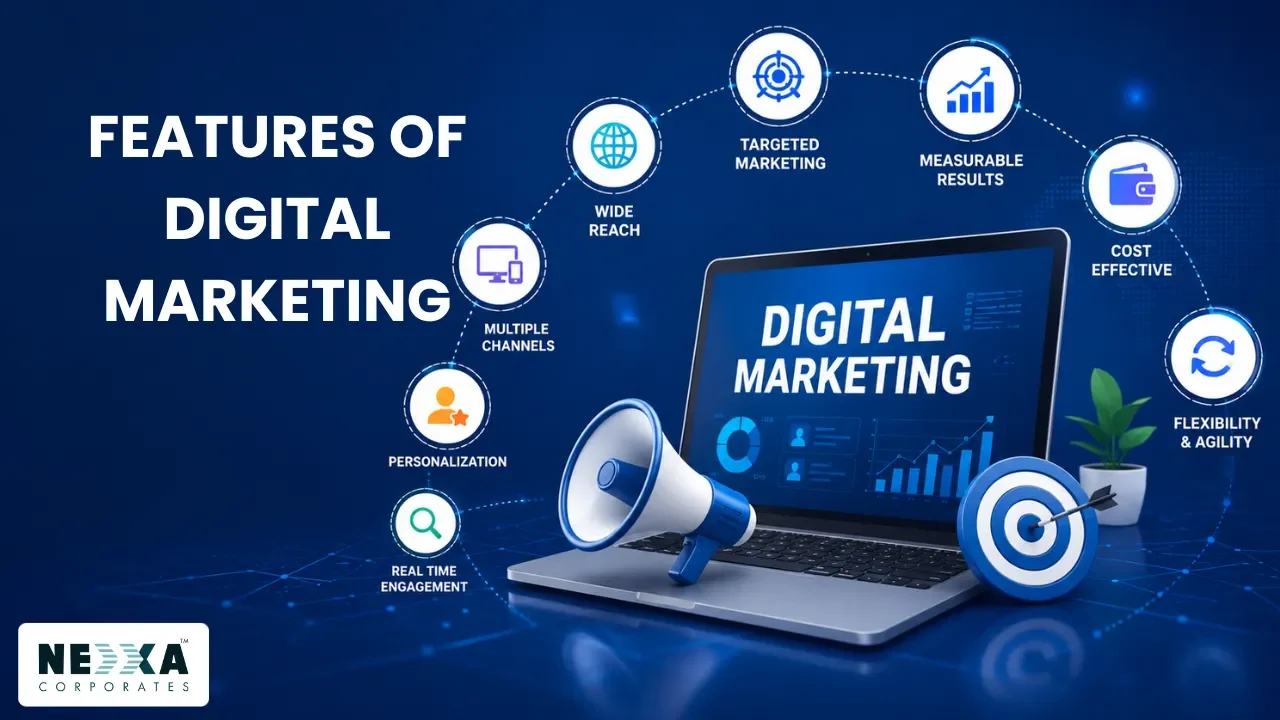
features of digital marketing

How do brands actually grow online without throwing money at guesswork? That’s usually the real question behind “should we do digital marketing.” The short answer comes down to a handful of specific traits — measurable, targeted, results-driven — in a way a newspaper ad or a hoarding never really was. We run Nexxa Corporates out of Thrissur, Kerala, and over the years we’ve built strategies for clients including Microtec, Herbalife, and CAD Build, across healthcare, education, e-commerce, and manufacturing.

Every one of those industries behaves differently online — a hospital’s audience doesn’t think like a manufacturer’s buyer, and pretending otherwise wastes budget — and that’s the experience this guide is written from. Not a textbook. A client list. This piece covers the core features of digital marketing, the types worth knowing, the benefits that genuinely matter to a business owner, and its broader role in growth. 

What is Digital Marketing, Really?

Strip away the jargon and it’s just this: using internet-based channels (search engines, social media, email, websites, mobile apps) to promote a product, service, or brand. Traditional marketing puts a message out and hopes the right people are watching. Digital marketing doesn’t have to hope. It reaches specific people, at a specific time, with a message built for them, and it can prove that it worked, because every click and conversion leaves a trail behind it. Those channels are exactly what show up later as the types of digital marketing worth knowing, and the payoff from using them well is what shows up as the benefits of digital marketing further down this guide.

We run Nexxa Corporates out of Thrissur, Kerala, and over the years we’ve built strategies for clients including Microtec, Herbalife, and CAD Build, across healthcare, education, e-commerce, and manufacturing. Every one of those industries behaves differently online (a hospital’s audience doesn’t think like a manufacturer’s buyer, and pretending otherwise wastes budget), and that’s the experience this article is written from. Not a textbook. A client list.

Key Features of Digital Marketing
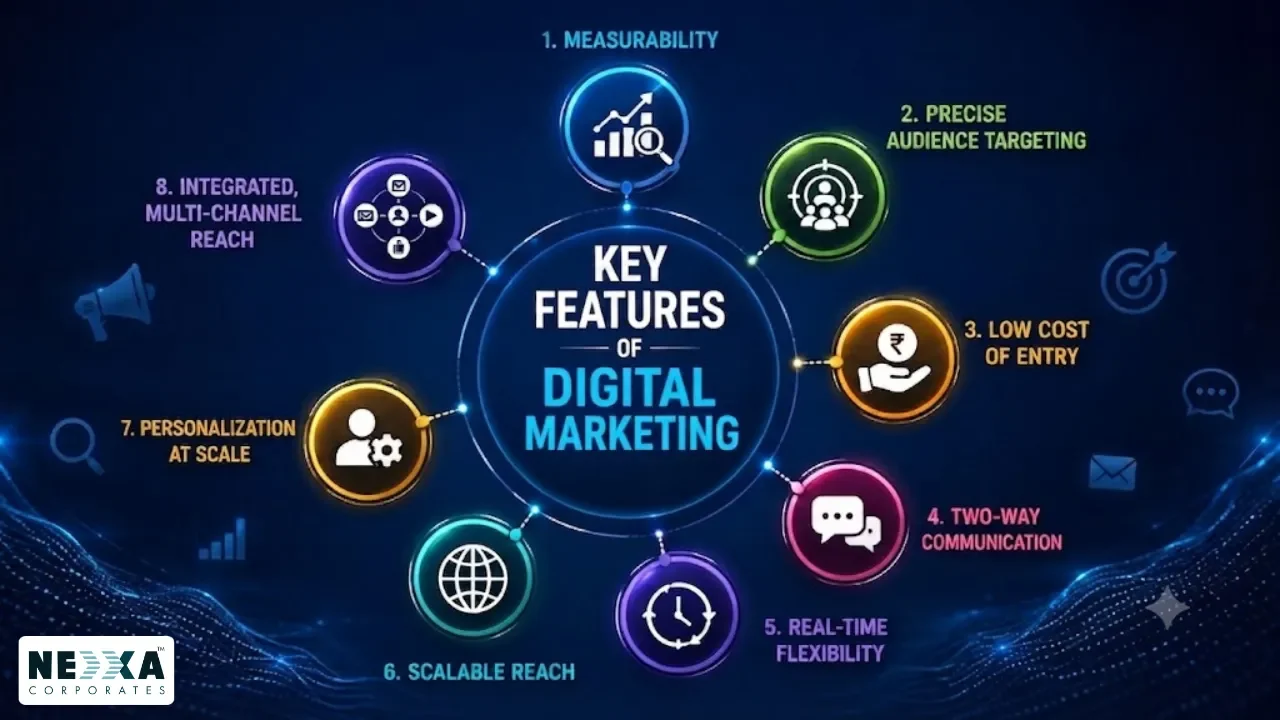
features of digital marketing

Knowing these traits helps a business figure out where to put its money and what to really expect once a campaign goes live. That’s really the whole point of walking through the features of digital marketing one at a time before looking at channels or budgets. Here’s what sets it apart from the old way of advertising.

1. Measurable Results

Probably the biggest one on this list. Full stop. Run a Google Ads campaign or post something on Instagram and you get numbers back — clicks, impressions, bounce rate, time on page, conversions. A hoarding on the highway can’t tell you how many people glanced at it twice. A digital ad can.

2. Precise Audience Targeting

Age, location, interests, browsing habits, device, even what someone bought last month, all of it can shape who sees an ad. This precision is one of the more underrated features of digital marketing on this list, because it cuts down on paying to show an ad to people who were never going to buy anyway.

3. Low Cost of Entry

A national TV spot needs money most small businesses don’t have lying around. Digital marketing lets someone start with a few hundred rupees a day and scale up once something’s working. That’s the trait that genuinely levels the field for smaller teams.

4. Real-Time Feedback

Old advertising was one-way. Social media and email aren’t. Comments, reviews, DMs, live chat, people respond. And that feedback often tells a business what’s actually wrong with a product long before a bigger problem shows up. Cheaper to hear it in a comment section than a lost contract.

5. Real-Time Flexibility

Pause it, tweak it, kill it, sometimes within minutes. Nobody’s stuck waiting for a print run to finish if an ad isn’t pulling its weight. The money just moves.

6. Scalable Reach

Target one neighbourhood, or forty countries, from the same dashboard, sometimes both in the same afternoon. Practical if you’re thinking about growing beyond your current city without opening an office there. A local business testing a new city doesn’t need a distributor or a storefront first. Just a campaign and a landing page.

7. Personalized Ads

Automation and AI now tailor content for thousands of people at once. Different product picks, different subject lines, different homepage content, depending on who’s looking.

8. Integrated, Multi-Channel Reach

Search, social, email, mobile: treated as separate silos, they underperform. Tied together, they show up consistently wherever an audience happens to be that week. That’s really the last of the features of digital marketing worth naming on its own, and it sets up everything in the role of the digital marketing section further down.

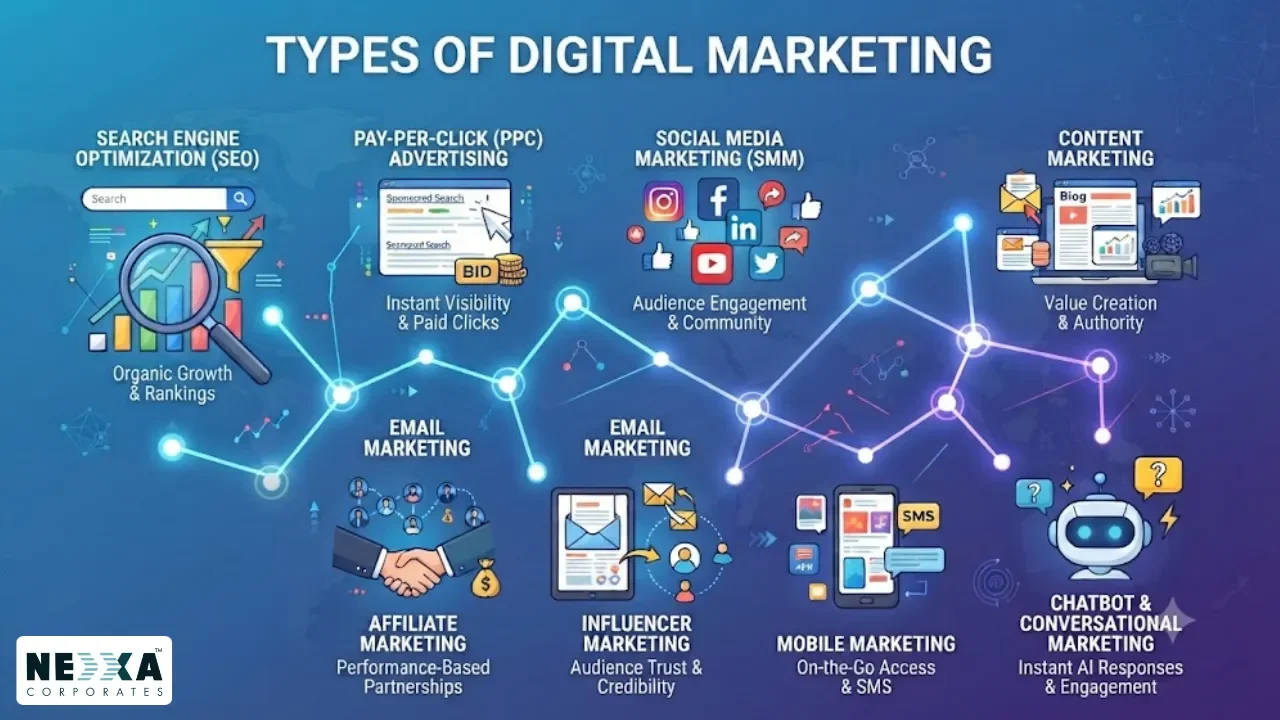
Types of Digital Marketing
features of digital marketing

There’s a fair number of types of digital marketing to choose from, and picking the right mix matters more than trying to run all of them at once.

Once the features of digital marketing make sense on their own, the next question is which channels genuinely fit a given business.

1. Search Engine Optimization (SEO) Improving how a website ranks organically. Slower than paid ads, but one of the more sustainable options; the traffic keeps arriving even during the weeks nobody’s actively working on it.

2. Pay-Per-Click Advertising (PPC) – Ads on Google or similar, paid only per click. Need visibility this week, not this quarter? This is usually the fastest option on the list.

3. Social Media Marketing (SMM) – SMM is the presence and paid campaigns across Instagram, Facebook, LinkedIn, YouTube, wherever the audience really spends its time.

4. Content Marketing – Blog posts, videos, guides, infographics. Slower to build trust, but it tends to stick once it’s there.

5. Email Marketing – Newsletters and offers straight into someone’s inbox. Still one of the better-performing channels for ROI, provided the list is actually segmented and not just blasted at everyone at once.

6. Affiliate Marketing – Other people promote a product and earn a cut of what they sell.

7. Influencer Marketing – Influencer marketing is borrowing someone else’s audience and, more importantly, their trust.

8. Mobile Marketing – SMS, app notifications, mobile-optimised ads; more important every year as browsing shifts from desktops to phones.

9. Chatbot and Conversational Marketing – AI-driven chat that responds instantly instead of making a visitor wait for a human to log on. This one keeps growing.

Most businesses don’t stick to just one of these types of digital marketing. They mix a couple depending on budget, industry, and what customers genuinely respond to, which usually takes some trial and error to figure out.

Benefits of Digital Marketing

The benefits of digital marketing tend to matter more once the types of digital marketing above are actually running together instead of in isolation. Here’s where it gets concrete. Businesses that commit to this tend to see things traditional advertising simply doesn’t offer. Start with the obvious one: ROI that’s actually calculable. Every rupee spent traces back to a click or a conversion, which is probably the clearest benefit when someone’s trying to justify a budget line to a founder.

Brand awareness works differently here too, compounding over months rather than living and dying with one campaign, and the engagement runs both directions, polls, videos, live sessions, people actually participating instead of just scrolling past.A few more benefits of digital marketing worth naming directly:

1. A wider net without a bigger office – A small local business can reach customers three states over.

2. Feedback that shows up in days – Not after a quarterly survey nobody fills out properly.

3. Room to keep improving – A/B testing means a campaign gets better with time instead of staying frozen the way a print ad does.

And maybe the most underrated one: a fairer fight. Because campaigns can start small, a two-person startup can genuinely compete in the same search results as a company twenty times its size, something that was never really true in the print or broadcast era.

Put together, these benefits of digital marketing are why almost every growing business now sets aside part of its budget for digital channels. Not because it’s trendy. Because the numbers back it up. When CAD Build came to us for a stronger digital presence, a targeted branding and marketing strategy helped push their sales up by roughly 30%, a result their own team credits to the strategy itself, not just higher ad spend.

Role of Digital Marketing in Business Growth

The role of digital marketing goes beyond any single campaign; it’s really about tying a business’s growth plan to how customers really behave online. Most purchase decisions start with a search or a scroll now, not a flyer in a mailbox, and that shift alone explains why this moved from “nice to have” to something closer to essential over the last decade.

It builds credibility before a customer ever picks up the phone — a decent website, an active social presence, honest reviews, all of it shapes whether a first-time visitor trusts a brand enough to buy. And it brings in leads who are already somewhat interested rather than shouting at everyone equally; a search, a retargeted ad, time spent reading a blog post, these all signal intent before a sale ever happens.Two things worth calling out separately:

1. It shows up at every stage of the buying journey, not just at checkout. The blog post read on day one and the retargeting ad that brings someone back on day twelve are both doing work.

2. It lets a single-location business compete well outside its own neighbourhood. Local SEO, geo-targeted ads, a properly filled-out Google Business Profile: these can do what once needed a much bigger budget.

There’s a quieter part of the role of digital marketing too, one that has nothing to do with ads directly: campaign data reveals which products or messages actually resonate, and that insight often shapes business strategy well beyond just ad spend.

For an agency, the role of digital marketing in client work usually means stitching a few of these types of digital marketing together — SEO for the long game, social for engagement, paid ads when leads are needed sooner rather than later. That’s the pattern that holds up across very different accounts: a hospital chain, an FMCG brand, a construction supplier — each needing a different channel mix, but all needing the channels to work together rather than as separate islands. AI-driven tools like chatbots have increasingly become part of that mix too, cutting response times and catching leads that would otherwise slip away overnight. 

How Nexxa Corporates Approaches This

We’re based in Thrissur, Kerala, and over the years we’ve worked with clients in healthcare, travel and tourism, e-commerce, education, and manufacturing, industries that don’t behave the same way online, which is exactly why we don’t run every client through the same template. Our work usually covers SEO, social media, email marketing, and, more and more, AI-driven tools like chatbots to cut down response times and catch leads that would otherwise slip away overnight. What matters to us isn’t ticking every box across every channel.

It’s building around what a specific business is genuinely trying to get done: more leads, better rankings, more sales by month’s end. That’s ultimately what the types of digital marketing and the benefits of digital marketing covered above are supposed to add up to, and it’s the same lens we apply to the role of digital marketing in every strategy we build.

Conclusion

Digital marketing stopped being a side tactic a while ago. It’s now one of the main ways businesses grow, compete, and stay in touch with the people who buy from them. What separates it from traditional advertising comes down to the features of digital marketing covered above: measurable, precisely targeted, affordable to start, quick to change course when something isn’t working. Knowing the types of digital marketing on offer makes it easier to pick the right mix, and understanding the real benefits of digital marketing makes the case for sticking with it past the first quarter.

The role of digital marketing, in the end, goes well past running ads; it shapes how much a customer trusts a brand, how that relationship develops, and decisions a business makes long after one campaign has wrapped up. Whether it’s a small local shop or a company with national plans, building a proper digital marketing strategy, with the right partner if one’s needed, remains one of the more dependable ways to grow in a market that isn’t getting any less crowded.

FAQ

1. What are the main features of digital marketing?

Measurability, precise targeting, affordability, real-time flexibility, two-way communication, and reach that works locally and globally at the same time.

Yes, arguably more so than for large ones. One of the clearer benefits of digital marketing is that a business can start small and scale as results come in, instead of committing a big budget upfront and hoping.

The role of digital marketing here covers building credibility, generating leads that are already somewhat warm, guiding people through the buying journey, and handing over data that shapes decisions well beyond the marketing team.

Most businesses would say measurable ROI, since it’s the one that makes budget conversations with founders and stakeholders far easier.

No. Most businesses weight their spend toward two or three channels that fit their audience and budget, rather than splitting it evenly across all of them.
7 types of digital marketing

7 Types of Digital Marketing: The Ultimate Guide for Business Growth

7 types of digital marketing

Over 5.53 billion people are online right now. Not “will be” someday — right now, this second, on a phone, a laptop, a tablet propped up on a kitchen counter somewhere. I still find that number a little dizzying, honestly. That’s more than two-thirds of everyone alive, and your next customer is sitting in that crowd, probably scrolling past three ads and a cat video before they even think about you.

I’ve been doing this for twenty years, and the question I get asked more than any other isn’t “should I be doing digital marketing.” Everyone already knows the answer to that one. It’s “okay, but which of the 7 types of digital marketing do I actually need?” Fair question. Digital marketing isn’t a single lever you pull. It’s closer to a set of doors, each one leading to a different room where your audience is already hanging out — their inbox, their feed, their search bar, their group chats. Knowing the 7 types of digital marketing, and which door to open first, is what separates a business that’s just “doing marketing” from one that’s actually building something people trust.

A quick aside before we get into it, because I think it matters. At Nexxa Digital Academy, we’ve trained people on this stuff long enough to know one principle never moves, no matter how many times the algorithms around it do: trust beats noise. Every single time. It’s why our training stays agency-based — real client work, not just slides — because you learn what actually earns trust by doing it, not by memorizing a framework. Everything below is built on that same idea, not on chasing whatever trick works this quarter.

So let’s actually answer it. What are the different types of digital marketing, how many types of digital marketing genuinely matter in 2026, and which ones deserve your time and your (probably limited) budget? Here’s how I’d break it down.

What Are the Types of Digital Marketing? A Quick Overview

7 types of digital marketing

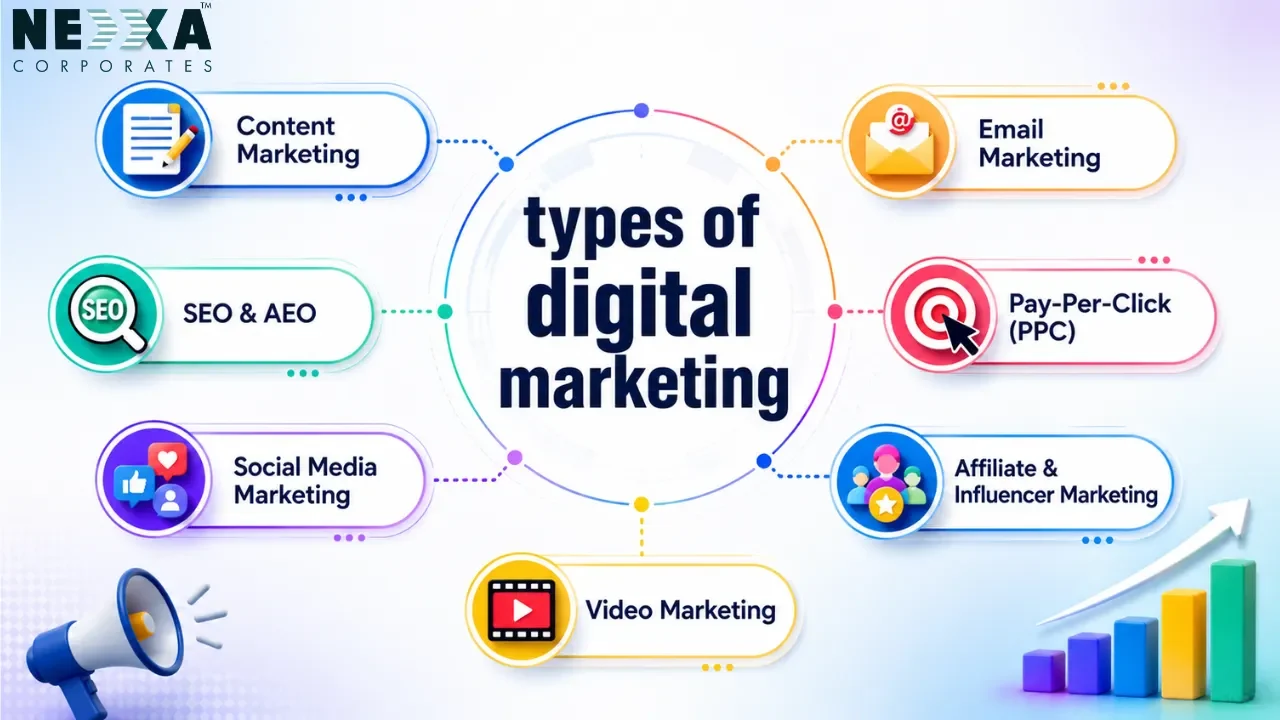
Google “what are the different types of digital marketing” and you’ll get a mess of conflicting lists — some agencies count five, some stretch it to twelve, and half of them are just splitting the same channel into different names to pad out an article. After years of testing this across real estate offices, e-commerce stores, and everything in between, I keep coming back to the same practical answer: there are 7 types of digital marketing that actually move a business forward.

Here’s the lineup, before we go deep on each one:

1. Content Marketing — the storytelling engine

2. SEO & AEO (Answer Engine Optimization) — the discoverability foundation

3. Social Media Marketing — the trust and community builder

4. Email Marketing — the highest-ROI “push” channel

5. Pay-Per-Click (PPC) — the instant-traffic sprint

6. Affiliate & Influencer Marketing — the borrowed-trust channel

7. Video Marketing — the current attention leader

That’s my honest answer to “how many types of digital marketing” you should actually care about — not twelve vague buckets, but seven you can act on before the month is out. Let’s walk through each of the 7 types of digital marketing one by one, and I’ll tell you why each one earns its spot on the list.

1. Content Marketing: The Storytelling Engine

Think back to the last brand you trusted enough to buy from without needing a hard sell. I’d bet money it started with content — a blog that actually answered your question instead of dancing around it, a podcast episode where you thought “okay, this person gets it,” a video that walked you through a problem step by step.

That’s content marketing, and out of all the 7 types of digital marketing, I’d call it the backbone, because everything else needs something to say. It’s not just blog posts anymore, hasn’t been for a while — think podcasts, YouTube explainers, LinkedIn carousels, the occasional downloadable guide people actually want. The goal never changes though: earn enough trust that by the time someone’s ready to buy, you’re the obvious pick, not some stranger asking for their card details.

Quick takeaway: Content marketing uses blogs, podcasts, and video to build trust and authority before a sale happens, making it the foundation for the other types of digital marketing.

2. SEO & AEO: Beyond Google Rankings

For the longest time, “SEO” meant one thing and one thing only: get on page one of Google. If your whole strategy still stops there, I’ve got some news — you’re already a step behind.

Search has split in two. Traditional SEO is still the slow, compounding grind of ranking for whatever people type into that little search box. But now there’s AEO too — Answer Engine Optimization — which is about getting your content pulled straight into AI-generated answers on the newer, SGE-style search experiences. Someone asks their AI assistant “who’s the best real estate marketing agency near me,” and you want to be the answer they get, not a link they might click three steps later.

Of the 7 types of digital marketing, this pairing has the longest runway before it pays off, but it’s also the most durable. It’s the difference between renting your visibility and actually owning a piece of it.

Quick takeaway: SEO earns rankings in traditional search; AEO earns citations inside AI-generated answers — together they’re the long-term visibility layer of the 7 types of digital marketing.

3. Social Media Marketing: Listen Before You Broadcast

This is usually where “types of digital marketing” articles drop the ball — they list the channels and just… stop. But knowing the 7 types of digital marketing doesn’t help much if you don’t know which ones match the goal sitting in front of you right now.

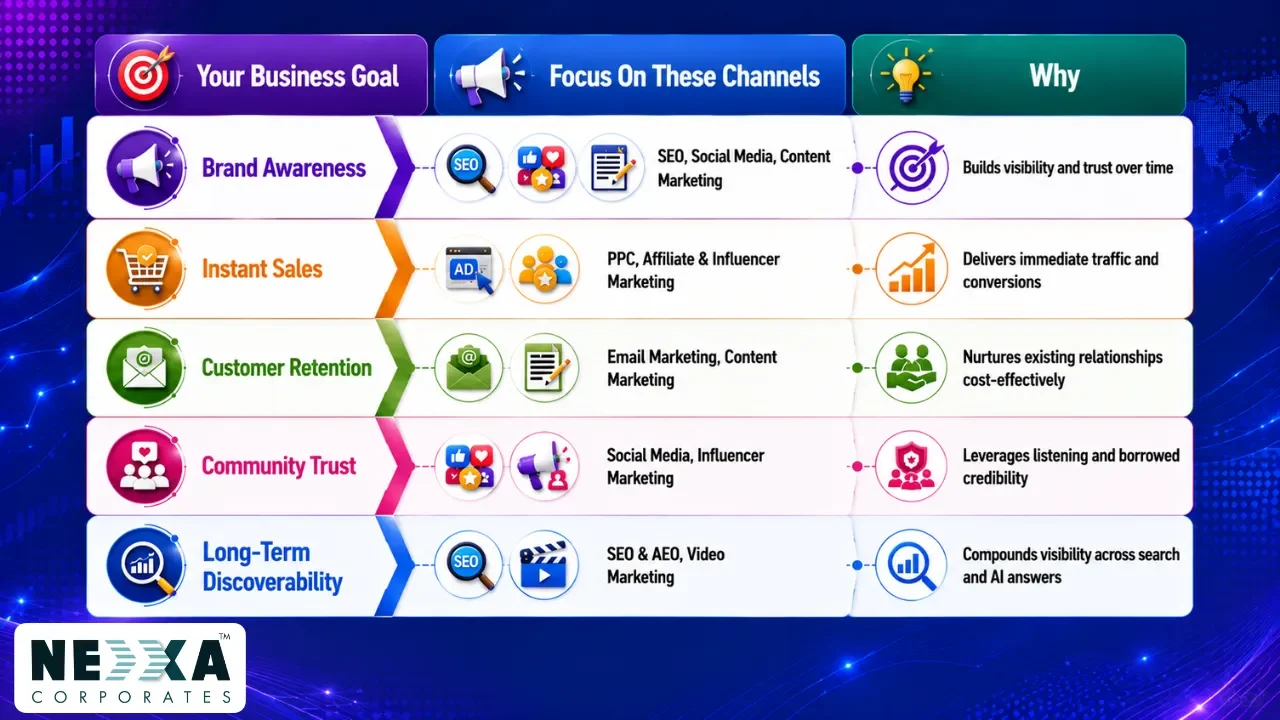
This is basically the exact table I sketch out for nearly every new client, whether they’re a startup founder stretching a shoestring budget or a corporate manager running an already-established brand. It turns “I have no idea where to even start” into something you can actually act on this week.

4. Email Marketing: The Quiet Powerhouse

Here’s a number worth sitting with: social media now shapes roughly 70% of today’s buying decisions. Not because people are seeing more ads — if anything they’re getting better at ignoring those — but because they’re watching what actual people say, share, and quietly recommend to each other.

The businesses doing social media marketing well in 2026 aren’t shouting the loudest. They’re listening the hardest. Social listening — paying attention to what your audience is actually complaining about, comparing, and asking for — beats a perfectly color-coded content calendar every single time. Out of the 7 types of digital marketing, this is the one I see businesses get backwards most often. They set it up like a megaphone when it should work more like a conversation you’re quietly part of.

Quick takeaway: Social media marketing now drives about 70% of buying decisions, and social listening outperforms broadcasting as a strategy.

5. Pay-Per-Click (PPC): The Sprint, Not the Marathon

If SEO is a marathon — slow, gradual, compounding over months — PPC is more like a hundred-meter dash. Bid on a keyword, someone searches it, your ad shows up, they click, you pay. There’s not much mystery to the mechanics, and the results show up fast.

Say a preschool owner needs enrollments locked in before the term starts in six weeks. SEO simply won’t rank them in time. But bidding on something like “best preschool near me” through PPC can put them at the top of the results by this afternoon. That’s the trade-off baked into this one of the 7 types of digital marketing — you’re renting the top spot, not earning it, and the second your budget runs dry, so does the traffic. Used right, though, it’s still the fastest way to figure out which message actually converts before you pour that learning into slower channels.

Quick takeaway: PPC is a bidding-based channel that delivers instant traffic and sales, ideal for time-sensitive goals, unlike SEO’s slower compounding growth.

6. Affiliate & Influencer Marketing: Borrowed Trust

Something I’ve noticed across dozens of client accounts, and it keeps holding true: Gen Z doesn’t trust ads much at all. They trust people. Specifically, people who are upfront about getting paid for the recommendation — weirdly enough, that disclosure makes the endorsement feel more honest, not less.

That’s the whole engine behind affiliate and influencer marketing, probably the most misunderstood of the 7 types of digital marketing. It was never about chasing whoever has the biggest follower count. It’s about finding someone whose audience already believes them, so that a genuine recommendation actually moves people to act instead of scrolling past it. Relatability is beating raw reach these days, and it’s not close.

Quick takeaway: Affiliate and influencer marketing works by borrowing an audience’s existing trust in a person, which resonates especially strongly with Gen Z consumers who value transparency.

7. Video Marketing: Where Attention Actually Lives

Last one on the list of the 7 types of digital marketing, and it might be the most obvious if you’ve spent any time on your phone lately: video. Short-form, specifically. YouTube Shorts, Reels — call it a trend if you want, but it’s really just where attention lives now, full stop.

Why? Because a short video can pack in the story, the product demo, and a bit of personality all inside fifteen to sixty seconds — which, let’s be honest, is about how long most people are willing to give a brand they’ve never heard of. If content marketing is the engine, video is the gear that’s currently spinning fastest.

Quick takeaway: Short-form video on YouTube Shorts and Reels currently captures the most attention of any format, making video marketing essential among the 7 types of digital marketing.

The Goal Matrix: Matching Business Goals to the Right Channel

7 types of digital marketing

This is usually where “types of digital marketing” articles drop the ball — they list the channels and just… stop. But knowing the 7 types of digital marketing doesn’t help much if you don’t know which ones match the goal sitting in front of you right now.

This is basically the exact table I sketch out for nearly every new client, whether they’re a startup founder stretching a shoestring budget or a corporate manager running an already-established brand. It turns “I have no idea where to even start” into something you can actually act on this week.

Future-Proofing: The Trust Frontiers Coming Next

The 7 types of digital marketing aren’t set in stone — they’re the foundation, sure, but three shifts are already changing how each one gets carried out day to day.

1.AI for content automation

More businesses are leaning on AI to draft, personalize, and scale content faster than ever. But the ones actually winning are still layering a real, human voice on top of it, not just publishing whatever the machine spits out.

2. Voice search optimization

As more searches happen out loud through Alexa or Google Assistant, optimizing for how people actually talk — not how they type — is turning into its own little discipline inside SEO.

3. Instant messaging marketing

WhatsApp and WeChat are becoming real sales and support channels, not just places to send a quick “hey, you around?” It’s a frontier most competitors haven’t bothered touching yet.

None of this replaces the 7 types of digital marketing. It just sits on top of them, changing how each one gets delivered to people.

Conclusion

If you take one thing from this, let it be this: stop asking “which one of the 7 types of digital marketing should I pick?” That’s the wrong question, honestly. The businesses that grow fastest don’t pick a favorite — they build an ecosystem. Content feeds SEO, SEO feeds email signups, email nurtures the leads that social and video keep warm in the background, and PPC fills whatever gaps are left while the slower channels keep compounding underneath it all.

You don’t need to master all 7 types of digital marketing by next Monday. But you do need a plan that eventually touches every one of them, sequenced around your actual goals — not whatever channel happens to be trending this week.

And if you’re just starting out and the whole thing feels like too many moving parts at once, don’t try to white-knuckle it alone. Find a proper course or a mentor — a place like Nexxa Digital Academy, where the training is built around live agency projects, not just slides — and let them close the skill gap faster than trial and error ever will. Twenty years into this, the fundamentals still haven’t moved an inch for me: understand your audience, earn their trust, and keep showing up on the channels where they already spend their time. That’s really the honest answer to what are the types of digital marketing that’ll still matter a decade from now.

Whether you’re a solo founder juggling every hat yourself or a corporate manager building out a full team around this, the 7 types of digital marketing give you a map to work from. Where you go from here is up to you — but at least now you’re not walking in blind, and you already know which of the 7 types of digital marketing to reach for first.

FAQ

1. How many types of digital marketing are there?

People argue about this more than they should. Some agencies will tell you there are twelve, some say five — really it depends on how thin you want to slice things. In my experience, seven is the number that actually holds up: content, SEO & AEO, social, email, PPC, affiliate/influencer, and video. Anything past that starts feeling like the same channel wearing a different hat.

No, and honestly, please don’t try. I’ve watched business owners burn themselves out attempting to run every channel on day one, and it never ends well. Start with whichever one or two match your actual goal right now — if you need sales this month, that’s PPC and maybe influencers, not a six-month SEO plan. Build outward from there.

Email marketing, hands down. It’s the one channel where you’re not paying to rent someone else’s attention — you already have the list, you already have the relationship. Content marketing is a close second if you’ve got more time than money, since it costs effort more than cash.

SEO gets you ranked on a page someone has to click into. AEO gets your answer pulled directly into what an AI tool says back to them, no click required. Think of SEO as earning a seat in the room, and AEO as getting quoted before anyone even walks in.

Depends on your bandwidth, honestly. If you’ve got the time and genuinely enjoy this stuff, a good course or mentor can get you further than you’d expect in a few months. If you’re already stretched running the actual business, that’s when it makes more sense to hand it to people who live in this every day.

Ai powered digital marketing

No.1 Trusted AI-Powered Digital Marketing Agency We at Nexxa have watched a lot of marketing trends come and go. This one isn’t a trend. It’s the new baseline. We see AI powered digital marketing as a simple shift: from manual workflows to predictive...

best digital marketing agency for real estate

Best Digital Marketing Agency for Real Estate in Kerala Generate High-Quality Real Estate Leads That Convert Into Sales. Nexxa Corporates helps real estate builders, agents, and property developers attract buyers, generate qualified leads, and increase property sales...

healthcare digital marketing services

Trusted Healthcare Digital Marketing Services for Generating Quality Leads Are you searching for healthcare digital marketing services ? Nexxa corporates  helps hospitals, clinics, and healthcare providers grow through data-driven healthcare digital marketing that...