Table of Contents
SEO vs Google Ads: Which Is Better for Your Business?
For local business owners, the debate of SEO vs Google Ads is one of the first significant online dilemmas. The dilemma is common among local business owners as they try to increase visibility and draw customers to their businesses.
SEO helps websites claim top positions on search engine results without per-click cost. SEO requires content that improves over time to gain visibility. In the campaigns we manage at Nexxa Corporates, rankings built on helpful, expert-written content keep delivering traffic without per-click costs, but they need regular updates to stay on top.
Instead of waiting, an ad can be purchased through Google Ads. Google Ads lets you buy paid ad placement, clearly labelled “Sponsored”, for the exact search terms your customers use. Unlike organic SEO rankings, ads don’t change your site’s rank, and you pay only when someone clicks. Google Ads is very flexible and fast, but traffic will stop if the budget is not renewed.
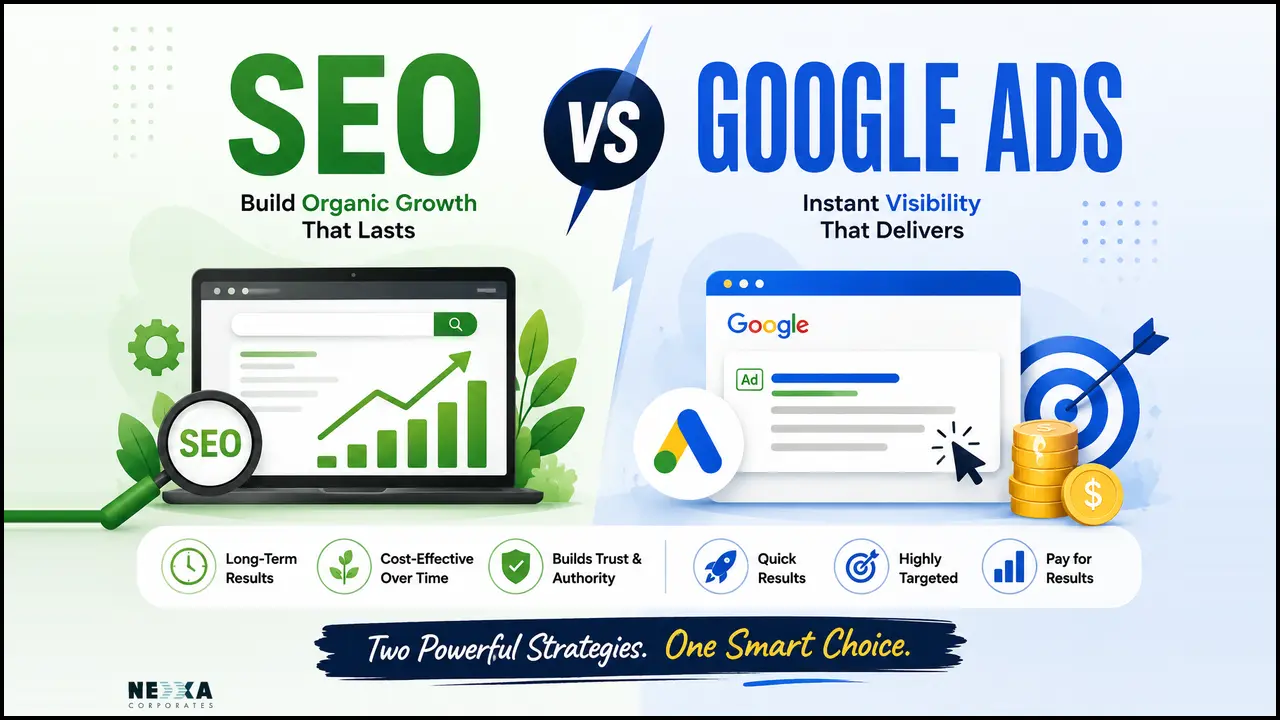
SEO vs Google Ads offer different approaches to online marketing. SEO builds long-term organic visibility, while Google Ads delivers faster, targeted results. Both can benefit businesses of any size.
What should you choose in the SEO vs Google Ads debate? Compare SEO charges and Google Ads cost in India, along with their benefits, to find the right option for your business goals, budget, and timeline.
What Is SEO? (Organic Search Engine Optimization)
Organic search engine optimization (SEO) improves website visibility in search engines via natural algorithm ranking rather than sponsored ads. It is a strategic method to enhance a website without the need for continued advertising costs.
SEO has 4 pillars that are interrelated. They are:
On-page SEO: Title tags, headers, keywords, internal links, alt text.
Off-page SEO: Backlinks, brand mentions, social media, and other activities that increase site authority.
Technical SEO: Site speed, mobile friendliness, crawlability, security (HTTPS).
Content: Quality content that addresses user searches.
It is a long-term investment because search engines take time to crawl and rank a website. However, once your site visibility is earned, it persists and doesn’t require an ad to be displayed like other paid ads. This also accounts for the wide range of prices charged by SEO service providers. Competition dictates the site’s size and how much on-page, off-page, and technical work will be done.
Knowing SEO costs upfront helps you set realistic expectations as it is an investment that grows over a period of time rather than offering an immediate return on investment as other services do.
What Is Google Ads / Google PPC?
Google PPC is Google’s pay-per-click advertising. In order to display ads on Search, Display (including YouTube), or Apps, businesses must bid and are only charged when ads are clicked.
Auction Process: Google Ads uses a real-time auction to determine ad placement based on bid amount, ad relevance, landing page experience, and Ad Rank. So, Google Ads cost depends not only on your bid but also on how relevant and well-targeted your ad is.
Google Ads Campaign types:
- Search – text ads in search results for high-intent users
- Display – banner ads across partner sites for brand awareness
- Shopping – product ads with image/price for e-commerce
- Performance Max – AI-driven ads across all Google properties from one campaign
On Google Ads pricing: Since it’s bid-based, not flat-rate, costs vary by industry and competition — some clicks cost a few rupees, others (legal, insurance) run much higher. Knowing your expected Google Ads cost upfront helps set a realistic budget.
SEO vs Google Ads: Key Differences
| Factor | SEO | Google Ads |
|---|---|---|
| Cost structure | Monthly service fee | Pay per click |
| Time to results | 3-6+ months | Immediate |
| Longevity | Compounds over time | Stop when budget stops |
| Trust factor | Higher organic trust | Instant visibility |
SEO vs Google Ads Cost
How Much Does SEO Charges in India?
SEO charges in India vary widely depending on the agency, city, industry competition, and scope of work.
Factors Affecting SEO Charges
1.Competition Level – The cost for ranking for “best restaurants in Kerala” would be significantly less expensive than the cost for ranking for “best law firm in India”. Competitive cities and industries draw more established players, making it more work for all new players.
2. City/Location – Agencies in the metropolitan cities of Mumbai/ Delhi/Bangalore charge more than those in the Tier 2/3 cities because of higher demand and operating costs.
3. Scope of Work – A simple on-page package will cost less than a package that includes content creation, technical SEO, link-building, and report generation.
4. Website Size and Health – A 500-page ecommerce site with existing technical SEO issues needs more work than a 10-page website, so it costs more
5. Industry – The legal, finance, healthcare, and real estate industries have high levels of market competition and require more effort to rank SEO listings.
Google Ads Cost & Pricing in India
Google Ads cost in India isn’t a fixed rate — it operates on a real-time bidding auction, meaning Google advertising cost depends on your industry, keyword competition, and how well your campaigns are optimized.
Factors That Affect Ad Spend
Quality Score – Relevant ads and well-structured landing pages will help lower cost-per-click for Google Ads. High Quality Scores decrease the cost for Ad positions, while low Quality Score advertisers are forced to bid against others to have a competitive position.
Competition – As the number of searchers increases due to more advertisers using the same keywords, the cost-per-click (CPC) increases. Competitive industries in large urban centers like Mumbai, Delhi, and Bangalore have high customer lifetime value (CLV), resulting in a higher CPC.
Keywords – Broad, high-intent keywords (like “buy” or “near me” searches) increase the cost to other advertisers, as they are competing for the same search results. Highly specific low-volume keywords are typically less costly and have a higher conversion rate.
Other contributing factors:
- Ad extensions and format (can improve Ad Rank without raising bids)
- Device targeting (mobile vs. desktop CPCs often differ)
- Time of day and seasonality
- Geographic targeting (city-level vs. national campaigns)
Pros and Cons of SEO and Google Ads
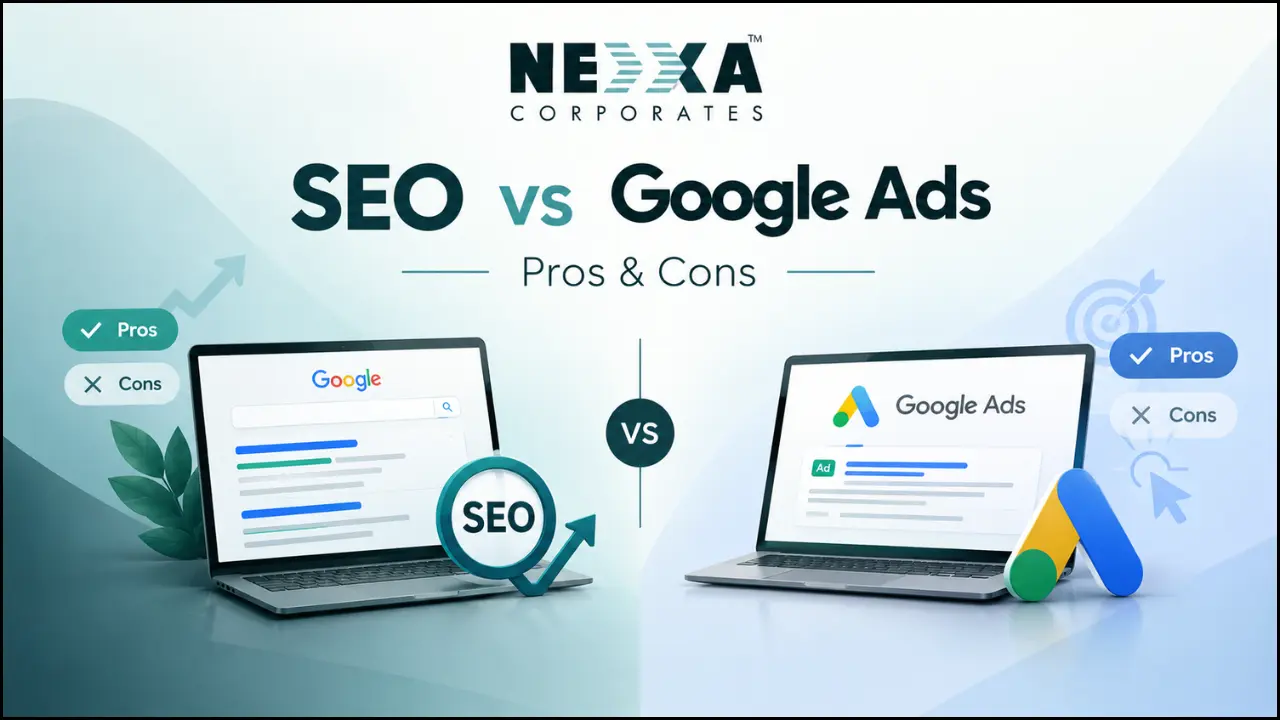
Both options have strengths and trade-offs. The table below shows how they compare, so you can match each to your goals and budget.
SEO
| Pros | Cons |
|---|---|
| No per-click fee, so cost per lead often falls over time | Results take time, typically 3–6+ months |
| Builds lasting visibility and brand authority | Needs ongoing content, updates and monitoring to hold rankings |
| Organic results earn higher user trust | Rankings can change with competition and algorithm updates |
| Content keeps attracting visitors long after publishing | Hard to guarantee exact positions or timelines |
| Works across many keywords at once | Slow to react to short-term offers or launches |
Google Ads
| Pros | Cons |
|---|---|
| Results start within hours or days | You pay for every click, and traffic stops when the budget does |
| Precise targeting by keyword, location, device and time | Cost per click rises in competitive industries |
| Easy to test, measure and adjust | Needs regular management to avoid wasted spend |
| Fast keyword and conversion data to guide your SEO | Users may skip ads in favor of organic results |
| Flexible budget, with no long-term commitment | Poorly set up campaigns can burn budget quickly |
Which One Should You Choose?
Search Engine Optimization (SEO) uses content, site structure, and strategies to build authority to rank in search results. SEO builds authority over time. It takes months to show results, but it often delivers a lower cost per lead in the long run, because organic clicks carry no per-click fee.
Google Ads delivers leads immediately, which makes it better for launches, offers and short timelines, but it costs money for every click.
Conversely, services like Google Ads (Google PPC) offer paid placement. You can expect to show up at the top of search results immediately, but traffic will cease to exist as soon as you stop paying.
Neither is better in every situation. Your timeline, budget and competition decide which suits you.
| Situation | Recommended Approach |
|---|---|
| New business, tight budget | SEO first (consider a small Ads test budget if runway is short) |
| Need leads immediately | Google Ads |
| Established business, steady budget | Both — let Ads data inform SEO strategy |
| Highly competitive industry | Weight more heavily toward Ads, regardless of stage |
| Low-competition niche | SEO can often carry the business alone |
Why Combine SEO and Google Ads?
SEO and Google Ads work best as a team, not two competing budget lines.
Here’s why.
1. PPC Data Sharpens SEO Strategy
Google Ads shows you which exact search terms convert — not just estimated volume. Use that data to prioritize your SEO content around keywords already proven to drive results, instead of guessing.
2. Retarget Organic Visitors With Ads
Most organic traffic by SEO doesn’t convert on the first visit. Tag organic visitors and retarget them with ads to stay visible while they’re still deciding — a warmer, cheaper audience than cold traffic.
3. Own More of the Search Results Page
Showing up as both an organic and paid result for the same query boosts total clicks, builds trust, and crowds out competitors bidding on your terms.
Conclusion
SEO vs Google Ads is not about choosing one as the clear winner. SEO is a long-term SEO strategy that builds visibility gradually, while SEO charges are generally an ongoing investment that can support sustainable growth.
Google Ads can deliver quick traffic and leads but requires continuous ad spending. For new or low-budget businesses, SEO may be a better starting point, while businesses needing faster results can use Google Ads alongside their long-term SEO strategy.
Relying on only one of these options limits your results. SEO, by nature, takes time to grow and Google Ads, on the other hand, means you must keep paying to stay visible. Other businesses often find most value in a balance of both. Google Ads offers quick and valuable data regarding keywords and conversions to support the development of a strong SEO strategy. In addition, if a user visits your site through an organic search, Google Ads allows you to target that user and keep your site at the forefront until they decide to act.
SEO and Google Ads are actually the best balance, and most businesses want that combination, even if they don’t know it.
FAQ
1. What is the average SEO charges in India?
Typically ₹15,000–₹2,00,000+/month, with most small businesses paying ₹15,000–₹50,000/month.
2. How much does Google Ads cost per click in India?
Google Ads cost per click in India typically ranges from ₹5 to ₹50 for most consumer categories such as e-commerce and education, and from ₹100 to ₹500+ for high-competition sectors like finance, insurance and legal. Healthcare and real estate usually fall in between, at about ₹30 to ₹250. Your actual CPC depends on keyword competition, Quality Score, location and device, so treat these figures as benchmarks, not fixed prices.
3. Is SEO cheaper than Google Ads in the long run?
Usually, over 12 months or more. SEO takes longer to show results, but once pages rank, they keep bringing traffic without per-click fees, as long as the content is kept up to date. Google Ads is cheaper for short campaigns and quick leads, but traffic stops when the budget does. The best choice depends on your timeline and goals.
4. Can small businesses in India afford both SEO and Google Ads?
Often, yes. A lean combo — basic local SEO plus a small, targeted Ads budget — can work for around ₹20,000–₹30,000/month.
5. Which gives faster results, SEO or Google PPC?
Google PPC. It can drive traffic within hours. SEO usually takes 3-6+ months to show meaningful results.