
What Is Performance Marketing? 7 Proven Strategies, Benefits & Examples
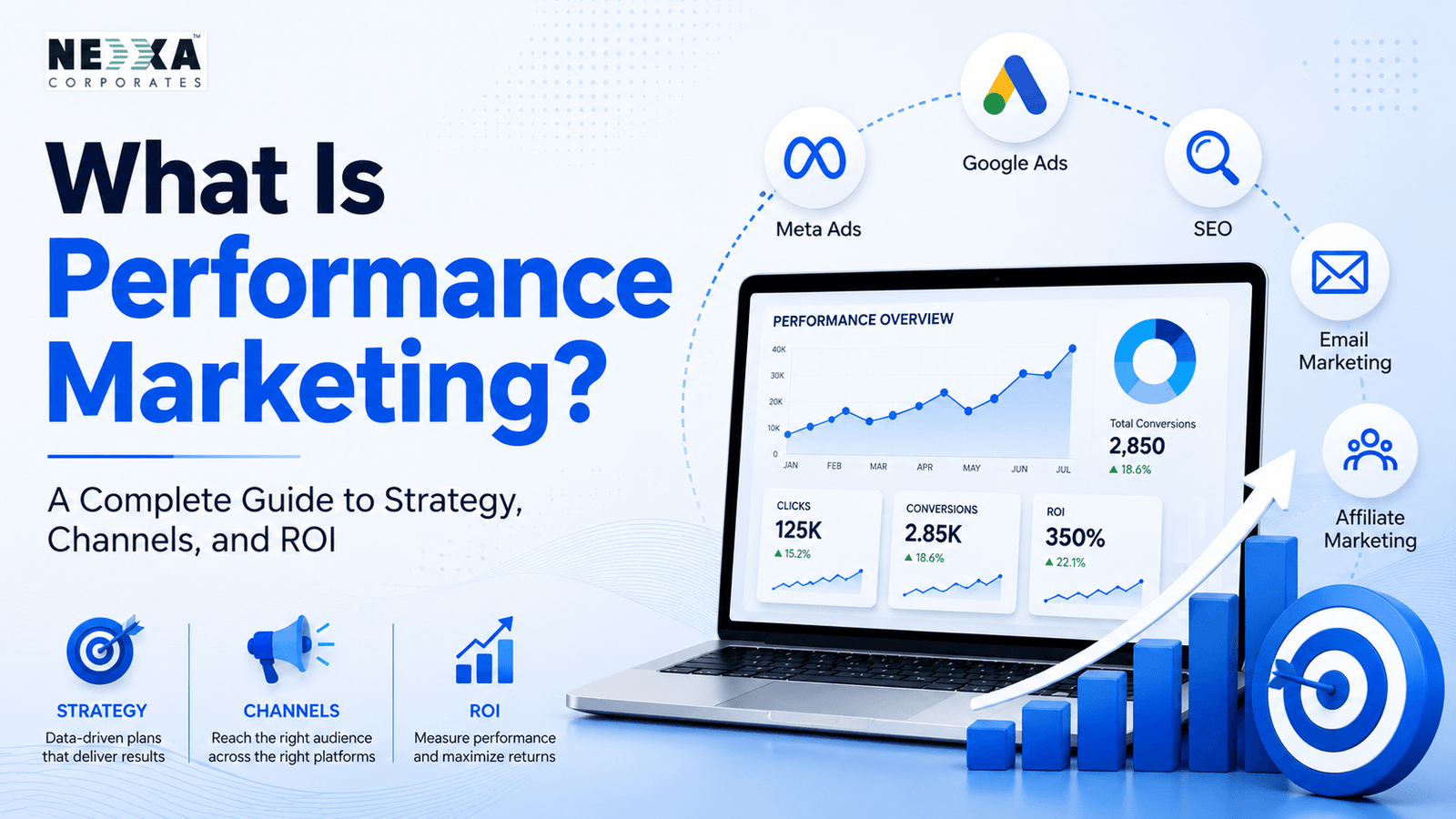
If you have ever paid for advertising based on clicks, registrations, leads, or sales, you have interacted with performance marketing. But what is performance marketing? It is a results-driven marketing approach where advertisers pay based on measurable actions and outcomes. The performance marketing definition focuses on transparent metrics such as cost per click (CPC), cost per lead (CPL), and cost per action (CPA).
Unlike traditional marketing, which often focuses on brand awareness and visibility, performance marketing measures specific user actions. For example, businesses may pay Google for clicks, affiliates for completed sales, or influencers for orders generated through their campaigns. Understanding what is performance marketing helps businesses choose measurable channels, track campaign performance, and improve return on investment (ROI).
What Is Performance Marketing?
Performance marketing is the name for online marketing and advertising programs in which the advertiser only pays for a particular result after it has been achieved. These results can be anything from a click to a phone call to a completed purchase. The characteristic of performance marketing is the payment methodology depending on the result – therefore, the answer to the question “what is performance marketing?” may lie in its cost structure.
Performance marketing differs significantly from traditional forms of advertising which were popular in the twentieth century. In traditional marketing, ads were paid for by the number of impressions – meaning that the more people saw the advertisement, the more money the company spending it had to pay. Performance marketing, on the other hand, only takes action (displays an ad) once the desired result has been achieved, making it much more cost-effective for businesses.
Therefore, when answering the question “what is performance marketing?” it is essential to highlight its unique characteristics, unlike other types of marketing. The key differences are as follows:
Measurability – all actions taken and results achieved in performance marketing are subject to analysis
Optimizability – the performance of the marketing campaign can be optimized quickly using the results of previous actions
Shared risk – the performance marketing campaigns only pay for what they get
Scalability – the ability to scale the marketing campaign depends directly on the amount of data available about conversions.
However, performance marketing does not replace other types of marketing, such as branding, which focuses on creating a brand image. Even though brands with a well-known status may have better conversion rates, they may see worse results due to a lack of popularity and recognition among customers. Thus, the relationship between performance marketing and branding is complicated that will be discussed further in the guide.
How Performance Marketing Actually Works
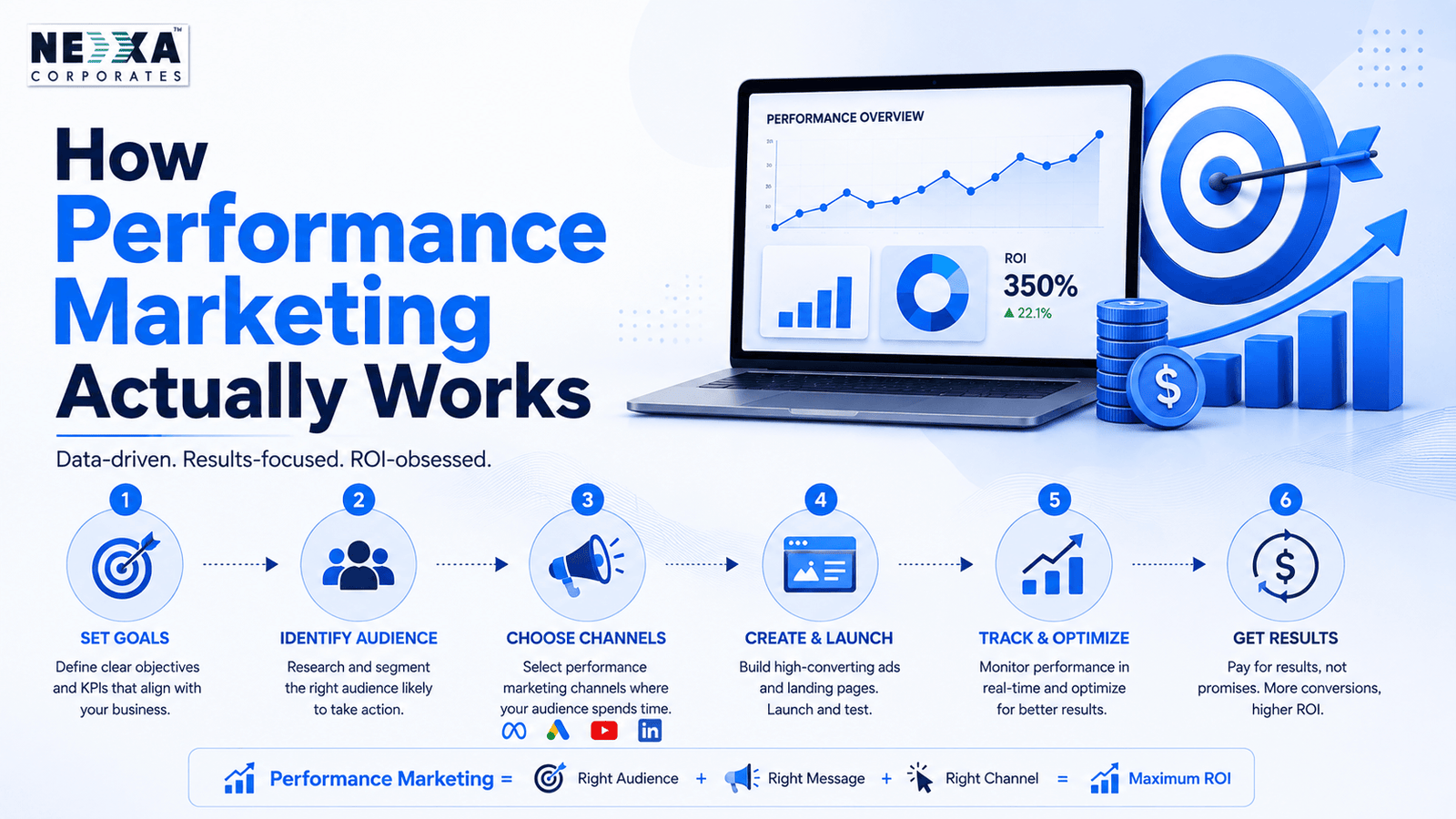
To explain performance marketing in practice, let’s begin with the mechanical description. Suppose there is an advertiser that runs a campaign on any platform: Google advertising, Meta, or, for example, a specific affiliate network. The advertiser should choose what outcome will be considered a conversion for the campaign.
It could be a click on the ad (for the advertisers who work with CPM, click-through rate), a purchase (for the CPA, cost per acquisition), or a captured lead (for CPL, cost per lead). Then, the platform needs to install a pixel (a small piece of code) on the advertiser’s website that will trigger every time someone performed the action the campaign wanted them to do.
The performance marketers will observe how people interact with the advertisement. For example, after clicking on your Google ad for waterproof hiking boots, the user saw your website and bought a pair of shoes 20 minutes after clicking. Now, all this information is collected in your campaign dashboard: who joined, the time of the transaction, the specific searched ad, the device they were using, and many others. These insights allow the marketer to improve the campaign by reallocating the budget to make more conversions like this happen.
Now let’s say there is an advertiser that sells running shoes. They are testing their Google Shopping campaign and have noticed that the advertisements for trail running shoes for women have more conversions than the ads that target just “running shoes.” Even though the latter get more clicks overall, the trail ones get converted three times better.
Now, the performance marketer knows they should shift the budget to the more rewarding niche. And if there was a brand marketer, they would have to wait for the brand audit at the end of the quarter, not knowing whether their campaigns drove sales or not.
This is how the performance marketing funnel works. Allocating the budget to get the most conversions (and spending the least for them) is the central point of performance marketing. That is why the field has tools and methods that only performance marketers use (or other marketers ignore). Most of them are somehow related to the conversion or attribution modeling, such as marketing mix modeling, conversion tracking, and multi-channel funnel analysis.
Performance Marketing vs Digital Marketing
If someone asks you what is the difference between performance marketing and digital marketing, this is the point where many people get confused, so it is important to clarify it. Digital marketing covers a wide range of activities including SEO, email marketing, social media community management, content marketing, and performance marketing. Performance marketing is a type of digital marketing that is characterized by its payment policy and measurement of results.
In other words, digital marketing is asking the question “how do we reach and engage people online?” while performance marketing is asking the question “how do we pay for the results and prove that?”
Digital marketing, in general, can have multiple goals ranging from brand awareness to customer engagement and even thought leadership. One company can do marketing in social media just to increase their audience without having a specific CTR or sales target.
Performance marketing is more focused on specific goals, usually related to sales or pipeline, and has a strict action that the customer needs to perform in order to get to the next stage. In performance marketing, there is no such thing as “just” building awareness, every action should have a specific metric and it is much harder to justify expenses without hard numbers.
1. Budget and Payment Policies
In digital marketing, most of the activities are paid either on a salary basis (hiring someone) or on a regular ongoing basis (buying software subscriptions). In performance marketing, the budget can vary significantly depending on the activities and it is much easier to scale up or down. For example, a performance marketer can spend anywhere from $50 or $50,000 in a month depending on the number of conversions and their cost. A performance campaign can be paused right away if it is not working while a traditional content marketing campaign will need several months to show results.
2. Measurement and ROI
This is probably the most evident difference between the two marketing types. Digital marketing usually focuses on engagement and has many metrics that are not directly related to sales, such as impressions, reach, followers, etc. Performance marketing focuses on conversions and has many metrics directly related to sales, such as CTR, CPA, ROAS, etc. A performance marketer can give a detailed report on what the marketing expenses brought in terms of revenue with little error, while a digital marketer usually cannot, and it is not their main goal.
3. Channels
Digital marketing covers all types of marketing, including both free and paid channels, while performance marketing focuses on paid channels. In other words, digital marketing is a set of activities that can be performed both in social media (organic and paid posts), SEO (organic and paid listings), content marketing, email marketing, and PR.
Performance marketing is a type of digital marketing that focuses on performance channels, such as paid social media, search engine marketing, affiliate marketing, retail media, and programmatic advertising. The two marketing types are not mutually exclusive, and the majority of companies use both, but they have different channels.
4. Best Use Cases
Digital marketing is great when you need to build brand awareness or community, while performance marketing is great to drive revenue or pipeline. Most companies use a combination of the two, but it is important to understand the difference between performance marketing and digital marketing to be able to choose the best type for your business needs.
Performance Marketing Channels
To fully understand what is performance marketing, one must remember that it is not a channel but a philosophy of compensation for actions. Below is a list of the most popular performance marketing types together with their advantages, disadvantages, and ideal use cases.
1. Google Search and Shopping
Google Ads is a performance marketing type based on the auction system. A company bids on certain keywords related to their industry to get their ad displayed every time a user searches for them. The payment is made per click, but this may also depend on the chosen campaign type (conversion-based and others).
A company that offers project management software may bid on the phrase “best project management software for agencies,” and if their ad is clicked, the company will pay for the click. It is logical to assume that a search query with a long tail and a specific request will cost more than a broad one (“project management software” vs. “project management”).
Advantages: extremely high intent, easy to set up and adjust, precise budget control.
Disadvantages: increased competition for certain keywords, requires optimization; otherwise, it can be costly. Especially for B2B, finance, law, insurance, and other markets.
Ideal Use Cases: almost all industries with considerable demand.
2. Social Media
Social media marketing (Meta, LinkedIn, TikTok, etc.) is another popular type of performance marketing. It is different from Google in that it does not aim to capture the searcher intent but instead uses the user’s data, such as age, gender, behavior, and occupation. An example of performance marketing here would be a direct-to-consumer beauty brand that runs social media ads targeting females aged 25-40 interested in skincare with a specific product video.
A similar campaign can be run on LinkedIn but with B2B audiences, such as VPs of people operations at medium-sized enterprises, promoting lead generation articles. In these ads, the link to a landing page can be placed where users will be prompted to provide their contact information.
Advantages: targeting, discovery, visual appeal.
Disadvantages: weaker intent, decreased performance on iOS, requires constant asset rotation.
Ideal Use Cases: consumer markets with a strong visual component, B2B, discovery, and direct response.
3. Affiliate Marketing
This performance marketing type involves establishing a partnership with an affiliate (a publisher, a YouTuber, a blogger, or a website owner) and compensating them a fee for promoting a product or service. An example of such marketing is when a SaaS company offers commission to finance bloggers for including a link to the software in their “best accounting software” posts.
The fee is usually based on a percentage of subscriptions acquired via the affiliate link. Another well-known example is the Amazon Associates program that enables bloggers to place links to products with a special tag that tracks the clicks and subsequent purchases.
Advantages: no risk if there are no sales, utilizes the audience of the affiliate, is cost-effective and easily scalable.
Disadvantages: loss of control over the affiliate’s message, potential for fraud, and reduced margin for the company if the commission is too high.
Ideal Use Cases: e-commerce and SaaS industries, products with a sufficient margin.
4. Native Advertising
This type of performance marketing is similar to contextual advertising but takes place on different platforms, such as news websites. Native ads are usually articles or videos with a promotional description placed at the end of the page. They are usually sold by Outbrain or Taboola, and their main advantage is that they appear at the end of the content, thus not interrupting the user as traditional pop-up banners do. An example of performance marketing here would be a native ad for an online brokerage service that looks similar to a regular article.
Advantages: engagement, discovery, brand awareness.
Disadvantages: lack of trust from users, lower intent.
Ideal Use Cases: content marketing, brand, media, educational content.
5. Display Advertising
Display advertising is a type of online advertising that appears as banners, videos, and images. They are usually sold on a CPM basis (cost per impression), but performance marketing also utilizes CPA (cost per acquisition) and CPC (cost per click). A company can place display ads of their travel website on the Google Display Network, and every time the user browses travel-related websites (remarketing), they will see the ad again.
Advantages: extensive reach, remarketing, flexibility in display advertising.
Disadvantages: lower engagement, banner blindness.
Ideal Use Cases: remarketing, general awareness, branding, and discovery.
6. Retail Media (Amazon)
Retail media advertising involves placing ads in online stores. Amazon dominates this advertising space, but other major retailers, such as Walmart and Instacart, have followed suit. This type of performance marketing is different in that it exploits the audience that already shops on these platforms. Thus, the purchase intent of retail media advertisers is extremely high.
An example of performance advertising would be a kitchenware retailer that has set up Sponsored Products ads on Amazon. When a user searches for “cast iron skillet,” the retailer’s ad will appear in the search results. The benefit of such advertising is that the shopper has already indicated their intent to purchase, so the advertising campaign has a good chance of converting.
Advantages: intent, first-party data, direct connection to conversion.
Disadvantages: dependence on the platform, increased competition among advertisers, and high cost.
Ideal Use Cases: any companies utilizing these online stores.
7. Email Marketing
Email marketing is a direct type of marketing communication where a company sends emails to opted-in subscribers. Email marketing used to be a separate category, but it fits perfectly into performance marketing, with emails serving as a tool for direct response. An example of performance marketing is a direct-to-consumer coffee roastery with an abandoned cart. The company can send out an email reminding them of the products they left behind and offer a shipping discount as a special promotion within 24 hours from the email sending.
Advantages: low cost, direct communication with the audience, great ROI if the audience is responsive.
Disadvantages: low performance if the audience is unresponsive, transactional and other types of emails may require more effort.
Ideal Use Cases: any company with an existing subscriber list, direct response, lifecycle marketing.
8. Influencer Marketing
Influencer marketing refers to cooperation with influencers. It is a performance marketing type in that the compensation can be based on a CPA basis (influencer receives money per action), similar to affiliate marketing, rather than a fixed price for the post. An example of performance marketing is a supplement brand gifting a fitness YouTuber a special discount code, so when their viewers purchase with it, the YouTuber receives a percentage from each sale. It is easier to measure the effectiveness of such collaborations since the influencers’ work directly drives revenue.
Advantages: utilization of the influencers’ audiences, good ROI, trust.
Disadvantages: difficult to scale, no control over content creation.
Ideal Use Cases: consumer products, beauty, health, and fitness niches, especially when the target audience is female.
9. Programmatic Advertising
Programmatic advertising is a type of performance marketing that allows the computer to bid for ad impressions in real-time. This type of marketing involves buying and selling display, video, and native ads using automated platforms rather than humans. Programmatic advertising campaigns are usually much broader and can span thousands of websites, targeting a specific audience.
An example of programmatic advertising would be a B2B company targeting mid-level managers and decision-makers in the manufacturing industry, which will be delivered across various trade publications and news websites. The company chooses who they want to target (managers), while the programmatic software chooses the websites to display the ad.
Advantages: scale, targeting, flexibility, ROI.
Disadvantages: brand safety risk, fraud risk, complexity and cost.
Ideal Use Cases: larger companies with a sufficient budget, targeting a specific audience for remarketing and consideration.
Performance Advertising: The Pricing Engine Behind It All
When explaining what is performance marketing, “performance advertising” and “performance marketing” are often used interchangeably, but incorrectly, because there is a clear distinction between the two terms. So, performance marketing is a comprehensive concept that covers various types of campaigns, including those beyond traditional advertising, such as affiliate marketing and email marketing. At the same time, performance advertising refers specifically to such models of advertising as cost per click (CPC), cost per acquisition (CPA), and others.
These advertising standards are essential metrics, and knowledge of these acronyms will allow one to properly determine, for a particular case, what resource is needed to achieve a positive result. Thus, for advertising, such a metric as a click is vital, and if the advertising is paid one, the company knows exactly how much money it spends on each click, because this information is available to them. As for CPA networks, they usually offer a variety of advertising products in which marketing people choose which ones to use, for example, cost per lead (CPL) or cost per acquisition (CPA).
However, CPA is a standard metric for all advertising networks that allows the buyer to control the cost of advertising. For example, for CPA networks, the customer is in the most responsible position since he is the one who pays for the results of the promotion. The advertising campaigns using the CPA model are more expensive than those using the CPC (cost per click) model.
As for the use of the term “ROAS”, this indicator is not directly related to the aforementioned models but is used in performance marketing to determine the level of profitability. Using ROAS (return on ad spend), the marketing person compares the amount of money spent on advertising with the revenue received from it. ROAS, together with CPA, is the primary metric in performance marketing. Therefore, the main focus of marketing people on these indicators allows them to determine whether their campaigns have been profitable.
In conclusion, the knowledge of the above terms is vital to anyone involved in paid advertising. So, a marketer needs to calculate ROAS to determine whether a campaign has been profitable. The importance of understanding the concepts of CPA and CPL lies in whether a business needs leads or sales. In turn, the metric of relevance to performance advertising, such as CPC, is necessary to determine how profitable it is to attract customers via advertising.
Performance Marketing in Action Across Business Types
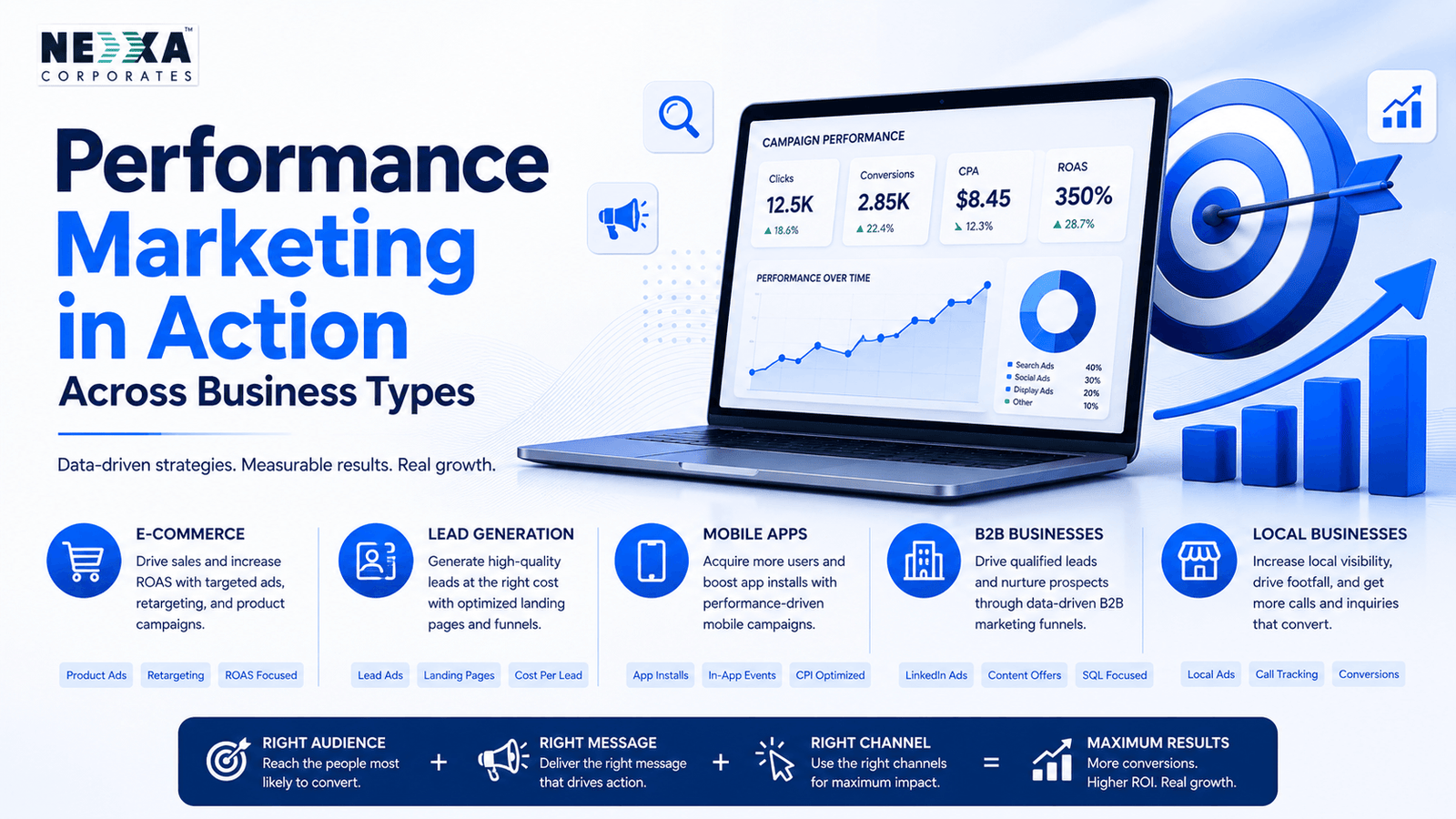
What makes performance marketing for an ecommerce company different from what it is for SaaS or B2B companies? Well, it’s not the channels per se’, but the mechanics of what drives them – each type of business has different goals that determine the allocation and use of the marketing budget.
Let’s say, you have a direct-to-consumer furniture brand that sells on its website but also on Amazon. Its performance marketing will be focused on Google Shopping, Meta platforms, and retail media (for Amazon). The main metric for such a company is ROAS – return on ad spend, because the customer buys the product in 1 click, and there are no other stages in the funnel.
Now, imagine a SaaS product – a collaboration software that has a subscription-based pricing model. For such a product, CPA (cost per acquisition) is a metric that matters most. In this case, the company is not interested in the first sale, but in the lifetime value (LTV) of the user. If a person subscribes for $20 a month, the SaaS product will be happy to spend more on advertising to acquire such a user, because this user will bring $240 to the company over two years.
A B2B company that sells enterprise software to manufacturers to streamline their operations will think in terms of enterprise sales too. Even spending $300 on each lead in the LinkedIn advertising campaign is a price the company is willing to pay – if this lead is developed into a $1M+ enterprise sale. Needless to say, enterprise software sales have much higher LTV than any of the examples above, so the budgets for performance marketing campaigns can be extremely large.
A local dentist that runs Google Ads to acquire new patients from the local area will have a different advertising budget and metric mix than the companies listed above. The local dentist will be focused on CAC (customer acquisition cost) and have a much smaller advertising budget, in which $40 per new patient is a reasonable price to pay. Overall, the channels for performance marketing are similar across industries, and the main differences are in the priorities and the budgets.
Benefits and Common Mistakes
One reason why what is performance marketingis such a sought-after search and business topic nowadays is evident: it is accountable. One can see a return on investment almost immediately and re-allocate the budget right away instead of waiting for a quarterly report. It is easily scalable too: one can start with a small budget of $500 and invest millions with a good understanding of the initial mechanics. Overall, it is more quantifiable than many other marketing types, which makes it safer in terms of budgets. However, teams that are new to performance marketing tend to make the same mistakes over and over:
Firstly, they try to measure everything possible. It may seem logical to track every metric one can find, but in reality, one should focus on one’s goals instead. If one wants to grow the subsriber base, one should track subscriptions; if one wants to sell more products, one should track sales. Secondly, they confuse impressions with sales. One should understand that impressions are great for brand awareness, but they do not directly impact revenues. Unless there is an impression-to-action ratio, a marketing campaign does little in terms of actual sales.
Optimizing for the wrong metric. Chasing a low CPC while ignoring conversion rate can produce cheap clicks that never turn into revenue.
Underinvesting in landing pages. A great ad sending traffic to a slow, confusing, or irrelevant landing page wastes most of the budget before it has a chance to convert.
Ignoring attribution complexity. Customers often touch multiple channels before converting — a display ad, then a search ad, then an email — and crediting the sale entirely to the last click can badly misrepresent what’s actually driving results.
Treating performance marketing as a replacement for brand. Campaigns almost always convert better when there’s some baseline brand recognition behind them; performance without any brand investment tends to hit a ceiling.
Set-it-and-forget-it management. Auction-based channels shift constantly — competitors change bids, algorithms update, seasonality moves demand. A campaign left unmanaged for months typically underperforms one that gets regular attention.
Best Practices for Getting Started
For a business that wants to understand what is performance marketing and test it in practice for the first time, there are several general recommendations. First of all, it makes sense to start with channels where customers have already shown intent to buy, such as search engines for products with a clear purpose. Second, a realistic budget should be set for the test campaign, and it is necessary to wait for the results that can provide statistically significant evidence.
For example, a week of testing with one or two hundred dollars of expenditure is usually insufficient to draw any conclusions. Third, campaign performance should be properly tracked and measured from the beginning of the campaign; thus, an optimizer will have accurate data to make optimization decisions. Finally, the first month of performance marketing campaign should be seen as a period of data collection rather than revenue generation, as the initial results are typically the worst throughout the whole campaign lifetime and should not be considered representative.
Performance marketing examples include search campaigns that drive sales. Performance marketing examples include affiliate campaigns with subIDs. Performance marketing examples include LinkedIn lead generation campaigns. Performance marketing examples include remarketing campaigns that recover abandons. Performance marketing examples include email campaigns that drive repeat sales. Performance marketing examples include influencer campaigns with CPE/ROAS.
Performance marketing examples include retail media networks campaigns. Performance marketing examples include local campaign with calls and bookings. This type of marketing is great for situations where it is possible to track conversions, which allow the business to optimize the marketing spend. In other words, performance marketing examples prove that different industries and business models can optimize their advertising based on very similar principles.
CPC can be used in performance advertising to acquire traffic. CPA can be used in performance advertising to drive conversions. CPL can be used in performance advertising to encourage the leads. ROAS can be used in performance advertising to measure the impact. Performance advertising should have the proper tracking mechanism set up. Performance advertising requires the test campaign with the audience, bid, and creative tests. Performance advertising can be used in addition to brand campaigns rather than being used exclusively.
Search is one of the performance marketing channels that can be used to reach customers based on intent. Social is one of the performance marketing channels that can be used to reach audiences based on targeting capabilities. Affiliate is one of the performance marketing channels that can be used to acquire customers based on payments. Display/remarketing is one of the performance marketing channels that can be used to remarket to users based on their behavior.
Retail is one of the performance marketing channels that can be used to market to customers based on intent. Email is one of the performance marketing channels that can be used to engage with customers based on lifecycle stage. Influencer is one of the performance marketing channels that can be used to work with influencers based on compensation terms.
Conclusion
Performance marketing isn’t a single channel or a single tactic — it’s a way of paying for marketing that ties spend directly to results, whether that’s a click on a Google search ad, a sale through an affiliate link, or a lead captured on LinkedIn. What makes it different from digital marketing at large is that narrower, sharper focus: everything gets measured, everything gets attributed, and budget moves toward whatever is actually working rather than what sounds good in a meeting.
Understanding what performance marketing is matters less than understanding how to run it well — knowing which channel fits your business, which pricing model (CPC, CPA, CPL, or CPM) makes sense for your margins, and which metrics, like ROAS, actually tell you whether a campaign is worth scaling. Get those pieces right, and performance marketing becomes one of the few forms of advertising where you can say, with real confidence, exactly what your money bought.
FAQ
1. How much does performance marketing typically cost?
The cost of performance marketing varies by channel, industry, and audience competition. Google Ads can cost from a few cents to several dollars per click, while monthly budgets may range from hundreds for small businesses to millions for large companies. The key factor is whether customer acquisition cost is justified by the customer’s lifetime value.
2. What is the difference between performance marketing and traditional marketing?
Traditional marketing channels – newspaper ads, TV, radio, billboards – usually have a much lower level of tracking and analytics, because they are designed to provide general awareness rather than directly drive sales. However, this does not mean that traditional marketing is ineffective. For example, brand advertising in traditional media is often used to build brand image and then supplement performance marketing channels to drive sales. Performance marketing channels, on the other hand, are much more analytical and focused on measuring results in real-time, which makes their advertising much more cost-effective but narrower in targeting.
3. Can small businesses benefit from performance marketing, or is it mostly for big companies?
In fact, small businesses can benefit from performance marketing much more than large corporations because the former often have a much smaller advertising budget. This type of marketing is ideal for local business owners who want to start buying traffic online but have a small budget. In such cases, small companies usually start by allocating a small amount of money to Google or other search engine advertising, which is initially quite affordable. In the simplest case, this can be a Google Ads campaign with a monthly advertising budget of three hundred dollars.
4. Is affiliate marketing a part of performance marketing?
Yes, since any form of affiliate marketing (both CPA and CPS) uses a payment model in which the marketer’s payment depends on the result – a customer acquired through an affiliate link, or a sale made on the advertiser’s website. In fact, the entire affiliate marketing system is a type of performance marketing, with the difference being that in affiliate programs, the marketer acts as an intermediary who must perform certain actions to acquire a customer (such as driving traffic to the advertiser’s website). Thus, the advertiser only pays if the customer has arrived at the target page via an affiliate link and performed a specific action (e.g., a purchase).
5. Is it possible to do performance marketing without a website?
In most cases, such marketing activities are not relevant, since all marketing channels require a place to collect customers – in most cases, this is a website with a high conversion rate. However, this does not mean that it is impossible to use performance marketing tools without a site: for example, Google’s call-only ads allow customers to contact the advertiser directly, bypassing the website. Some Meta and LinkedIn channels also have specific tools in their advertising platforms to collect leads directly within the ad without redirecting users to another resource. However, options without a website are limited and less flexible when it comes to collecting and analyzing customers.