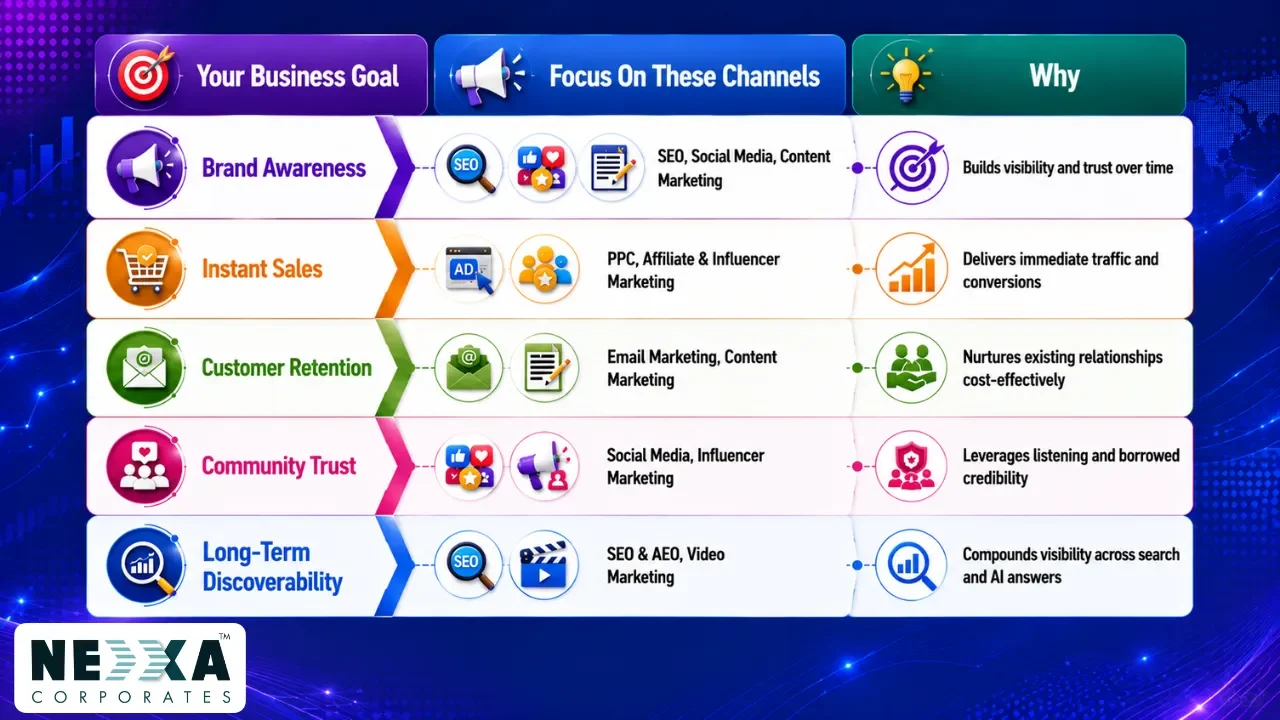
how to improve website traffic

how to improve website traffic

How to Improve Website Traffic in 2026: A Complete Guide to Attracting the Right Visitors

how to improve website traffic

There’s a thing with traffic, having more doesn’t mean it’s more effective. It’s possible to invest time and money into bringing in customers, but even if they’re not your ideal customers, none of it matters — they arrive, glance around, then walk away. What makes a business more successful is people who are curious about what’s available and are on the verge of doing something about it. This guide outlines a practical and sustainable way to think about how to improve website traffic so it actually converts, rather than simply putting up a bigger number on a graph.

For most companies, it’s not about whether traffic can be increased. With enough advertising budget, virtually any website can attract more traffic. The tougher issue, and the more important one, is how to generate traffic that continues to grow on its own each month, without a paid advertising campaign propping it up the whole time. It all boils down to using the right search terms, content that’s actually valuable, a website that functions effectively on a technical level, and trust signals that are genuine rather than just cosmetic — all moving toward the same goal. That way, people arrive at a high level of interest, and search engines continue to send more and more.

Master Keyword Research & Intent Mapping

Before typing a single word, you need to understand exactly what a user wants to accomplish when they hit “Enter.” In Search Engine Optimization (SEO), we categorize this into four types of search intent: informational, navigational, commercial, and transactional. If your page layout doesn’t match the user’s immediate goal, they will bounce within seconds, signaling to search engines that your page shouldn’t be ranked on page one.

To beat out massive competitors, focus heavily on long-tail keywords—highly specific three- to five-word phrases. They have lower search volumes, but the conversion rates are significantly higher because the user has a clear objective.

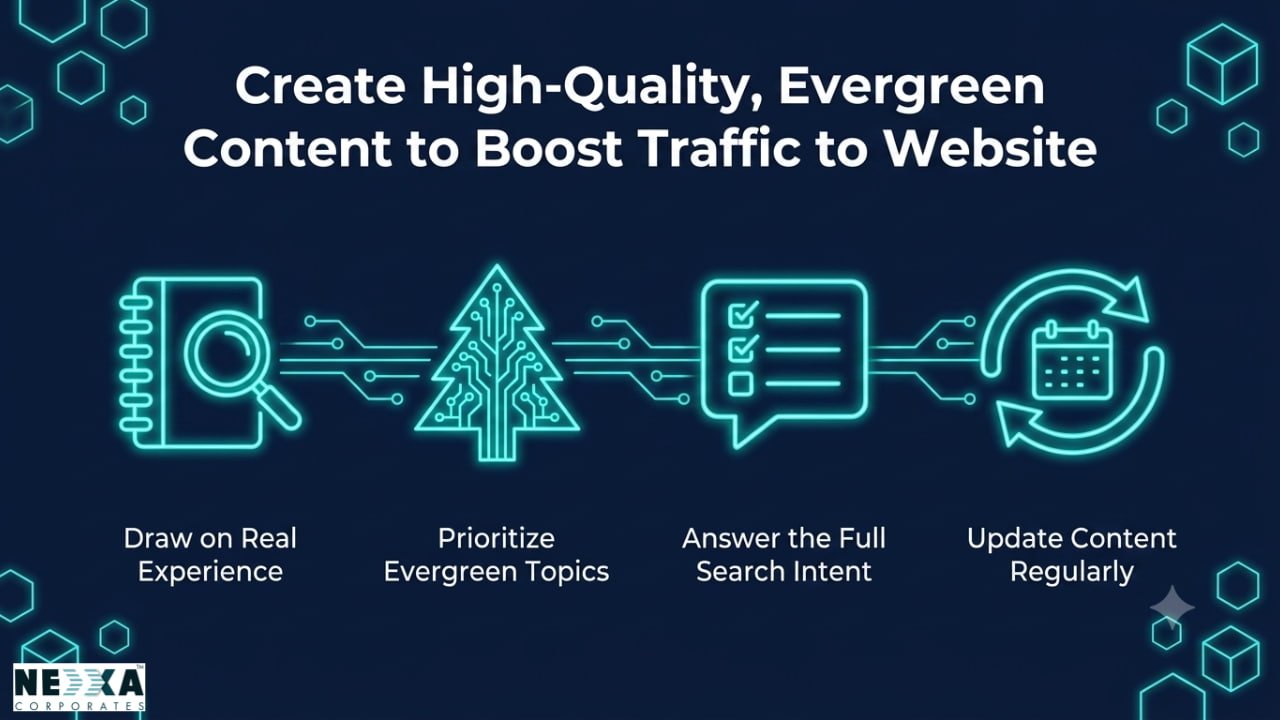
Create High-Quality, Evergreen Content to Boost Traffic to Website

boost traffic to website

Draw on Real Experience

Search engines are getting better at telling the difference between content that solves a real problem and content that’s simply there to rank. The pages that hold up over time — the ones that keep drawing visitors and help boost traffic to website long after publication — are usually the ones built on something original: real data, a real-life example, or a method that’s actually been tested. A case study, a small experiment that was actually run, or a step-by-step guide built out of hands-on experience tells both readers and search engines that there’s genuine expertise behind the page, not just a summary of what other sites already say.

Prioritize Evergreen Topics

Timely, news-driven articles have a short shelf life. Evergreen topics — the kind that don’t depend on a passing trend — are worth the extra effort because they keep gaining traffic month after month instead of fading once the news cycle moves on. Building a content plan around a handful of durable, high-value topics is one of the more reliable answers to how to improve website traffic over time, rather than constantly chasing whatever’s trending that week.

Answer the Full Search Intent

A page that only partially answers a question will lose visitors to a competitor who covers it completely. Anyone researching how to improve website traffic is usually looking for a full answer, not a partial one — so mapping out every sub-question a reader might have, and addressing each one directly, keeps them on the page longer and signals to search engines that the content genuinely satisfies the query, which is ultimately what helps boost traffic to website in a way that lasts and continues to increase website traffic month after month rather than in a single short-lived spike.

Update Content Regularly

Publishing a strong page once isn’t a permanent solution. Revisiting evergreen content every six to twelve months — refreshing statistics, examples, and recommendations — keeps it accurate and keeps rankings from slipping. This ongoing maintenance is often what separates a page that briefly spikes in traffic from one that continues to boost traffic to  website steadily over time.

Sustainable Link Building Strategies to Increase Website Traffic

Backlinks remain one of the most powerful signals available. However, earning them has to be a matter of quality, not quantity. A single link from a website that’s trustworthy and relevant to the subject is far more valuable than a pile of links from low-quality, random sources. Done properly, this is one of the most overlooked answers to how to improve website traffic, in a way that mass link-building doesn’t really achieve.
Two approaches worth keeping:

  • Guest posts on sites with real authority — you get the backlink, sure, but you’re also putting your content in front of a new, relevant audience, which is often the fastest way to boost traffic to  website from a source you don’t already own.
  • Broken link building — locating dead links on relevant websites and providing something valuable to replace them. It’s simple and low-cost, and it’s a real benefit to the site owner too, making it a much easier task.

Both approaches work best as a long game rather than a quick fix. If you’re chasing increase website traffic through links alone, without the content or technical health to back it up, the gains tend to fade about as fast as they showed up — real, lasting ways to increase website traffic always come from links and content working together, not links doing all the heavy lifting on their own.

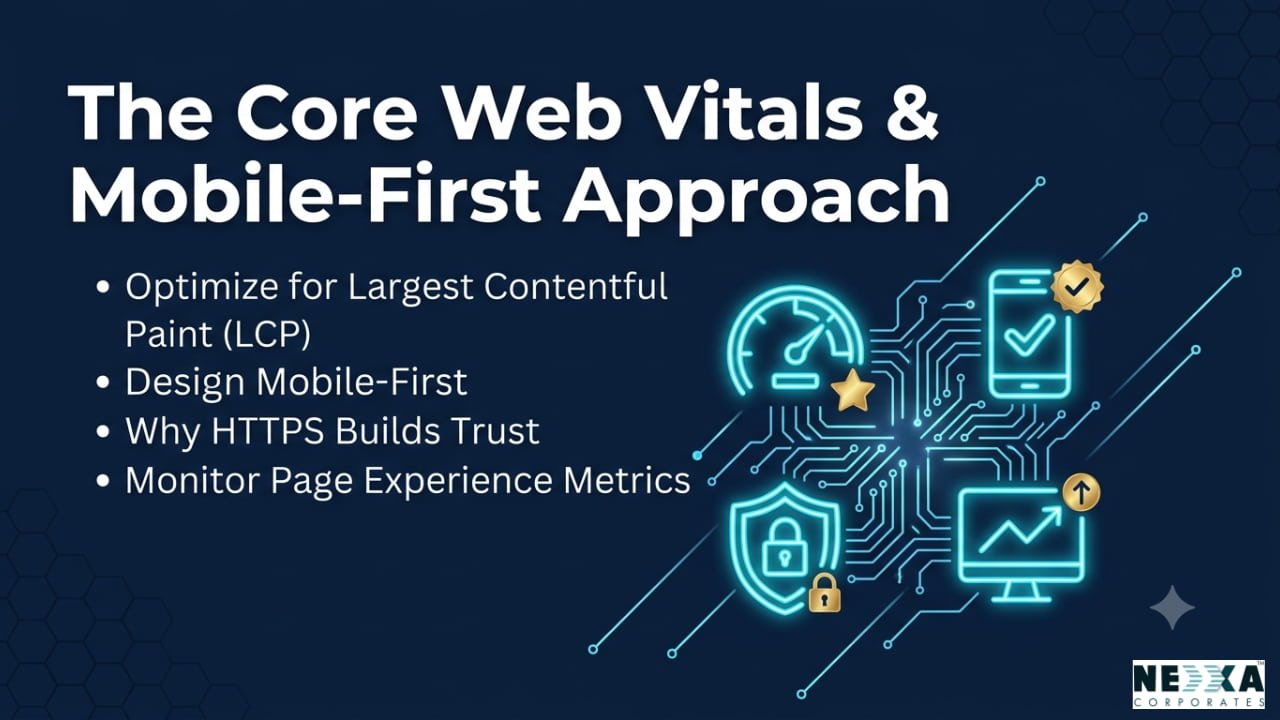
The Core Web Vitals & Mobile-First Approach

increase website traffic

Optimize for Largest Contentful Paint (LCP)

CP measures how quickly the main content on a page becomes visible. When it’s slow, visitors leave before reading a single word, and that bounce is a signal search engines take seriously. Compressing images, trimming unnecessary scripts, and using faster hosting are some of the more direct answers to how to improve website traffic, since this number has a bigger impact on rankings than most site owners realize

Design Mobile-First

Most search traffic now comes from smartphones, so a site that wasn’t designed with mobile in mind is already a step behind — no matter how good the content is. Prioritizing mobile layout, tap targets, and load speed before worrying about the desktop view is one of the more overlooked ways to increase website traffic, since a clunky mobile experience quietly turns visitors away before they even engage.

Why HTTPS Builds Trust

HTTPS is a confirmed ranking factor, and just as importantly, it protects visitors’ data on every page they interact with. At this point it’s less of a nice-to-have and more of a baseline requirement — a site that isn’t trusted by browsers or users tends to lose ground in search rankings, making it that much harder toboost traffic to website even when the content itself is solid.

Monitor Page Experience Metrics

A well-structured website helps search engines understand what matters and how everything connects, and it helps users discover more of what they’re looking for. Descriptive anchor text — wording that tells you what the linked page is about, instead of a generic “click here” — gives search engines real context about the page on the other side of the link. Good internal linking also spreads authority more evenly across a site, so newer pages — or ones that don’t get much direct traffic — still have a real shot at being found by crawlers and visitors alike, which is exactly why site structure is such an underrated piece of how to improve website traffic.

Internal Linking & Site Structure

A well-structured website helps search engines understand what matters and how everything connects, and it helps users discover more of what they’re looking for. Descriptive anchor text — wording that tells you what the linked page is about, instead of a generic “click here” — gives search engines real context about the page on the other side of the link.Good internal linking also spreads authority more evenly across a site, so newer pages — or ones that don’t get much direct traffic — still have a real shot at being found by crawlers and visitors alike.

This is genuinely one of the more underrated ways to boost traffic to website pages that would otherwise sit buried a few clicks deep. If you’re trying to figure out how to improve website traffic on a site with thousands or hundreds of pages, linking your older and high-authority posts to newer ones is often faster than waiting around for new backlinks. It’s a small habit that compounds — every new page becomes one more chance to increase website traffic to the pages that already convert well.

Social Media & Community Engagement

Rankings don’t occur in isolation, separate from everything else happening across the internet. Showing up in the right communities — a Reddit thread, a Quora question, a LinkedIn group — and actually adding something of value, instead of simply dropping a link, builds trust and brand recognition, which eventually feeds into search results even when the link itself isn’t followed. Keeping an eye on social media trends can point you toward the same conversations, since what’s gaining traction there often ends up as a search query days or weeks later.

These spaces also tend to surface the exact questions people are already typing into Google, which makes them a surprisingly good, informal source of content ideas. If you’re stuck on ways to boost traffic to website pages that have gone quiet, pay attention to what people are actually asking in these communities, then answer it more thoroughly on your own site. It’s a reliable way to increase website traffic without spending a cent on ads.

Expand Reach Through Multi-Channel Promotion

Organic search shouldn’t carry the entire load on its own. The sites that grow fastest tend to treat search as one channel among several, using each one to reinforce the others rather than competing for attention.

Email Marketing for Long-Term Engagement

Email still holds up as one of the most reliable ways to bring people back to a site. A newsletter that shares new content, useful updates, or a quick roundup of what’s changed keeps a business in front of people who’ve already shown interest, rather than hoping they stumble back through search on their own. It also tends to convert well, since the audience has already opted in and knows what to expect.

Choosing the Right Social Platforms for Your Audience

 Not every platform makes sense for every business, and spreading effort too thin across all of them usually does less than focusing on the one or two where the actual audience spends time. A B2B service tends to get more out of LinkedIn than Instagram, while a visually driven brand might see the opposite. The point isn’t to be everywhere — it’s to consistently show up where the right people actually engage.

Measure and Adapt with Data

None of this works as a one-time setup. Traffic growth holds up best when it’s checked on regularly and adjusted based on what’s actually happening, rather than what was planned six months ago.

Track the Metrics That Actually Matter

Google Analytics and Google Search Console cover most of what’s needed here — organic traffic trends, keyword rankings, bounce rates, and the paths visitors take before converting. It’s less about watching every number available and more about picking a handful that actually reflect progress toward the goal, then checking them on a consistent schedule instead of only when something feels off.

Turn Search Console Data into Quick Wins

One of the fastest ways to pick up extra traffic is looking at pages already ranking in positions seven through fifteen in Search Console. These are close to page one but not quite there, and often just need a small push: a missing subtopic addressed, a more specific answer to a related question, or a bit of structured data added. That’s usually a faster win than starting a new page from scratch.

Conclusion

Growth in organic traffic is a long game that rewards consistency and patience more than any single clever tactic. It’s also a matter of making adjustments based on what the data actually shows, instead of making assumptions. Websites that combine real expertise, high-quality technical performance, and authentic trust signals are likely to produce traffic that’s not just larger, but also far more likely to convert — a far more sustainable way to increase website traffic than chasing any single tactic in isolation.

Each piece doesn’t accomplish much on its own. A site that’s slow and has thin content won’t attract anyone’s attention, and great content sitting on a slow, insecure site is unlikely to be found at all. The websites that grow steadily are the ones that treat keyword strategy, content quality, technical health, and trust signals as a single system — revisiting and reworking every component regularly, rather than simply going through a checklist once and moving on, since that ongoing discipline is what actually helps boost traffic to website over the long run.

FAQ

1. How long does it take to see results from SEO efforts?

Most sites start experiencing real change between three and six months in, but it’s contingent on the competition, how old the site is, and how consistent the effort has been. SEO tends to compound rather than deliver anything overnight.

2. Is more content always better for boosting website traffic?

Not really — the quality and relevance of content matter more than sheer volume. A few well-thought-out, targeted pages typically outperform a large number of generic, thin ones.

3. Do backlinks matter as much as they used to?

They do, but the bar has shifted toward the authority and relevance of the linking site, rather than merely the number of links.

4. How often should existing content be updated?

Evergreen pages tend to benefit from a review every six to twelve months. Keeping the data, examples, and recommendations current helps rankings stay in good shape over time.

5. Does social media activity directly affect search rankings?

Not directly, usually, but it can increase visibility and could indirectly lead to the kind of engagement and link opportunities that help improve rankings.

seo services in kerala

seo services in kerala

10 Proven SEO Services in Kerala to Boost Traffic & Sales

seo services in kerala

If your business does not show up on the first page of Google, you are losing customers to other businesses that do. This is true for any business, whether you have a shop in Kochi or a new startup in Thiruvananthapuram.

People usually look for things online before they make a purchase, so they will find your competitors whose businesses show up on the first page of Google. This is why more and more people in Kerala want SEO services for their business, because they know that SEO services in Kerala can help their business show up on the first page of Google.

That’s where SEO services in Kerala come in. Search engine optimization helps your website rank near the top of Google’s results when local customers search for what you sell, driving more visitors to your site and more leads without paying for every click.

As more Kerala businesses build websites, competition for those top search rankings keeps growing. Simply having a website isn’t enough anymore—you need a deliberate strategy to get found. That’s exactly what professional SEO services in Kerala are built to deliver.

What Are SEO Services?

Search Engine Optimization is the process of making a website so it shows up higher on search engines like Google. Businesses use Search Engine Optimization services in Kerala to find people get more people to visit their website and get more sales. They use Search Engine Optimization to make sure the right people see their website. A good digital marketing agency puts everything together in one plan. They do not do things separately.

  • On-page SEO
  • Off-page SEO
  • Organic SEO
  • Technical SEO
  • Content marketing
  • Link building
  • Local SEO

Why Every Business in Kerala Needs SEO

Businesses in Kerala are going online quickly. This is why more and more people in Kerala want Search Engine Optimization services.

More people discover your business. Ranking on Google’s first page puts your business in front of far more potential customers, naturally increasing both website visits and inquiries.

You attract the right visitors. SEO shows your business to people who are already looking for the products or services you provide. They’re actively searching, so they’re much more likely to choose your business.

You save money over time. Unlike paid ads, SEO doesn’t charge you per click. Once your rankings improve, that visibility continues to bring in traffic long after the initial work is done, making it a genuine long-term investment rather than a recurring expense.

You build trust. Most people trust businesses that appear first when they search online. A high ranking on Google makes people think a business is credible, even before they visit your website.

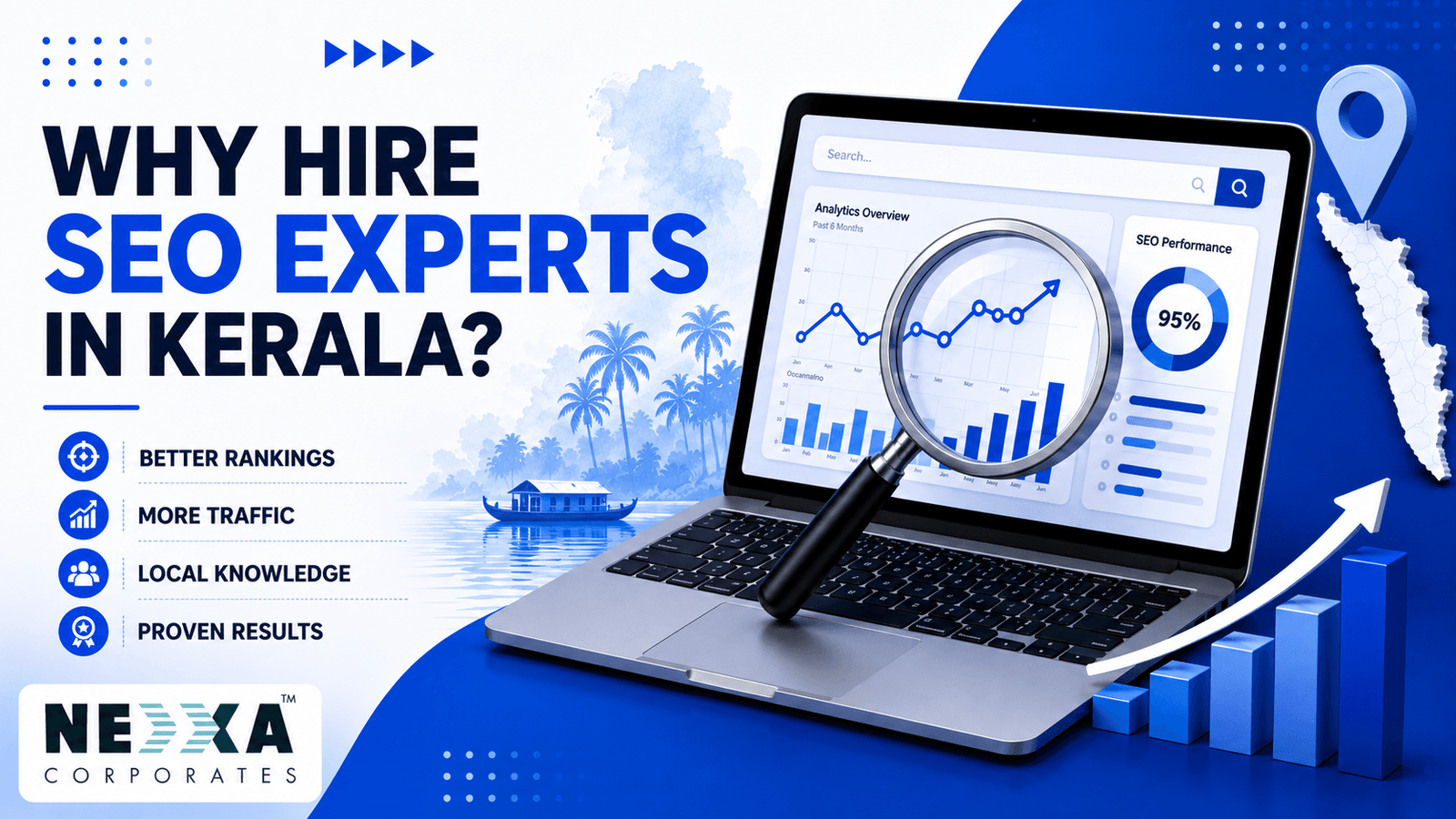
Why Hire SEO Experts in Kerala?

Why Hire SEO Experts in Kerala

Hiring professional SEO services in Kerala has several advantages because they understand the demands of local clients. A professional agency knows what keywords people are searching for, where they are searching, and what kind of information compels customers to choose one business over another. SEO consultants help you rank higher on search engines based on the preferences of the local audience.

Professional SEO agencies offer end-to-end services, including keyword analysis, on-page SEO, technical SEO, content creation, local SEO optimization, and link building to improve your website’s performance in search engine results pages (SERPs). Consultants analyze every element of your website to ensure it meets Google’s requirements and encourages customers to take action.

Professional SEO agencies offer the best value by combining SEO services in Kerala with digital marketing. In addition to helping you achieve long-term organic growth, SEO consultants can work with you on digital marketing initiatives to maximize your leads and online sales. SEO and digital marketing complement each other, with SEO boosting your online presence and digital marketing focusing on generating more leads and sales.

Moreover, professional SEO agencies stay up to date with Google algorithm updates and follow white-hat SEO practices. Instead of experimenting with cheap SEO options that may ultimately penalize your website, it is better to invest in an ethical SEO agency that understands the intricacies of search engine optimization and helps your business grow over the long term.

SEO needs to be monitored and maintained constantly. Experts ensure that your keywords rank higher, your website receives enough traffic, and conversions continue to improve.

Without prior knowledge, most companies find it challenging to maintain their rankings, attract enough traffic, and convert visitors into paying customers. Working with an SEO company offering SEO services in Kerala allows professionals to handle your SEO while you focus on running your business. You can also expect better rankings, increased traffic, and more visitors turning into paying customers.

Why Your Kerala Business Needs Local SEO

If a customer in Kerala searches for a particular product or service but cannot find your business in the search results, they are likely to choose your competitor instead. This is why Local SEO is one of the most essential components of SEO services in Kerala. Local SEO increases your business’s visibility to customers searching for specific products or services in your area.

Local SEO differs from standard SEO because it specifically targets customers within a particular region. Whether you own a clinic, restaurant, retail shop, salon, travel agency, or any other local business, Local SEO helps your business appear in search results alongside other businesses in your area.

Local SEO can also help you generate high-quality leads rather than just any leads. By focusing your SEO efforts on the areas you actually serve, you attract visitors who are more likely to contact you, visit your store, or purchase your products or services. This improves your conversion rates and increases the return on investment from your marketing efforts.

Local SEO also strengthens your online reputation. Positive customer reviews, consistent business information across online directories, and location-specific content contribute to your authority not only in Google’s eyes but also among potential customers. The stronger your local authority, the greater your chances of ranking well in local search results.

Local SEO can also be expanded for businesses that serve multiple towns or districts across Kerala by creating dedicated location pages and optimizing them for local keywords. This approach helps you reach customers in multiple locations without appearing in irrelevant search results from other areas.

For example, if you are in Ernakulam and search for “dentist near me,” Google uses local ranking factors such as proximity, relevance, and prominence to determine which dental clinics appear in Google Maps and local search results. A dental clinic with a complete Google Business Profile, excellent customer reviews, and up-to-date business information is more likely to receive calls than competitors that have not implemented these optimizations.

Types of SEO Services in Kerala

A complete SEO strategy isn’t one tactic — it’s several disciplines working together. Here’s what every Kerala business should understand about each type of SEO services in Kerala before choosing a provider.
On-Page SEO Services
When you think about the things that’re on your website On-page SEO services is what takes care of all those things that people and search engines can see. This includes things like the title of each page the description that shows up in search results the headings on each page where you put your keywords the links to other pages on your site the text that describes your pictures and the addresses of your web pages being easy to read.

If you do On-page SEO services correctly it helps Google understand what each page of your website is about which means it can show up when people search for things that are related to your website and On-page SEO services. This is important for On-page SEO services. It really helps with, On-page SEO services.
Off-Page SEO Services
Off-page SEO happens outside of your website. It has a big effect on how much Google trusts your website. This is when you get links from good websites you list your website in directories people talk about your website on social media you write guest posts for other websites and you make sure people are saying good things about your website online.

Basically off-page SEO is what other people on the internet are saying about your business and the good websites that say good things, about you the more Google will trust your website too. One thing off-page SEO does is proves Google your site can be trusted.
Organic SEO Services
Organic SEO is about getting rankings without paying for them. You do this by making your website better getting websites to link to you and having a good plan for the content you put up. It takes a while to see results from Organic SEO. It does not work fast, as paid ads.

Once you get Organic SEO working for you it keeps bringing people to your website. The kicker? Organic SEO continues to send free traffic to your website even when you aren’t actively paying for each click that comes through.
Technical SEO
Google needs to be able to find your site and read its contents in order to understand what is on there. This is what technical SEO is for. Technical SEO refers to on-page factors influencing your ranking. It entails optimizing your site for speed, mobile devices, and Google’s ability to read and comprehend your data.

Moreover, it involves a number of aspects in terms of repairing broken links and addressing errors in the way Google views your website. The site’s security and its labels must also be addressed. Without Google being able to read your content, nothing else matters. Google will not be able to rank your page even if it has excellent material.

As a result, in order to enhance discoverability, it is critical, particularly in Kerala, to conduct a SEO audit before optimizing your search engine.
Local SEO
For Kerala businesses, local SEO is what gets you found ahead of nearby competitors, and it’s usually the fastest-moving part of any SEO services in Kerala campaign. It’s essential for restaurants, clinics, salons, law firms, and real estate agents — anyone whose customers search with location intent. Local SEO includes:

  • Improve your Google Business profile
  • Using your city or town name naturally across your site
  • Consistently update business name, address, and phone number (NAP) across all online profiles
  • Actively collecting customer reviews
  • Setting up location pages for each market where you offer service

The setting up and totally optimising of your google business profile is free and one of the easiest and quickest way of increasing your visibility.

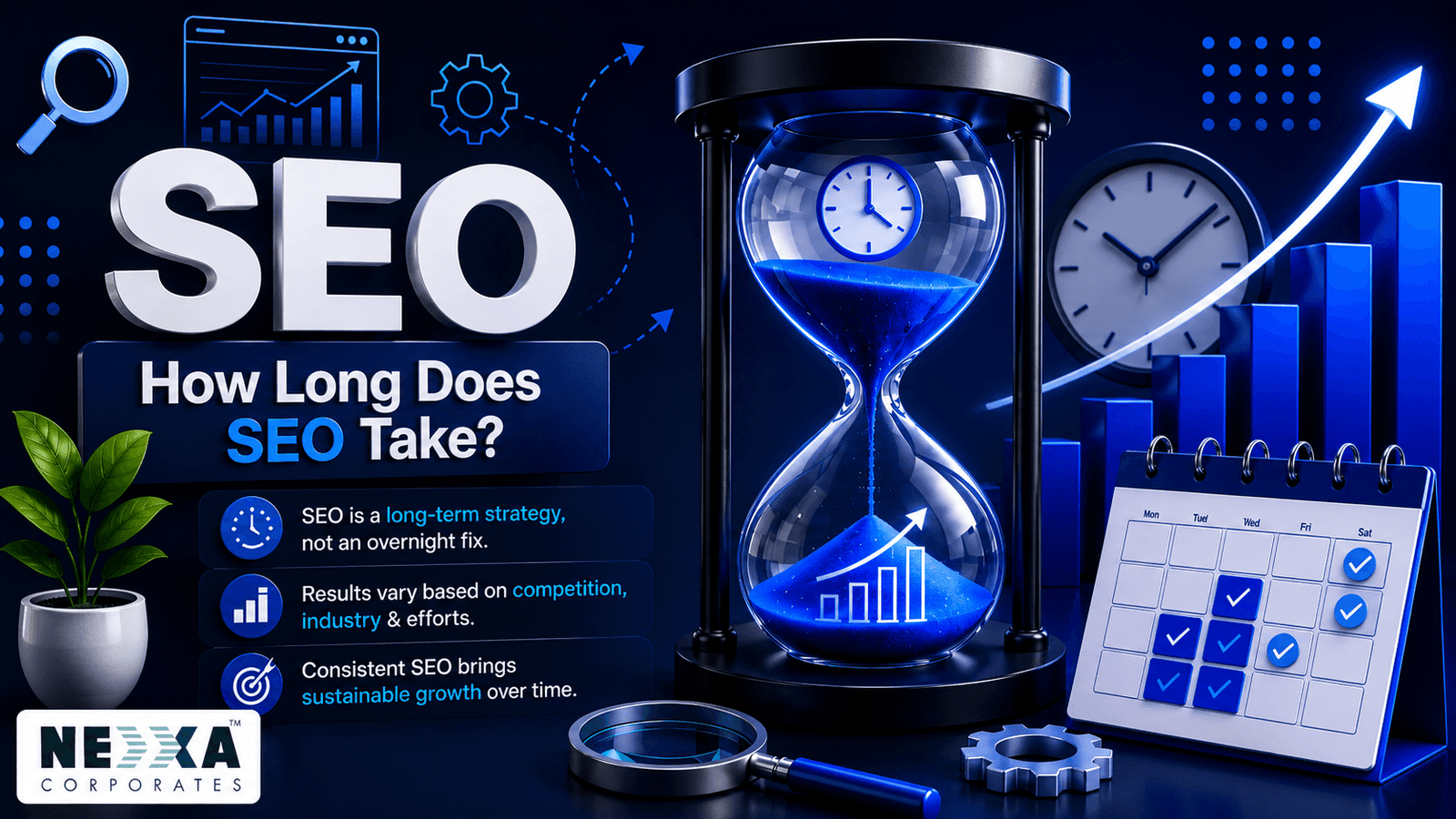
How Long Does SEO Take?

How Long Does SEO Take

Most people beginning an SEO campaign in Kerala want to know when they can expect to see a return on their investment. In other words, “How long will it take to start getting results with SEO?”

The truth is that SEO is not the fastest marketing strategy. It requires a long-term investment. The timeline depends on factors such as your industry’s competitiveness, your website’s health, your content strategy, and the amount of SEO work already completed.

While search engine optimization is a long-term strategy, it offers lasting benefits. Unlike paid advertising, which stops generating traffic as soon as you stop paying, SEO can continue driving traffic and leads even months after your SEO service provider has completed their work. Every website has its own SEO journey, but most campaigns follow a similar timeline.

Month 1: Research and Website Audit

During the first 30 days, SEO specialists establish a strong foundation. They perform a comprehensive website audit, analyze technical issues, assess competitors, research target keywords, optimize or create your Google Business Profile, and develop a customized SEO strategy for your business.

Month 2: On-Page SEO Optimization and Content Strategy

After the research phase, it’s time to optimize your website. This includes improving meta tags, headings, titles, URLs, internal linking, images, and website content. At the same time, an SEO content strategy is developed, and the first SEO-optimized pages or blog articles are created.

Month 3: Early Ranking Improvements

By the third month, Google begins recognizing the improvements made to your website. Lower-competition keywords may start climbing the search results, technical fixes begin showing results, and your website becomes easier for search engine bots to crawl and index.

Months 4–5: Authority Building

At this stage, your focus expands beyond your website. You continue building authority through high-quality backlinks, off-page SEO, local SEO optimization, and regular content creation. These efforts often lead to noticeable improvements in keyword rankings.

Month 6 and Beyond: Growth in Traffic and Leads

Many businesses begin seeing steady growth in organic traffic, quality leads, and customer inquiries around the six-month mark. As your website gains authority, it becomes easier to rank for more competitive keywords, resulting in sustainable business growth.

Months 9–12: Long-Term SEO Success

With ongoing content creation and continuous SEO improvements, your website builds greater authority and relevance within your industry. Rankings become more stable, organic traffic continues to grow, and SEO becomes one of your most reliable sources of lead generation without paying for every click.

Be Careful of Unrealistic Promises

If an agency claims it can rank your website at the top of Google for a competitive keyword within a few weeks, you should be cautious. No agency can guarantee first-page rankings because Google’s algorithm considers more than 200 ranking factors, many of which are outside anyone’s control.

Professional SEO services in Kerala focus on sustainable, ethical SEO practices that deliver consistent long-term growth. The goal is not quick wins but lasting improvements in search rankings, steady website traffic, and increased business opportunities.

The long-term results provide a much higher return on your investment.

SEO versus paid ads: Which one do you need?

Most companies use SEO and paid ads to maximize their digital marketing efforts because each offers distinct advantages. If you need immediate results, paid ads are ideal, while SEO focuses on long-term, sustainable improvements in your website’s visibility. Depending on your budget and business goals, you can decide which strategy is the better fit.

Why Choose SEO?

If you want to grow your business over the long term, investing in SEO services in Kerala is a smart choice. SEO helps improve your website’s rankings and increases its visibility in Google’s organic search results. As a result, your website attracts more organic traffic from customers searching for your products or services. Unlike paid advertising, you don’t have to pay for every click.

A strong ranking can continue generating results for months or even years when your website is consistently maintained and optimized. Organic search results also tend to earn more trust because users often view them as natural rather than promotional.

Why Choose Paid Ads?

Paid advertising is designed to deliver immediate results. Google Ads and social media advertising can help you reach your target audience quickly. This makes them ideal for promoting new products, announcing sales, generating leads, and increasing sales through seasonal campaigns.

However, once your advertising campaign ends, the results usually stop as well. You continue receiving customers only while your ads are running. For this reason, paid advertising is better suited for short-term goals rather than maintaining consistent traffic growth over the long term.

Which Strategy Is Better?

There is no single answer because each strategy has its own advantages and serves different business goals. If your business needs immediate leads, quick traffic, and fast sales, paid advertising is the faster way to achieve results.

However, if your goal is to build a strong online presence, increase organic traffic, and generate consistent leads over the long term, SEO services in Kerala are a much better investment. Many successful businesses choose a combination of both strategies.

Paid advertising can generate immediate traffic and sales while you simultaneously invest in SEO to improve your Google search rankings, attract organic visitors, and reduce your dependence on paid marketing. As your rankings improve, your website continues attracting potential customers without requiring you to pay for every click on an advertisement.

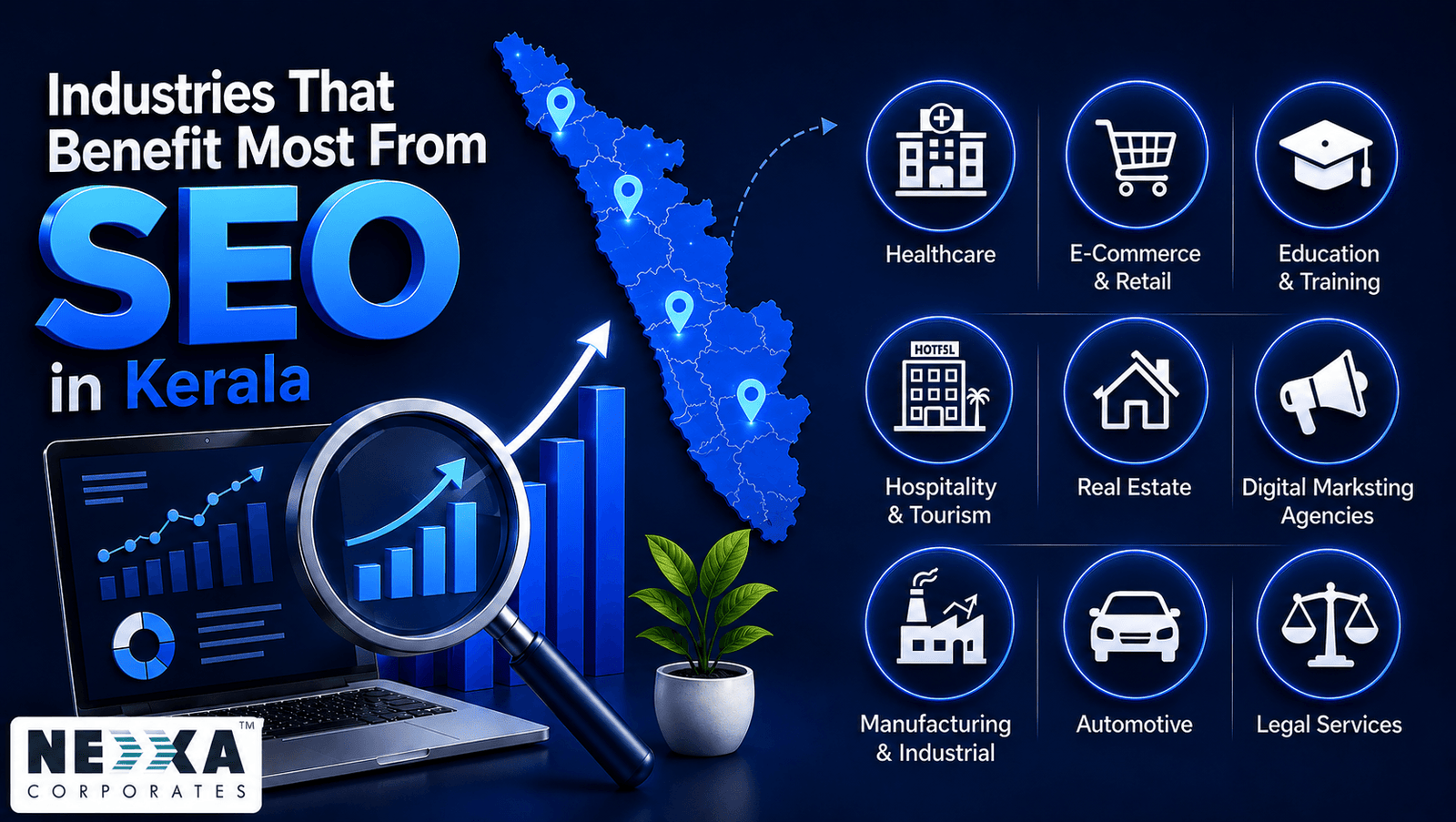
Industries That Benefit Most From SEO in Kerala

Industries That Benefit Most From SEO in Kerala
  • Clinics, hospitals, and ayurvedic centres are primary healthcare providers, and patients check their symptoms and providers online before making a booking.
  • Search is the primary method used to search for the vast majority of travelers, who plan and book their trips entirely through tourism/hospitality (homestays, resorts, travel agencies).
  • Real estate — before anyone calls into your agent’s office, you need to ensure your website is optimized for that area.Real estate — buyers do a lot of research before calling the agent so location-based SEO is a must.
  • Trust is built before a client calls — legal services
  • Education (schools, colleges, coaching centres) – Organic SEO search leads to enrolments in enrollment seasons.
  • Using a product level SEO approach can generate sales without relying heavily on ads, as with e-commerce.
  • Local service (contractors, salons, repairs) — “near me” searches lead to immediate calls and bookings
  • No matter whether you’re a startup or a small business — SEO can be an affordable competitor to those who have huge budgets.

How To Select Right SEO Company in Kerala

The Kerala SEO service you use may be utilizing antiquated practices, as well as you can get even more damage to your online presence than anything at all! When hiring, make sure that the agency:

  • Provides you with a clear and individual plan instead of a standard one
  • Can present real case studies or ranking results.
  • Describes the process in a clear way, avoiding the use of vague promises
  • The #1 ranking is never guaranteed in 30 days, which is a word of caution to consider (30 days is a lot of time, especially when a #1 ranking should always give reason for concern).
  • Adheres to Google’s official guidelines for the web
  • Reports, communicates regularly
  • Possesses a clear grasp of your sector and/or local market
  • Strikes the right balance between technical SEO and content strategy
  • Has a well-defined pricing and deliverables
  • Has good track record of positive client reviews

It’s a common mistake to just select the most affordable SEO agency — the poor quality that is done can lead to penalties, which can take many months to bounce back.

Common SEO Mistakes Kerala Businesses Make

  • Even when most of the Kerala users search on mobile first, they are not optimising for mobile.
  • Too many keywords (bad for both reading and rankings),
  • Not completing or updating the Google Business Profile. Not filling out or updating Google Business Profile.
  • Ignoring the performance of a slow-loading site that is losing customers before it even loads the page
  • The lack of uniformity of NAP data in the directories makes it difficult for users and Google. Inconsistencies of NAP data in the directories make it difficult for both users and Google.
  • Creating thin content that the searcher isn’t looking for.
  • Buying poor quality links that might attract a penalty instead of a reward.
  • Without analytics and tracking, making decisions based on gut feeling.

These problems are identified at the beginning of any campaign when a technical audit is done properly, and the good thing about a technical audit is that it does not simply write down the issues, it gives a priority to which issues are important.
The one thing to do over again: not to view SEO as “set it and forget it. Search algorithms are always changing and so must be your approach.

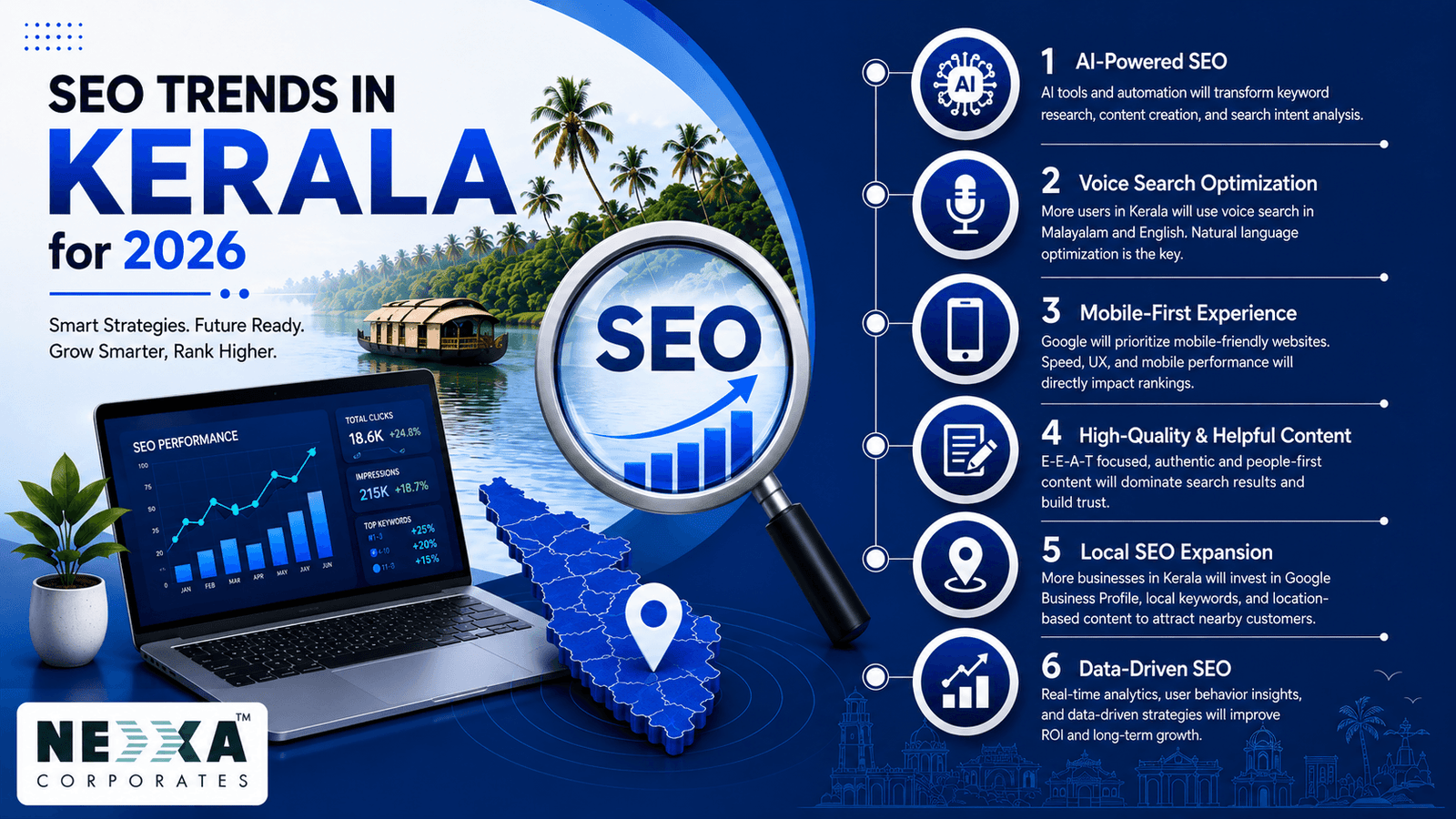
SEO Trends in Kerala for 2026

SEO Trends in Kerala for 2026
  • Search engines generally summarize answers directly on the results page, especially since they’ve been influenced by AI.Because search engines are showing AI-driven answers as summaries right in the results page, on page content and structured data take center stage.
  • Core Web Vitals still one of the more important rankings.
  • Increasing amounts of users searching conversational natural questions, voice/conversational search growing.
  • Hyper Local SEO is on the rise and businesses are optimizing down to neighbourhood and street level.
  • E-E-A-T – Experience, Expertise, Authoritativeness, Trustworthiness – will remain a major ranking factor.E-E-A-T – Experience, Expertise, Authoritativeness, Trustworthiness – will remain a key ranking factor.
  • Blended search is growing more and more with results as videos, images and text.

In the case of Kerala businesses, this means that SEO cannot just focus on keywords and backlinks anymore; it must consider the structure of the content, page speed on midsize smartphones, and the clarity of the page’s answer to the actual question.

Conclusion

Having a website today is not enough to ensure your success. Customers constantly use Google to find businesses, so if yours doesn’t appear in the search results, you’ll likely lose customers to your competitors. Fortunately, SEO services in Kerala can help you optimize your website for Google’s search engine, increase traffic and qualified leads, and grow your business steadily. Whether you run a startup, a local business, a retail store, a healthcare business, or an established corporation, the right SEO strategy helps your company attract the right customers at the right time.

An experienced SEO expert can help you achieve this by improving your website’s technical performance, enhancing its design, creating valuable content that ranks well in search engine results, building your online authority, and increasing your local visibility. Unlike paid advertising, where traffic stops once your advertising budget runs out, SEO is a long-term marketing investment. With consistent optimization and a strong focus on your customers’ needs, your website can continue generating traffic and qualified leads for months or even years, becoming one of your most valuable business assets.

FAQ

1. What are the prices for SEO Services in Kerala?

The cost of SEO services in Kerala depends on your industry, the level of competition, and the goals you want to achieve. Many SEO agencies work on a monthly retainer model, so it’s best to have your business evaluated to receive a customized SEO plan and pricing.

2. When will I start to see results?

Many of our clients begin to see noticeable improvement between 3–6 months, with rankings really starting to strengthen in competitive markets over 6–12 months.

3. How to differentiate from the difference of on-page and off-page SEO?

On-page SEO refers to on-site website content enhancements and off-page SEO is off-site website enhancement such as links and citations.

4. Am I Ready For an SEO Audit?

Your site may benefit from a technical SEO audit if it’s taking too long to load, you haven’t added any content for months or years or if users aren’t mobile friendly.

5. Can small businesses in Kerala take on big players with SEO?

Yes – the use of localized and niche targeting SEO techniques helps many smaller players to outperform large players in their target regions for localized search terms.

Future of seo

Future of seo

The Future of SEO in 2026: How AI, Content Strategy, and Search Behavior Are Changing the Rules

Future of seo </p>
<p>

The future of SEO is not a distant future. It’s already transforming how businesses are discovered online. SEO has shifted away from ranking pages solely on keywords and backlinks to look at intent and context as well as trust at a higher level. Artificially generated summaries, conversational searches, and the shift in user behavior indicate that strategies that worked five years ago don’t have the same effect when utilized by themselves.

Making SEO strategies that can last over time and not merely strategies that are designed to last through any algorithm updates requires a solid foundation of know-how, actual expertise, and trustworthiness that is proven. 

This guide provides a roadmap of where SEO will take us in the year 2026. We also discuss the increasing importance for AI SEO services, the rising importance that AI SEO capabilities play in AI SEO capabilities, and the reasons why seo and content strategy must be used in tandem rather than as two distinct tasks.

How AI Is Rewriting the Search Landscape

The future of SEO is being shaped by how much search behavior has changed more rapidly over the last two years than during the past decade. Some patterns stand out:

  • AI Summary pages are transforming how people click

Industry research on AI-generated search results has repeatedly demonstrated the fact that the moment an AI summary responds to a query directly on the search results page, fewer people visit individual websites, even though the overall visibility (impressions) increases. Certain analysts refer to this gap between growing views and decreasing clicks as “the great decoupling.”

  • AI tool use is increasing

A growing share of marketers are now using Artificial intelligence(AI) tools for regularly creating content as well as keyword research and optimization, but the adoption rate among ordinary users is less clear, as many users still opt for traditional search methods for high-risk or more complex queries.

  • Search intent is diversifying

Beyond the classic informational, navigational, transactional, and commercial-investigation intents, a newer “AI-native” intent is emerging – users asking layered, conversational questions and expecting a synthesized answer rather than a list of links.

The key insight about the future of SEO, the importance of visibility isn’t just about getting into the traditional top 10 positions. It’s about being the point of reference AI systems draw on when they come up with an answer, as well as the metrics that go into it, differing from the click-through rate that the majority of SEO reports have tracked historically.

AI SEO Service: Why It's Becoming Essential, Not Optional

An AI SEO service is more than just traditional optimization. It analyzes the performance of content through AI Overviews Chat-based assistants, chat-based tools, and search engines that generate results that go beyond traditional blue-link results.

With more and more people turning to AI-generated or conversational responses, business owners need a strategy designed specifically around the way these systems choose the right information, interpret it, and then present it to users data.

ai seo service</p>
<p>

What This Actually Involves

Content Structuring to enable extraction

This is done by using clear headings, simple responses, and parts that AI systems can quickly synthesize. Content that is divided into sensible, scannable sections tends to be integrated into AI overviews and chat responses more effectively than lengthy unstructured text blocks. This can also increase the comprehension of humans, providing an advantage of two kinds: better AI extraction and a more pleasant user experience.

Optimization for Semantics

This is when you write about themes and goals instead of focusing on specific keywords, and anticipating the larger query that a user wants to answer, rather than focusing only on one keyword. Semantic optimization can help content remain relevant across a variety of related queries and variations in phrasing, which are particularly important because conversational search continues to grow.

Answer-First Formatting

This is a way of guiding sections using an easy, concise answer before proceeding to provide more information. This is similar to how AI systems usually collect information, pulling an encapsulated summary first, and then referring to additional details if required. This is also in line with how people consume content, particularly when using mobile or voice-based gadgets, in which a rapid and clear answer is required at the beginning.

Visibility Tracking Beyond Rankings

his requires checking the degree of content appearing in AI-generated summaries and not only tracking position 1-10 within traditional results. This requires a change in reporting – away from the click-through rate and the ranking position as a whole, to determining the frequency of citations, appearances in AI Overviews, and the share of voice across all generative platforms. Businesses that only track traditional rankings may miss warning indications of declining or increasing popularity in these emerging formats.

Generative Engine Optimization and the Rise of LLM SEO

A more recent discipline is in line with the traditional SEO. It’s called Generative Engine Optimization (GEO), also called Answer Engine Optimization (AEO). It is focused on having information selected, cited, and analyzed by AI systems like Google’s AI Overviews, ChatGPT, and other big models of language.

This shift toward AI-driven answers is exactly why understanding the future of SEO now means understanding how LLMs interpret content, not just how search engines rank it.This is closely linked to what’s now known as LLM SEO – a process that optimizes your website so AI models understand and reference your content with precision. In the real world, that refers to:

  • Writing in a clear, factual, and well-sourced language that is easy for a model to deduce and then summarize
  • The building of authority on a topic through extensive and well-linked content clusters, instead of single posts
  • Updated content: Research on AI is consistent in showing that newly published or updated pages are cited more frequently than stagnant, older pages.
  • Real authority signals authentic author credentials, original information, and even citations, which make a website better suited to being cited as an authoritative source.

Traditional keyword optimization won’t go out of style, but it’s only one of many layers. The ability to adapt to the future of SEO, not a rigid checklist, is what distinguishes websites that remain visible from those that slide away.

Why SEO and Content Strategy Can No Longer Be Separate Functions

  • Topic clusters rather than individual keywords 

Create interlinked content around themes, rather than just one keyword per page.

  • Map of intent 

determining the reasons why people are searching for the term, not just what the term means, and creating the content around that.

  • E-E-A-T-driven plan 

which involves subject-matter input, citing credible sources, and is based on real personal experience.

  • Content refreshes are scheduled

updating pages on a regular basis instead of only releasing new pages and letting the old content deteriorate.

  • Coverage in multiple formats 

Linking textual content and video with structured information or interactive elements to mimic how people browse.

Brands that integrate SEO into the planning phase of content, instead of putting it on later, have seen much longer-lasting results as the nature of search changes over time.

Brand Visibility Beyond Your Website

A component that’s getting as important as backlinks is how your brand’s name is referenced across the internet, and not only on your domain. AI systems increasingly draw inspiration from forums, community platforms, and third-party discussion forums when they generate responses, and not only from the official pages of your brand.

This signifies:
The community presence is crucial. Genuine, helpful involvement in relevant discussions (Reddit threads and industry forums, as well as Q&A platforms) can affect the likelihood that your brand is highlighted when AI tools are used to summarize a subject.

Third-party citations are often regarded as having more importance than self-published assertions. A brand mentioned positively within an independently reviewed or comparison article is generally regarded as trustworthy by both users and AI systems, much more so than a similar assertion on the brand’s own website.

Share-of-voice tracking is becoming an actual measure. Monitoring how often (and how precisely) your brand appears in AI-generated responses is emerging as an alternative to traditional rank tracking.This growing focus on where and how your brand appears across the web is becoming a defining part of the future of SEO.
Businesses that used to focus solely on their website’s SEO represent an evolution toward the future of SEO, where visibility now extends to conversations about your brand’s name on the web, not only those pages that you directly control.This is another reason seo and content strategy now have to be planned together from day one.

E-E-A-T: From Ranking Factor to Central Requirement

Seo and content strategy</p>
<p>

1. Experience

Sharing personal results, such as case studies and actual results of clients, instead of general guidance. This is about going beyond just the description of what a service can do and instead describing the results when it was actually utilized with real numbers as well as real timelines and actual challenges that were worked through.

Content based on lived experiences is much more difficult to replicate on a large scale than general guidance, which is the reason it has more credibility in the eyes of both AI users and systems.

2. Expertise

Utilizing accredited authors and naming subject matter contributors with clear author bios. This requires the use of authentic names, credentials, as well as relevant backgrounds to the content, instead of publishing under an unrelated “admin” byline.

The visible evidence of expertise, like certifications and years of experience or specific industry expertise, can help readers as well as AI systems assess whether the person who wrote the content is actually knowledgeable about the subject rather than simply reciting information that has been found elsewhere.

3. Authoritativeness

In addition, you can earn backlinks and citations through trustworthy and reliable sources. It’s more about the quantity of links and more about the people connecting or referring to the content. A reference in a reputable industry publication or from an acclaimed person is much more important than hundreds of low-quality directories. With time, constant recognition from trusted external sources creates an image that search engines as well as AI models are able to trust.

4. Trustworthiness

Maintaining content that is accurate, well-sourced, and clear, with transparent information about the business and contact information. This includes avoiding vague or unsubstantiated claims, using reliable sources when making claims that are factual and making it simple for readers to identify who’s responsible for the information.

Simple indicators – such as an actual address, working information about contact and clear disclosure of any commercial relationship – can reassure both the user and algorithms that it has come from a reliable, trustworthy source.

What Happens When Brands Don't Adapt

Falling behind on the future of SEO and  delaying an AI SEO service — doesn’t always look like a major issue at first – it’s more likely to occur slowly:

Declining AI Visibility
Visibility gradually diminishes from AI-generated results even as the traditional ranking of keywords appears steady, due to AI systems drawing information from more well-structured, other sources instead.
Competitors Gaining Ground
Competitors are now the primary source for AI overviews and chat responses, helping to establish brand recognition and trust that could otherwise be yours.
Growing Analytics Blind Spots
Blind spots of analytics increase as AI referral traffic, share of voice, and citation frequency can’t be tracked by rank-tracking software — which means a business may be losing ground without any warning indicators of the metrics they’re used to track.

Zero-Click Search and the Changing Results Page

Highlighted snippets, AI Overviews, and knowledge panels indicate that a greater percentage of users receive answers without visiting the website. This is a shift in the meaning of what “ranking well” actually means.Zero-click behavior is one of the clearest signs of the future of SEO already arriving.

AI-Generated Summaries
Appear in highlighted snippets of content, without the need to click.
Voice & Conversational Structure
The structure is designed to accommodate voice search and conversational questions.
Findability Goal
The goal is to make important information easy to find, as it’s how information is usually presented, even as a no-click result.

Technical SEO Still Matters - It's the Foundation, Not the Whole Picture

With all the changes, technical SEO isn’t becoming optional. It’s the foundation that allows everything else to function. Technical SEO remains a core part of the future of SEO, not a separate concern. Businesses must continue to put the following priorities first:

  1. Site Speed-Vital Web Content and overall speed of the site.
  2. Mobile-First Design -Design that is mobile first, as the majority of internet traffic is now coming from mobile devices.
  3. Structured Data (Schema Markup)-Helps both AI and traditional systems understand pages accurately.
  4. Clean Website Structure-Clean website structure with the ability to link internally in a way that both crawlers and users can navigate easily.

This is exactly the technical layer a proper AI SEO service should audit before any content work begins

How Businesses Can Prepare for What's Next

Preparing for the future of SEO starts with these five steps:

  • Review existing content for compliance with E-E-A-T standards and find out the areas where authorship or expertise signals are not present.
  • Combine SEO and content strategy starting at the beginning of the plan, but not just after an initial draft has been written.
  • Build an AI SEO service capability either through internal training or a specially trained partner.
  • Track the visibility of AI-generated results as well as brand mentions on the web and beyond, not only traditional rankings for keywords.
  • Prioritize original content over content that is generic, in particular, since AI helps make shallow content easier to create at a large scale.

Conclusion

The future of SEO isn’t about adjusting to each algorithm update or trying to catch every new AI feature that search engines launch. It’s about creating a solid foundation based on genuine experience, well-structured content, and technical dependability that will hold up no matter how the search interface evolves.

AI is transforming the way people search for information, but the fundamental principle driving it hasn’t changed — real value for users remains the goal. Companies that approach SEO and content strategy as an integrated field, rather than two distinct tasks handled by two separate teams, will be better prepared.

As generative search — including voice search and AI-driven summaries — takes up a larger part of how people browse, investing in a true AI SEO service now isn’t about keeping pace with the latest trends; it’s about future-proofing your brand’s visibility for whatever the future of SEO looks like next.


FAQ

1. Is SEO being replaced by AI?

No. SEO is changing and not going away. AI has altered the way results are generated and presented; however, businesses require strong optimization in order to be prominent in both traditional and AI-driven searches.

2. What SEO professionals require going forward?

Beyond core technical and keyword knowledge, experts will need to be skilled in the strategy of content, structured data AI/LLM optimization, as well as understanding performance data across different surface types of search.This is why seo and content strategy skills increasingly live in the same role rather than separate teams

3. Should businesses consider investing in the AI SEO service right now?

 Yes. AI-driven SEO results are already available in large numbers across all major engines. Companies that are able to adapt before the shift are at an advantage over those who wait for the change to fully take place.

4. What is Generative Engine Optimization (GEO), and is it different from SEO?

GEO, or Answer Engine Optimization (AEO), focuses on getting content cited or summarized by AI systems like AI Overviews and chat assistants. It works alongside SEO, since the same authoritative, well-structured content performs in both classic rankings and AI answers.

5. If zero-click searches reduce website visits, why should businesses still invest in SEO?

Appearing in AI Overviews, featured snippets, and knowledge panels builds brand credibility even without a click. Businesses that get featured early build trust competitors miss out on — even if it doesn’t show up as direct traffic.

lead generation strategies

lead generation strategies

Lead Generation Strategies That Actually Bring In Customers

Lead Generation Strategies

Whether you’re managing a small business or launching a brand-new startup, you understand the core problem. It doesn’t matter how exceptional your product is in its niche, how professional your website looks, or how persuasive your sales talk can be.

Hence, the significance of lead generation strategies today. After all, these methods divide successful companies from those that get stuck after the initial spurt of the first couple months. Many people equate lead generation strategies with pouring cash into advertisements and seeing if anything comes of it.

In the world of business, this simply isn’t the case. Consistent success with new customers is typically achieved by combining different tactics, including well-placed paid ads that supplement organic content, ingenious use of messaging applications and the visual power of social media such as Instagram, and various messaging apps for client interaction.

In this article, we will take you step by step through what actually makes small companies and their marketers win today.

Why Most Lead Generation Strategies Fail Before They Start

The fact that the businesses do not view this process as ongoing activity is one of the main causes of campaign failure. Simply said, company owners run their one-time advertising campaign, produce a number of leads, and hope that they will continue to attract new customers at the same pace.

Most businesses regularly fail at lead generation strategies because they don’t know how to do it. People forget that they should not only depend on one marketing tool; instead, they ought to always improve their approach in order to draw more possible customers.

The consumers nowadays do not buy from the first business they come across. These days, they usually check reviews and investigate their choices before committing.

Therefore, a consumer might use a Google search to locate your business, follow you on Instagram, read your reviews, and seek help on WhatsApp from a friend. These activities indicate their interest in your company; therefore, you ought to pay attention to every phase of the purchasing process.

Furthermore, lead generation strategies presents still more dangers. Most often one is thinking that the more leads the better.

Should you run any commercials, it can be difficult to make sure that every single person who has seen your ad is truly interested in your offer. It might be that only a small portion of them will buy your product or service and most of them have spent their time and money.

Understanding Organic Lead Generation Strategies

Organic lead generation is the idea of piquing possible customers’ interest in your business free from direct payment. Using this strategy, companies don’t depend on paid promotion of their goods and services. Rather, by producing excellent material and interacting with their audience, they receive free leads.

Although they take more time and work, organic methods usually produce superior quality leads.

Those who seek you out voluntarily through free sources are prospective clients depending on your company’s interests. Since they already believe and support your company, they will probably be with you for quite long.

Bloggers who publish useful content on their site are one kind of organic lead generation strategies. The content might be “The 30-day deadline for submitting your taxes” or “How small companies may lower their tax obligation.” They grab the interest of their intended audience by providing helpful content.

More useful material they offer will draw more interested customers. Businesses so don’t have to spend any money on advertising their services yet still get leads and increase their reach.

Organic lead generation strategies uses several approaches to foster close relationships with the intended audience. Such techniques include SEO, Performance Marketing, content marketing, email marketing, referral and loyalty programs, social media marketing, networking, and community building.

Though it takes much longer for them to show results, they have long-term worth. Those ready to wait for many months to a year, though, will be rewarded for their work with a constant stream of leads that will help their company to grow for years.

WhatsApp Lead Generation Strategies : An Underused Channel

WhatsApp Lead Generation: An Underused Channel

There’s this one element many businesses miss out on. With more than two billion users globally, WhatsApp is where customers often find the ease of having a “real” conversation, particularly in Asia, Middle East, and Latin America markets. The reason WhatsApp lead generation strategies works is by eliminating the hassle of forms and emails. Customers will reach out to you exactly like they would a friend.

Think of a boutique furniture shop placing a WhatsApp click-to-chat button on their site and bio. Rather than seeing website visitors bounce off who wouldn’t bother filling in a form, you capture a prompt “Hey, do you have this in walnut finish?” message which may convert to a sale on the spot. To leverage this for lead gen, businesses normally combine a handful of tools like: WhatsApp Business API (to automate responses, list products), Click-to-chat links (on your website, ads, social bio), Broadcast list (for promotions, but use sparingly to avoid spam), Quick reply templates for frequent queries.

The companies that excel at using WhatsApp for lead generation strategies also ensure to use it like a sales chat, and not a blast messaging service. Sending many broadcast messages, or a large number of unsolicited chats, can have a boomerang effect, as many customers are fast to block.

Instagram Lead Generation Stratigies for Modern Brands

It’s not a picture-sharing app with 50 filters; Instagram can serve a major purpose for your company to promote a product/service (e.g., apparel, a fitness class, or cuisine). Should your business function within such a sphere, Instagram can provide a useful tool to establish connection.

The way to get there isn’t as complicated as one would think. So, the strategy isn’t exactly rocket science. Utilize your content—videos, images, stories—to build confidence and an established presence among potential consumers.

Then, present an invitation of some sort—a direct message, click to your web page, or simply complete a data-entry form for information purposes.

Consider a coach in fitness who records quick tutorials for squats on their page, coupled with an encouraging caption inviting, “to receive your personal workout plan, DM me”. Through these actions, you’re capable of garnering an immense client list without investment; increase audience size via paid advertising on your post and watch it snowball!

Even more effectively, Instagram provides advertisers with functionality to place sign-up offers or lead generation strategies prompts right on their ads, allowing for direct engagement with interested consumers within the app, without the redirection to external links or pages.

Content Marketing as a Long-Term Lead Magnet

Content marketing is one of the most reliable and lucrative methods of generating leads through long-term investment. It involves SEO, organic outreach, and social media engagement in which blog posts, video content, downloadable guides, infographics, and case studies can be used to accomplish said goals.

All of these types of content share the common purpose of providing an answer to the problems a potential customer may face, thereby introducing the business while addressing the issue. This strategy’s success depends on being able to provide the kind of information one’s audience is seeking and benefitting them in the process.

When a customer has an issue they wish to research, the first place they are likely to turn to is not the company page directly. Instead, they may look to Google or other search engines to get an idea of how to handle the problem.

For instance, instead of searching “best digital marketing agency,” they may ask “How to get more leads for my business” or “How to get better website conversion rates.” Therefore, if the content is informative enough for the customer to reach them, it can effectively make the business appear before the consumer even when they are not yet interested in purchasing services directly.

As such, it is critical to remember that marketing almost always requires a certain amount of content creation, where articles and other media pieces are developed with the intent of appealing to other people. Articles that contain little to no actionable content may rarely benefit both the consumer and the company, as the former is unlikely to read it for entertainment or to find out what the latter has to offer.

Instead, customers tend to seek knowledge, solutions to their problems, and sometimes even entertainment. As such, building an online presence and engaging in content marketing is ultimately a way to provide value to one’s audience while helping the company reach out to the public without relying on hard-sell advertising.

Email Marketing Still Works, Just Not the Way It Used To

Some of us might write email marketing off, but it still provides the best return, especially once you’ve got a list of interested leads. Today, that’s differentiated by making your emails more personal.

Blasting out to the entire email list, as used to be common, often just isn’t effective anymore. Dividing people based on their actions—like what you’ve downloaded, or the pages on your website they looked at—makes emails a more useful conversation to have.

For example, an email sequence to someone that downloads a price sheet will be entirely different from a welcome email sequence sent to someone signing up to a free trial. This kind of personalization can also be done through tools even if your team is fairly small.

Send a welcoming email sequence to get new signups warmed up, a couple of emails that add value to your leads, and then one more well-timed email making an offer. Email is no replacement for WhatsApp and social media, but it is definitely an add-on to help nurture potential customers who are not ready to buy at this stage.

Paid Advertising and Why It Should Support, Not Replace, Organic Efforts

Fast lead generation strategies brings the most obvious concept of focused marketing on sites such Google, Meta, and LinkedIn. They do help you to exponentially grow your clientele and acquire premium leads. If you choose, however, to rely only on paid ads, your campaign budget will run out fast and you will soon lack leads.

Using a mix of paid and organic lead generation strategies would help you to get leads of high quality over a long period. While the latter will guarantee a steady flow of clients in the long run, the former will provide you a respectable ROI in the short run. Basically, you will be able to combine the best of paid marketing and organic promotion, therefore removing the flaws present in each.

Assume you want to greatly raise sales having recently entered a new industry. In this instance, using paid ads to create leads helps the business to be known. You’re developing your organic advertising—blogging, SEO, and social media—as the campaign is going on.

You can stop your ad campaign in a few months when you have a good amount of regular guests, sure of the consistent stream of consumers.

Using both organic and paid lead generation strategies helps you to be far more relaxed about the long-term prognosis of your company. The latter helps to drive short-term sales growth and therefore provides room for maneuver; the former builds the visibility of the company.

Furthermore, given your organic flow, you will not be left without new clients when the advertising budget is being spent. Hence, you will be able to answer current rising demand at any one time.

Landing Pages and Forms: The Small Details That Change Results

Though many businesses invest heavily in Google Ads, social media, email marketing, and SEO to drive website traffic, they often overlook the most important element—the landing page. This is where visitors decide whether to take action or leave.

Even a small mistake on a landing page can reduce conversions and waste your marketing budget. On the other hand, optimizing the page for conversions can significantly improve your results.

A few simple changes can make a big difference. Use a clear headline that immediately explains the offer. Remove unnecessary form fields so visitors can complete the form quickly and with less effort.

Add trust signals such as customer testimonials, reviews, certifications, or guarantees. These elements reassure visitors and increase their confidence in your product, service, or consultation.

Another effective improvement is using a stronger call-to-action (CTA). Instead of a generic button like “Submit,” use action-oriented text such as “Book My Free Consultation.” One of our dental clients made this simple change and saw appointment bookings increase significantly within a few days.

Since most visitors access websites through mobile devices, your landing page must be fully responsive. It should load quickly, display correctly on every screen size, and feature large, easy-to-tap buttons that provide a smooth user experience.

Common Lead Generation Mistakes Businesses Should Avoid

There are several patterns that repeat in most industries; some of them you can recognize right away.

  • Trying to learn every new channel instead of building true expertise in one or two areas
  • Neglecting the response time—if the call happens minutes after you contact a lead, their conversion chances are significantly higher than if they had to wait an entire day
  • Focusing too much attention on lead quantity and not enough on who ultimately becomes a paying customer
  • Forgetting to personalize the outreach based on the conversation or the content the lead interacted with
  • Checking off the boxes of traditional lead gen without actually measuring the impact on sales

And fixing even one or two of these recurring issues often leads to a substantial improvement in the lead generation quality, even without touching the marketing budget at all.

Choosing the Right Lead Generation Strategies for Your Business

There is no one-size-fits-all solution to this question, since a B2B software company will most probably have different needs than a local restaurant. It is important to assess which communication channels your customers are using on a regular basis and what they prefer to use when interacting with businesses like yours.

An analysis of the communication channels used by customers is essential for choosing the most appropriate ones for your own business. First of all, you may want to take a closer look at the people who have already chosen your product or service and see how they found you in the first place.

Chances are that these are the most relevant sources, so it is advisable to prioritize them over other channels that may seem interesting but have little to do with your customers’ preferences.

You should also consider allocating some time and resources to testing purposes before making any final decisions about which platform(s) you want to invest more into promotion-wise. For example, running an advertising campaign across two different platforms for a certain amount of time (say, one month) will give much better insights than mere speculation could ever hope for.

Then, based on these findings, further steps can be taken towards improving lead generation strategies performance via whichever source proves itself worthy enough after said trial period has expired.

Bringing It All Together

Lead generation strategies work best when they’re seen as an integrated system – not individual tactics. Lead generation strategies the best lead generation companies understand: a lead generation machine doesn’t just generate a list. Lead generation strategies is best approached when it is treated as a cohesive system rather than disparate tactics. Organic lead generation strategies creates a trusted relationship and lower cost in the long term.
WhatsApp lead generation strategies will catch any of the conversation you’re losing. Instagram leads capture customers right where they are currently at their screens. Paid advertising and email marketing tie everything together so your lead funnel keeps flowing. Companies with the best results generally do not implement something that is exotic, unusual, or extraordinary.

Instead, they implement consistent principles, with focus on what customers want and need, and employ a blend of a few different channels instead of staking their claim in one place. If your team is lost for direction, consider teaming with experts with prior experience designing those lead generation strategies such as those at Nexxa Corporates.

FAQ

1. How can small businesses make the best lead generation strategies?

Most small firms will be able to expand themselves through the choice of the most appropriate content for their website, the one social media channel, and the one marketing tool. It is important to focus on those things that bring paying clients, always measure the results, and enhance your Conversion Rate Optimization.

2. How are organic lead generation and paid lead generation different?

Organic lead generation  refers to the process of attracting leads through SEO, content, and referrals. It has a long-term impact on the business and provides continuous value. On the other hand, paid lead generation is a short-term process that requires continuous spending to yield sustainable results.

3. Is it possible to produce leads using WhatsApp?

WhatsApp is an excellent channel for lead generation strategies because it helps the business owners to establish direct contact with the customers. With the help of WhatsApp Business, you can add WhatsApp button to your site and social networks to get in touch with your customers in a blink of an eye.

4. How can I utilize Instagram to create extra leads for my organization?

Instagram lead generation strategies refers to the act of getting people to visit your profile, keep them engaged by providing value, and eventually turn them into leads through your posts, stories, direct messages, and calls-to-action. Maintaining the right content strategy plus using the best hashtags can drive traffic and help you get high-quality leads.

5. How much time do I have to wait to get results from lead generation activities?

The amount of time needed will vary based on the approach you choose. Using paid advertisement will allow you to create leads fast, but SEO and content marketing take a few months to get started. For sustainable growth, the recommended approach is to integrate paid ads, SEO, and CRO to create more leads. By following the guidelines for best practices as outlined by Google Search Central SEO guide, you will achieve success.
components of search engine marketing​

components of search engine marketing​

Components of Search Engine Marketing (SEM): The Best 2026 Guide

components of search engine marketing

SEM is not a single unit; it’s a combination of various parts. Let’s break down the components of search engine marketing one by one. Search Engine Marketing, popularly known as SEM, is one of the most powerful strategies businesses use to get discovered on Google and other search engines.

People usually search like this when they are looking for things they want to buy. Understanding the components of search engine marketing is important for anyone who wants to get more out of their web presence by getting the right type of visitor on their website. SEM combines Search Engine Optimization (SEO) and Pay-Per-Click advertising (PPC) to attract highly targeted website traffic and improve conversions. 

Search Engine Optimization is when you make your website better so it shows up in search results naturally. You do this by making your website content good and relevant, so search engines rank it well. Pay-Per-Click advertising is when you pay to have your website show up at the top of search results. 

In today’s world, getting on the first page of search results is a must. It is not something you can ignore. Search Engine Marketing  helps businesses do that. It uses both organic and paid methods to make sure people see your business online.

This guide will break down what is search engine marketing made of. 

What is Search Engine Marketing

So, what is Search Engine Marketing exactly? In simple terms, it’s the practice of increasing your visibility on search engines using both free and paid methods. Search Engine Marketing is a way to make a website show up more on search engine results pages. It does this by using both optimization and paid advertising.

Search Engine Marketing combines two things: getting a website to show up naturally and paying for ads. In simple terms, SEM = SEO + PPC. When you search on Google you see two kinds of results.

One is the organic results that show up because of Search Engine Optimization and the other is paid ads from Google Ads. These two things work together to make up a Search Engine Marketing strategy.

It also makes their brand well known when people are searching for things. It helps turn visitors into customers by bringing in people who are really interested in what they have.

For example, if someone searches for ” digital marketing course“, they will see a paid ad from Google at the top, followed by a blog post that shows up naturally below it.  This is one of the clearest components of Search Engine Marketing in action ,organic and paid results working side by side to reach the same customer.

SEM SEO
Immediate visibility Long-term growth
Paid traffic Organic traffic
Fast results Slow results
Budget dependent Content dependent
Stops when budget stops Keeps working over time
Sponsored trust Higher user trust

How Does Search Engine Marketing Work

Each step below reflects one of the working components of search engine marketing in action. SEM is a process made of connected steps. some of them are:

Step 1: Keyword research

Every SEM  starts with understanding what people are actually typing into search engines. Keyword research identifies these search terms, along with the intent behind them.

Step 2: Campaign creation

In SEM, campaign setup includes both SEO and PPC. For SEO, you optimize your website content, headings, internal links, and technical elements. For PPC, you create ad campaigns by choosing keywords, writing ad copy, and setting your target audience.

Step 3: Ad auction

When a user searches on Google, Google selects ads through an auction process and also  decides which ads appear and their position, based on factors like your bid amount, ad relevance, and landing page quality.

Step 4: User clicks

Users may click on either organic results or paid ads, depending on which one best matches their needs. This components of search engine marketing helps your business appear in both, increasing visibility and attracting more customers.

Step 5: Landing page

After the click, users land on a page that matches their search. A good landing page loads quickly, explains the offer clearly, and encourages the user to take action.

Step 6: Track conversions

The final step is tracking performance. Marketers measure clicks, conversions and bounce rate. This data helps improve campaigns and increase return on investment.

Major Components of Search Engine Marketing

components of search engine marketing

1. SEO

SEO focuses on improving organic rankings in search engines without paying for clicks. It includes: On-page SEO , such as content marketing, keywords, meta tags, and heading structure. Off-page SEO: such as backlinks and brand mentions. Technical SEO: such as site speed, mobile-friendliness, crawlability, and indexing.

Example: A blog post that ranks on Google’s first page purely through quality content and backlinks without any paid promotion. SEO is important because it builds long-term traffic and trust.

2. PPC

PPC is a paid advertising model where advertisers pay only when users click their ads. PPC is commonly used in Google Ads and can generate traffic quickly, budget control and high targeting accuracy.

3. Keyword Research

Keyword research is really important in components of search engine marketing. It helps us figure out what people are actually searching for on the internet.

This information is useful for creating content that people will want to read and for making ads that will reach people. When we do keyword research well we can make sure that our content and ads are relevant and that we are not wasting our time.

4. Ad auction system

An ad auction system is how ads get shown on search results. It is based on how much money you are willing to pay for each ad, how good the ad is, and whether it’s relevant to what people are searching for. If you understand how the ad auction system works, you can make our ads more visible without spending much money.

5. Landing Page Setup

Landing page optimization is about making the page that people see after they click on an ad really good. A good landing page should be easy to understand, useful and focused on one thing like getting people to fill out a form or make a purchase.

6. Bid management and strategy

Bid management and strategy are important for pay per click advertising. You need to decide how much money you are willing to pay for each click or conversion. If you are smart about how you bid, you can balance your budget, get a lot of traffic, and get results.

7. Audience targeting and segmentation

Audience targeting and segmentation let you show your ads to  people. You can target people based on where they live, what device they use, what language they speak, what they are interested in, and how they behave. If you segment your audience, you can show ads that are really relevant to specific groups of people.

8. Performance Analytics

Analytics and performance tracking help you see how your ads are doing. These tools to track how many people are visiting our website, how many people are converting, how much money you are spending and what people are doing on our website. This information helps you make your ads better in the future.

These eight elements together make up the full components of search engine marketing that drive real results for a business.

Essential SEM Tools Every Marketer Should Know

These tools support the different components of search engine marketing, from keyword research to performance tracking.

1. Google Ads

2. Google Keyword Planner

3. Google Analytics 4

4. Google Search Console

5. SEMrush

6. Ahrefs

How SEM Creates a Complete Digital Marketing Funnel

SEO  builds organic visibility that contributes to awareness and trust. PPC, on the other hand, helps provide instant traffic that allows businesses to reach  users right when they need them. Landing pages help turn website visitors into leads or customers.

Analytics help marketing professionals understand what works and what doesn’t. Remarketing and retargeting are other benefits of SEM. They allow businesses to present their advertisements to people who already visited the website and failed to convert.

Benefits of SEM

The benefits of SEM go beyond just visibility, it’s one of the few marketing methods where results are fully measurable. Understanding the components of search engine marketing  is really good for businesses. It helps them get noticed fast because paid campaigns can put a business at the top of search results right away.

This components of search engine marketing also helps businesses reach  people so they can focus on the things that matter like what people are searching for, where they are, what device they use and how they behave online. With SEM businesses can see what they get for their money because they can track every click and every time someone does what they want them to do. 

SEM is also a way to grow a business because it is easy to make campaigns bigger or smaller depending on how much money a business has and what they want to achieve. Because SEM helps businesses connect with people who are already looking for something it brings in people who are ready to buy right away.

One of the biggest benefits of SEM  is that it gives businesses a lot of control over their campaigns. They can use SEM to reach people who are searching for things online. This means businesses can use components of search engine marketing to get people to visit their website or store.

SEM is a way for businesses to get their name there and get people to notice them. The main thing about components of search engine marketing  is that it helps businesses get customers and make more sales.

For example, we can take a small ecommerce store, for instance. Once they started running SEO and PPC side by side instead of picking just one, their traffic and leads picked up within a matter of months. That’s really the whole point of SEM, organic and paid working together tend to move faster than either one on its own.

Why SEM is Important for Businesses in 2026

Understanding the components of search engine marketing helps  businesses stay ahead as search keeps changing. SEM is super important in 2026  because how people search for things is getting more competitive and is based on data.

Search engines are using AI to help people find what they are looking for, this means businesses have to make sure they show up in both the search results and the paid ads. The competition for ad space on search results pages is getting tougher.

So businesses need to target their ads and make sure their landing pages are great. People are mostly searching on their phones so it’s really important that websites load fast and are easy to use. Components of search engine marketing helps businesses to get a return on investment faster than other marketing methods.

This is because you can track the results clearly. It helps businesses make decisions and control their budgets. SEM results are measurable which supports decision-making and budget control. One of the benefits of SEM is that Businesses can see how well their SEM efforts are doing.

Modern Trends in Search Engine Marketing

components of search engine marketing

1. AI in Google Ads

Artificial intelligence has become a key part of Google Ads. AI helps advertisers improve audience targeting, automate bidding strategies, create more relevant ads, and optimize campaign performance based on real-time data.

2. Performance Max Ads

Performance Max campaigns allow businesses to advertise across multiple Google channels including Search, Display, YouTube, Gmail, Discover, and Maps, from a single campaign. Google’s AI automatically identifies the best placements to maximize conversions.

3. Automation in Bidding

Smart bidding uses machine learning to adjust bids automatically for every auction. It analyzes factors like user intent, device, location, and time of day to help achieve goals like increasing conversions or maximizing return on ad spend (ROAS).

4. Voice Search Impact

With the rising popularity of voice assistants, the way people search on the web has been affected. Companies need to focus their SEM campaigns on natural keywords and searches in the form of questions.

5. GA4 Analytics

Google Analytics 4 (GA4) uses an event-based measurement model instead of the traditional session-based approach. This gives marketers a better understanding of  user behavior, customer journeys, conversion rates through websites and apps.

6. First-Party Data

Now that the laws about privacy have changed and third- party cookies have decreased in reliability, the value of first- party data has risen. The first-party data collected by businesses from their customers can be used to make personalized marketing campaigns, target an audience, make good marketing decisions, and budgeting advertisements.

This demonstrates the way in which search engine marketing continues to change through the use of AI, automation, and data. Businesses that embrace these changes will be able to improve their campaigns and reach marketing goals.

Common Mistakes in SEM

Many SEM campaigns fail because of avoidable mistakes. Targeting the wrong keywords, ignoring landing page quality, no conversion tracking, poor ad copy, weak campaign structure, not testing or optimizing regularly.

A strong SEM strategy requires constant improvement. Even small mistakes can reduce clicks, increase costs, or lower conversions. That’s why a strong SEM strategy isn’t something you set up once, it needs constant attention and improvement to keep working well.

Apart from not falling prey to such basic errors, marketers must pay attention to aligning keywords with search intent in order to ensure that their ads target only those customers who are ready for action. Checking search term reports periodically will help in identifying any waste, whereas A/B testing ad copy will ensure continuous improvement in ad messaging.

The allocation of budget is another key factor, since a reallocation of the budget to those keywords and campaigns that are performing well could greatly improve the return on investment.

Conclusion

Understanding the components of Search Engine Marketing is essential to building a strategy that actually works. Search Engine Marketing is really good because it uses the long term power of Search Engine Optimization and the immediate impact of Pay Per Click to create a plan that gets results.

All aspects starting from the keyword research and ad auctions, and then to ensuring that the landing page records the conversion all play an essential role in helping businesses reach the right target audience. Understanding the components of search engine marketing, how SEM works, and the benefits it offers can help businesses create more effective online marketing strategies.

As people keep changing how they search for things because of Artificial Intelligence, using their phones to browse, and being more careful with their data, businesses that use a Search Engine Marketing strategy will do better. They will be able to stay visible and make money in 2026 and after that.

If you are just starting or making your campaign better you need to know about these parts of Search Engine Marketing to make a different plan that actually works.

FAQ

1. What are the major components of search engine marketing?

The main components of Search Engine Marketing are SEO, PPC, keyword research, ad auction system, landing page optimization, and conversion tracking.

2. What is landing page optimization in SEM?

It is the process of improving the webpage where users click an ad. It focuses on fast loading speed, clear design and relevant content to increase conversions.

3. How does SEO differ from SEM?

While SEO focuses on organic ranking, SEM involves the use of SEO as well as paid methods in order to boost search engine visibility. The main benefits of SEM are that it gives quick as well as organic results.

4. What are the latest modern trends in SEM?

Modern SEM trends include AI-powered bidding, Performance Max campaigns, marketing automation in Google Ads and google analytics.

5. How is PPC used in SEO?

Pay Per Click is a method in which businesses pay for ads when people actually click on them. This means businesses only pay when someone clicks on their ad. Platforms like Google Ads use PPC to help businesses reach potential customers quickly.