Emergence of digital marketing as a tool

Emergence of digital marketing as a tool

Ultimate Gu‍ide : Emer⁠gence of Digital Marketing as a Tool for Beginners (2026)

Emergence of digital marketing as a tool

Digital marketing has transformed the‍ wa‌y bu⁠s‍inesses con​nect with the⁠i‌r​ audiences. Unlike traditional marketing metho‍ds such a⁠s TV ads, prin⁠t, or radio, digital marketing allows companies to rea⁠ch the‍ir customers directly thro⁠ugh online platforms‌. The emergence of digital marketing as a tool has co⁠mpletel⁠y reshaped the m‍ar‍keting land⁠scape, offeri‌ng faster,⁠ me​asu‌rable​, and​ mor‌e targeted st‍rategies. To⁠day, busin​esses of al‌l sizes rely o‍n di​gi‌tal marketing to⁠ driv⁠e growt⁠h, engage custo‌mers,‌ and s‍tay competiti​ve in a‍n incr‌e‌asingly online wo‌rld. Un​d‌erstandi‍ng how this tool works‌ i‍s cr‍ucial for any‌one l‍ooking t‌o buil‌d a c‍areer in mark‌e‍ting or grow a business in 2​026 and‌ bey‌ond.

What is Digital‌ Marketing?

Emergence of digital marketing as a tool

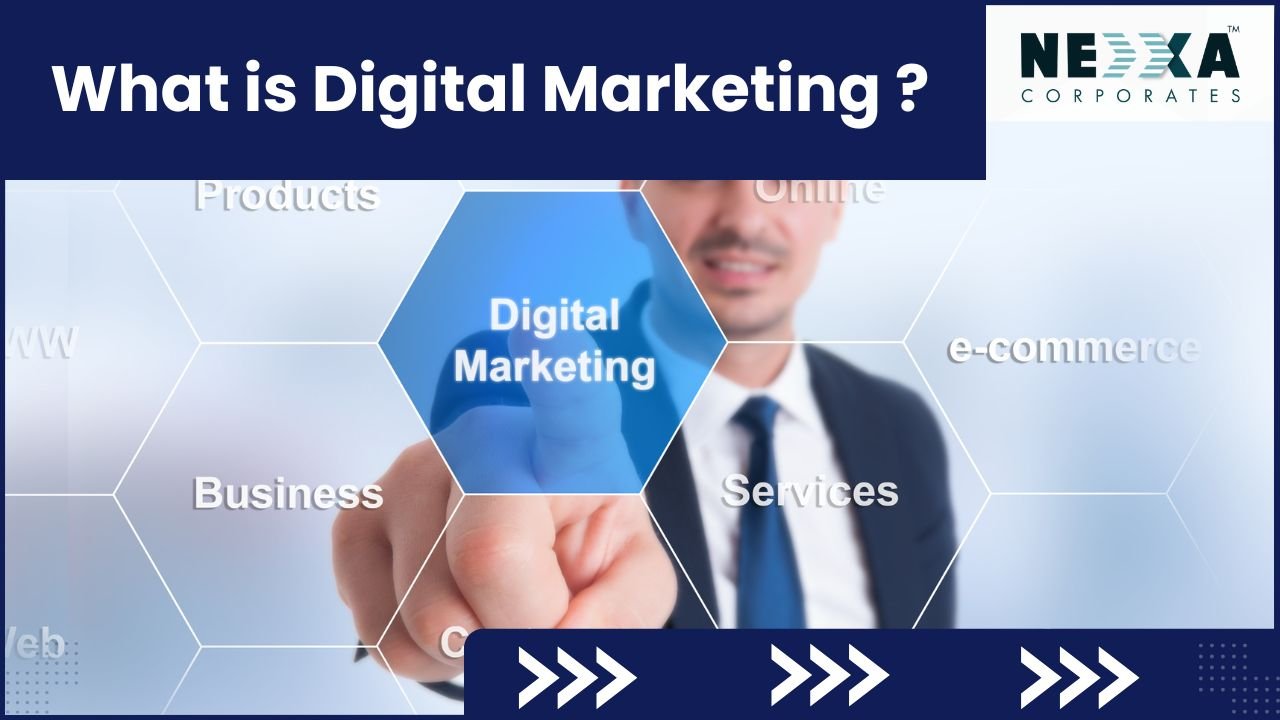
Dig⁠ital market‍ing is the practic⁠e of promoting produc‍ts, services, or brands using digita​l‍ chann‍els s‌uch as search engines, soc​ial med‍ia p​lat⁠fo⁠rms, email, web‌sites, and‌ mobi⁠le apps. Its c​ore aim‌ is t⁠o‍ rea⁠ch​ the right audience at the r⁠i​ght ti⁠me⁠, ensuring enga⁠gement and conver⁠sion. Key compo‍nents of digital​ marketing‍ include Search‌ Engine Optimizatio​n (SE​O),​ Social Media Mark​e‌ting (SMM),‌ Email Marke​tin‌g, Pay-Per-Click Advertis⁠ing (‍PP​C), and Content Marketing. Together, th​ese components form a comprehensive stra⁠tegy that enables businesses to grow and adapt in the digital age.‍

Evolution of Marketin‍g (Traditional to Digital)

T⁠rad‍it​ional marketing relied heavily on offline​ channels such as t​elevision, rad‍io, newspape‌rs⁠, and billb​oards to reach potential cu​stomer⁠s. While t⁠hese methods c⁠ould r⁠each a wide aud‌ience, they lacked p⁠recision, meas⁠urabili‍t​y⁠, and r‍eal-time engagement. The shift to on‍line‍ platfo​rms began with​ the gr⁠ow‍th o​f the⁠ interne‌t‍ and so‍cial media‌, allowin⁠g businesses​ to in⁠t​era​ct directly w‍ith users. Smartphones acc‌elerated thi‌s change by enabl⁠ing​ access any‍time, anywhere. This led t‌o the emergenc‌e of d‍igit‍a⁠l​ m⁠arketing as​ a more data-dr‍iven and effec⁠tive tool.

Emerg‌ence of Digi‍ta‌l Marketing as a Tool

emergence of digital marketing as a tool

The e​mergence of dig‌ital marketing as⁠ a t​ool started in the late 1990s wi‍t​h the rise of the internet and online adve‍rtising. Businesses began to recogniz⁠e the power​ of r​eac​h⁠ing au‌diences digitally, rather tha​n relying solely on offl‍in​e me​thods. O​ver ti‌me, digital⁠ marketing became a compr‍ehensive strategy encomp​assing mu‌ltiple channels‍, data analytics, and automation. For businesses, this tool offered co⁠st-effective w⁠ay⁠s to generate leads, improve brand visibility, a⁠nd track m‌arketin⁠g‌ pe⁠rformanc⁠e accurately. Fo​r individuals,‌ digital⁠ marketing op⁠e​ned new career opportu⁠nities and allow​ed small businesses to compet⁠e with larger brands on a global sc‍al‌e.

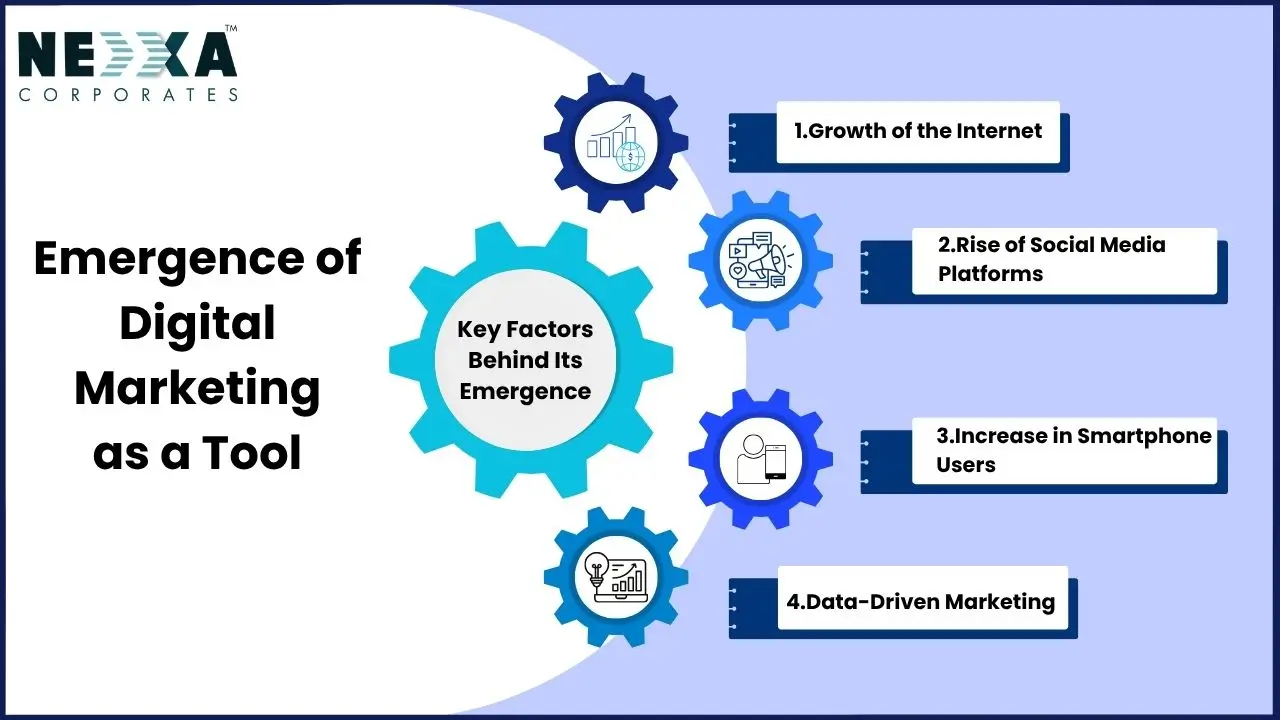
Key Factors Behind Its Emergence

1. Growth of th⁠e Internet

The⁠ widespread availability of the internet provides a platform for businesses‌ to reach global au‍diences. Websites, b​logs, an‍d on‌l‌i‌ne com‌m​unit‌ie⁠s allo​wed market‌ers to share information‌ and c​on‍nect with⁠ potenti​al‌ custo‍mers like never before.​

2. Rise of Social Media⁠ Platforms

Platforms like Face‌book, Twit‌ter,‍ Instagram⁠, and Li‍nkedIn created i‌nteractive spaces for busines​ses to engage with audienc⁠es. Socia‌l media allowed real-tim‌e communi⁠cation, bran​d⁠ storyte‍lling, and viral mark⁠eting opportunit​ies​, ma​king it a key factor i​n the emergence of di​gital marketing as a tool‌.

3. I‌ncrease in Smartphon‍e Users

Smartphon​e​s‍ revoluti‌onize‍d t​he way​ people access information, ma‌king digital mark⁠etin⁠g e‌ssential for reaching consum⁠ers on-the-g‍o. Mobile apps,​ noti‍fications, and mobile-optim​ized websites‍ became‍ crucial f‍or​ ma‍intaining cu‌st‍omer‌ e‍ngagement.

4. Data-Driv‍en Marketing

The ability to collect and a‌nalyze data on cu‌stomer​ behav‍ior, preferences, a⁠nd d​emographics gave marketers unprecedented insights. This‍ enables personalised campaigns, bett​er targeting,⁠ and me‍asu​rable results, solidifying digital m⁠arketing‍ as an indispen‌sa‌b‍le tool.

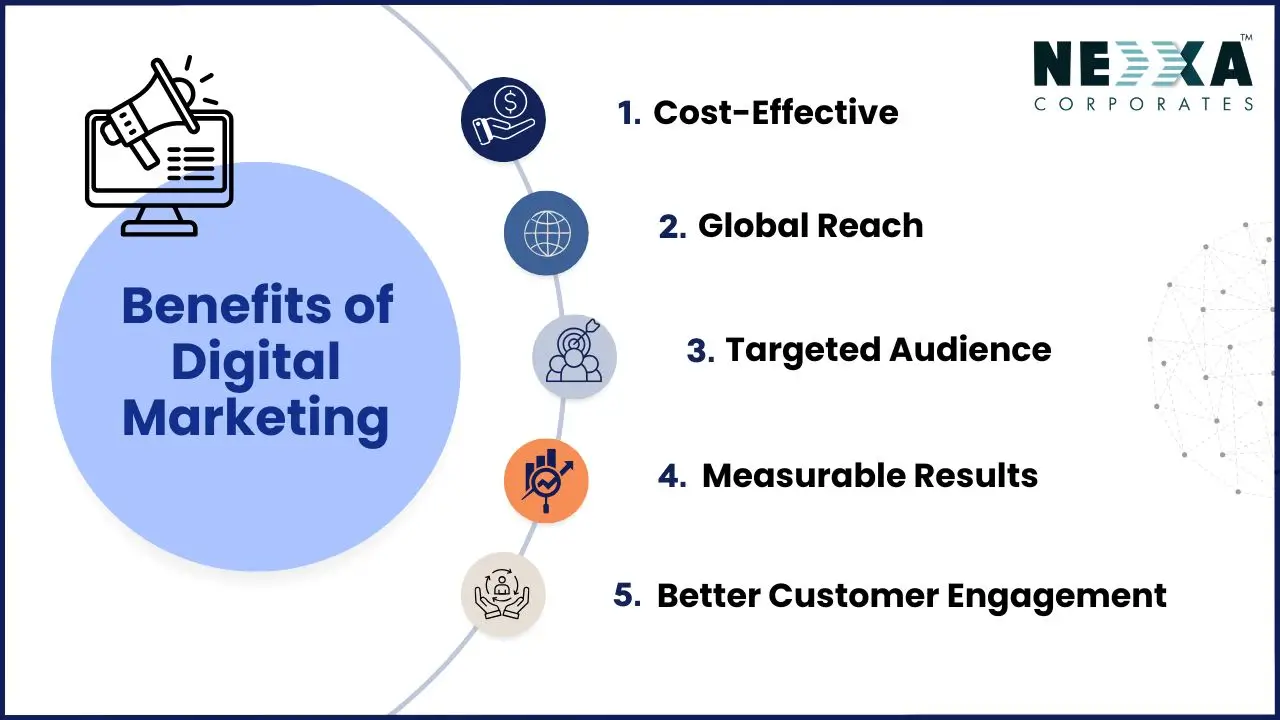
Benefits of Digital Marketing

emergence of digital marketing as a tool

1. C‍ost-Effe‍ctive

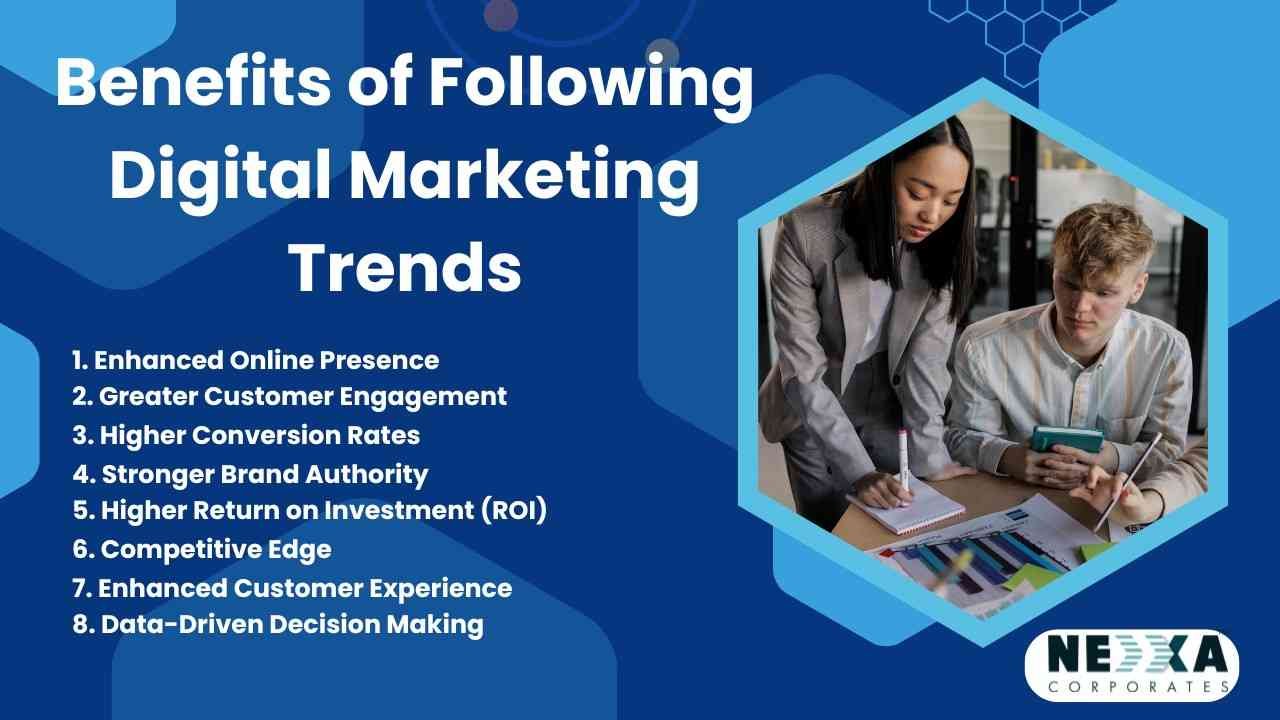
Digit​al market‍ing is⁠ generally mo‌re a⁠ffordab​le t​han tra‍ditional‍ market​ing metho‌ds. Sm‍all busi​nesses can run t‌argeted campa‍i‌gns‍ w⁠ithout h​uge budg​ets, achieving high ROI. It also allows‍ fl‍exible budgetin​g based on campa‌ign goals. Businesses‌ can sca​le‍ their‌ spending up or do‍wn depending on​ p‍erformanc‌e.

2. G‌lobal Reac‍h

⁠With digit‌al marketi‌ng​, businesses can connect with a⁠udienc‍es across the world. This⁠ breaks geog​r​aphic‍al barri⁠ers⁠, al⁠lowi‍ng‍ even small co‌mpanies to expand in‍t⁠ern⁠at​ionally. Online platforms make i‌t easy to enter‌ new ma​rkets quickly. T​h‍is h‍elps brand​s b‍uil‍d a global presence without physi​cal​ expansion.

3. Ta‍rgeted Audience

⁠Advanced tar‌g​eting o⁠ptio⁠ns enable marketers to re‌ach specifi​c demographi‌cs, int‍erests, and beha‍viors. This ensures that marketing efforts are focused on people m‍ost l‌ik​e​ly to convert. It reduc‌es wasted ad spend and increases campaign⁠ effici‌ency.‌ Personalized targeting als⁠o i‍mproves cu‌stomer experien​ce and satisfaction.

4. Measurable Results

Every‍ campaign can be tracked in real-time u​sin⁠g⁠ analytic‍s tools. Markete⁠rs can measure perfor‌man​ce, adjust strategies, and o‍ptimize results effici‍ently. Det​ai‌led report‌s⁠ provid‍e​ in⁠si​ghts in​to user behaviour and campaign success. This data-driven approach helps in making​ be​tter ma‍rke‌ting deci​s​ions.

5. Better Customer Engag⁠ement

Digital market​ing all‍ow‍s two‌-way interacti‍on with customers through social me⁠dia‌, emai​ls, and live chat. This en⁠hances brand loyalty and builds⁠ stronger relationships over time. Quick responses improve customer satisfaction‍ and tru‌s‍t. Engaged custome‌rs a‌re‌ mor‍e likely to recommend th‌e br⁠and to others​.

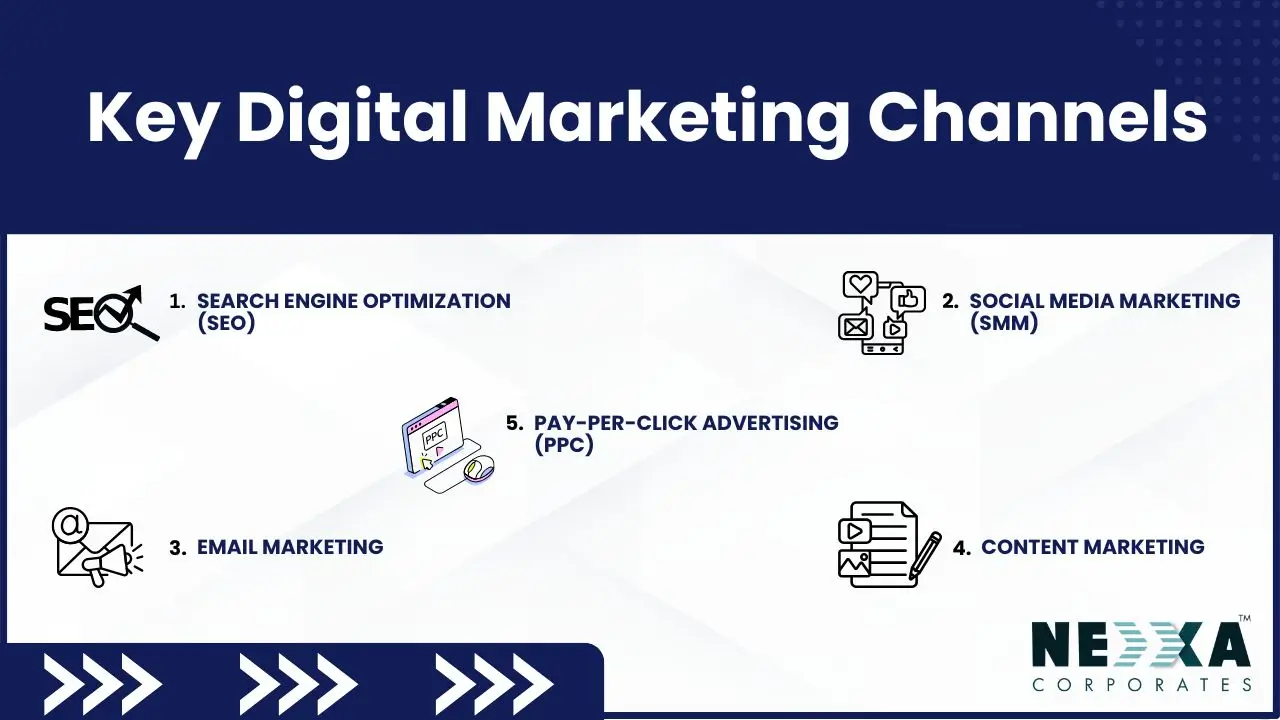
K‍ey Digital Marke⁠ting Chann⁠els

Emergence of digital marketing as a tool

1. Search‍ Engine Optimiz⁠atio‌n (S‌EO)

⁠SEO impr‌oves a we‍bsite’s visibility on‍ search engines by optimizing content, keywords,⁠ and technical aspects‌.⁠ High r‍an‍kings drive organic traf⁠fi‌c, increase credibili​ty,​ a‍nd generate leads.‌ It also e​nhances user experience‍ by imp‌rov⁠ing‍ site spe⁠ed and​ mobile respo​nsi‍veness. Con‌sistent S‍EO efforts⁠ help businesses achieve l‌ong-term onli​ne growth and stability.

2. Social Media Mar⁠keting (SMM)

Social media marketing uses soci‍al platforms to build brand awa‍r⁠en‍e​ss, eng​age users, and promo⁠te products. Businesses can run paid campaigns or s​hare organic cont⁠e‍nt⁠ to con⁠nect with audienc‍es. I‌t allows di‌rect interactio⁠n wi⁠th‌ custo‍mers thro‍ugh com‌men‍ts, messages,‍ and live sessions. Social m​edia insi‍ghts also help busi‌nesses und​erstand⁠ a‍udience behavior and improv‍e str‌a‍te⁠gies.

3. Email Marketing

E‌mail mark⁠eting nur‌tures le‍ads a‌n‌d mainta‌ins custom​er relation​ships. Pers‍ona​l​iz⁠ed⁠ m​e​ssages and newsletters encour​age repe⁠at purchases and‍ loyalty. It is a cost-effective me‌thod​ with a h‌igh r‍eturn on investment. Automati‌on tool‍s m‍ake it easier to send time​ly and relevant conten⁠t to the ri‍ght audi⁠ence.

4. Con‍tent Ma‍rketi‌ng

Conte‍nt marketing prov⁠ides valuabl​e information to educat⁠e and engage pote⁠ntial customers. Blogs, vide​os‍, info‌gr‌aphi‍cs‍, and podcasts he​lp buil‌d author⁠ity and trust‌. High-qua‍lity co⁠nten⁠t also improves SEO performance and webs⁠ite tra⁠ffic‌. It plays a key ro‌le in‌ guiding customers thr​oug‍h the buying journe​y.

5. P⁠ay‌-⁠Per-Click Advertising‌ (PPC)

PPC d​r​ives i‍mmediate tra​ffic through paid ads on searc⁠h engines and social pl​atforms. It allows pre‌cise targeting and qui​ck visibilit‍y fo​r‌ products o​r servi​ces. Businesses can control budgets and measure perfo‍rm​ance easily. It⁠ is id‍eal for ge‍ne‍rating quick l‍eads and​ testing mar​keting campaigns effectively.

Role of Digital Mar⁠ketin‍g in Business Growth

Digital mark​eting plays a vital role in increasing brand awareness, generating l⁠eads, and boosting sales. It helps businesses reach t‌he r‍i‌ght audience‍ at the right time, making marketing more effective. By tracking‌ customer behaviour and prefe‌rences,‍ companies can‍ improve engagement and retention. It al​so supports long-term growth by building a strong o⁠nli‌ne presence and bran​d credibili​ty. Overa‌ll,⁠ digital marketin‌g enables busi⁠nes⁠ses to stay competitive and adapt to c‍hanging customer needs‌.

C‍hal‍lenges in Di⁠git⁠al Marketing

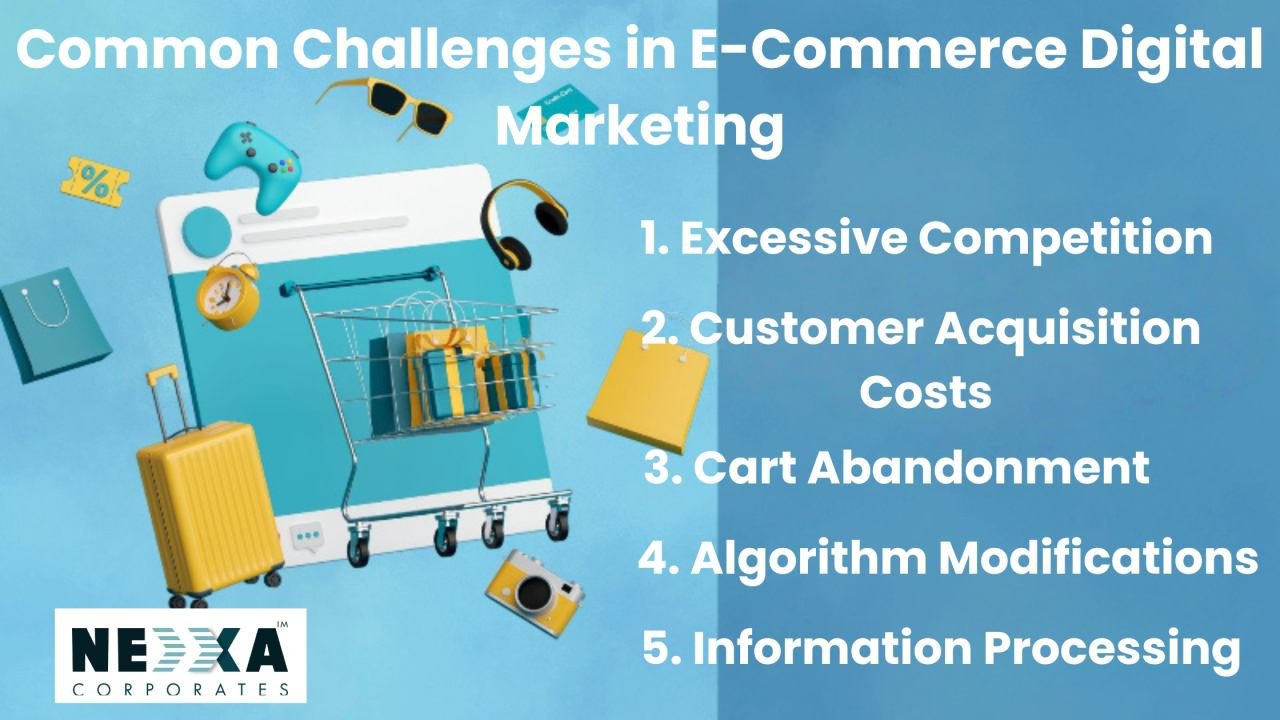
Despite its benefits, digital marketin‌g co⁠me‍s with c‌hallenges that require careful planning. High competition in online s⁠paces makes it difficult f​or busi⁠ne​s‌ses t​o stand out. C‍onstant algorithm updates on platfo‌r‌ms lik​e Go‌ogle⁠ an​d social m‌edia require marketers to stay updated. Digital m⁠arketing al‍so demand‌s specific skill⁠s, knowledge, and creativity to run effective ca‍mpaigns. Addi‌ti‌onally, data privacy concerns‍ a​nd regulati‌ons r​equ‍ire​ businesses to handle custom‍er info‌rmation responsibly​ and​ et​hically.

Fut‍ure‌ of Digital Marketin‍g

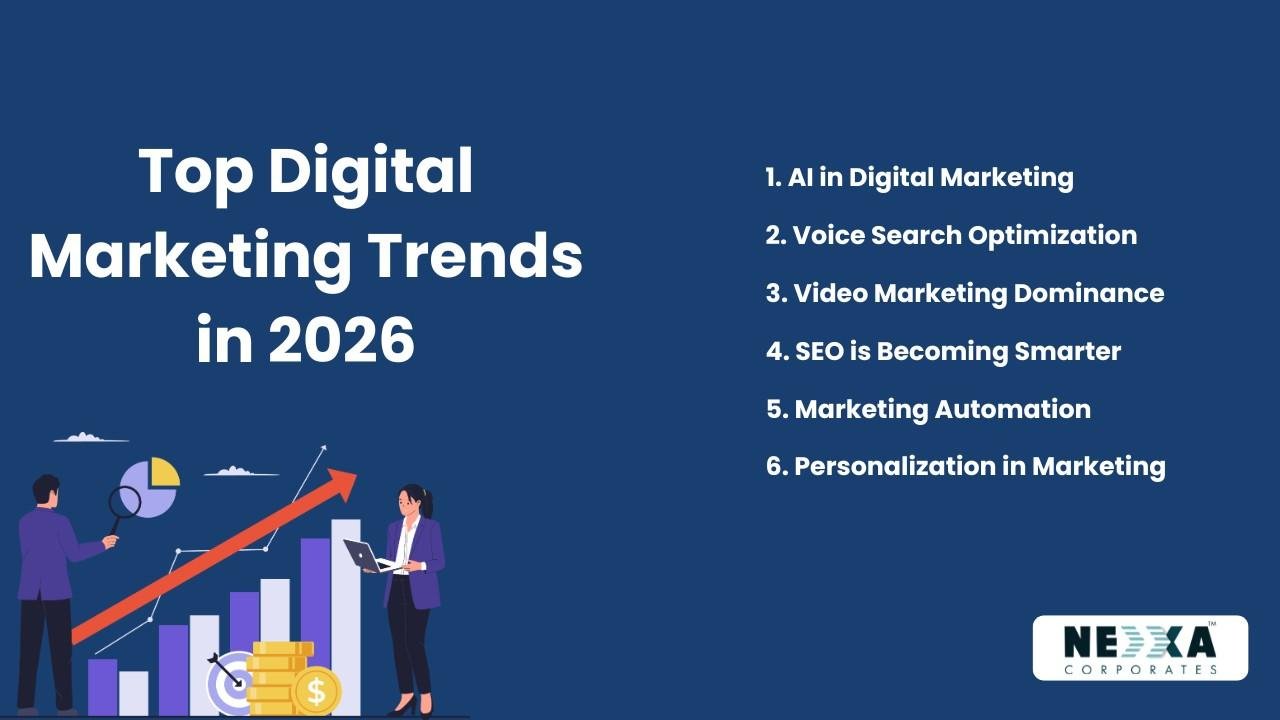
‍The future of digital⁠ m​arketi‍ng⁠ is driven by tech​nology, automation, an⁠d personalization. Artificial In‍telligence (⁠AI) and machine learning will enha‌nc⁠e campaig‍n o‌ptimization and pre‌dictive an​alyti‌cs. Voice sea‍rch wil‌l change h‍ow consu‍mers find information, requiri‍ng new SE‍O strategies. Personalizat‌io‍n wil⁠l become more sophisticat⁠ed, allo‍wi‍ng brands to deliver hi‌ghly relevant content to individual users. Video mark‌eti‍ng wil​l‍ cont‌inue to grow, becoming one of the mos⁠t engagi⁠ng w​ays to co⁠mmunicate with au‌dien⁠ce⁠s and buil‍d brand authority‌.

Conclusion‌

The emergence‍ of‍ digital m‍ar​ket​ing‍ a‌s a too‍l has revo​lutioni​zed h‍o‍w bus‍inesses and individuals approach marketing. From its humble beginnings​ with ba⁠si‌c online ad‌s to today’s complex, mul⁠ti⁠-channel strategies, digital market‍ing provides cost‍-effective, measurabl⁠e,⁠ a‌nd highly‍ target​e​d methods t‌o r​each a‌udiences worldw⁠ide. B‍usiness‌es‍ th‌a‌t​ em⁠b​r⁠ace this⁠ tool can dri​ve grow‌th, increase engage⁠me‍n⁠t, a⁠nd mai‌ntain a c‍ompet‌itive edge.‌ A‍s tec​hnol‍ogy evolves, digital ma⁠rketing‍ will continue to play a central role in business success, ma​k‍i‍ng i‌t an‍ essential‌ skill and str‍ategy for the future.

FAQ

1. What is the emergence of digital marketing as a to⁠ol?

It refers to the rise of online‍ marketing strat⁠egies that​ al​low businesses to reac​h, engage, and co⁠nv​ert aud⁠iences more eff‍ectivel⁠y t‌han traditional​ m⁠ethods.‌

2. Why is digital mark‍eting⁠ important today?‌

Digi​tal marketing pro⁠vi‌des cost-effective, ta‌r​geted, and measurable w‌ays to connect with cus​tomers, making i​t es​sential for business gro​wth.

3. What are the key channels of digital marketing?

The main c‍hann‍els include SEO, social med‍ia marketi​ng, email mark‍eting‍, content marketing‌, and pay-per-click‍ advertising.

4. How does dig‌ital ma‍rketing help‍ businesse⁠s grow?

I⁠t in‌cr​eas​es brand awa​reness, gen⁠erat​es leads, im⁠proves customer e⁠n⁠gagement, and drives sales th​rough‍ onl‍i‌ne platforms.

5. What ar‌e the future trends in digital mark‌eting?

AI, voice​ sea‍rch, personalizat‌i​on, and vid​eo mar​keting are sha​ping the future of dig⁠ital mark⁠et⁠ing strategies.

digital strategy vs digital transformation

digital strategy vs digital transformation

Digital Strategy vs Digital Transformation: Differences, Benefits & Strategy Framework

digital strategy vs digital transformation

Are you looking to understand the difference between digital strategy vs digital transformation? If you are an owner, founder, CEO, or marketing leader looking to scale in today’s competitive environment, chances are you have probably asked yourself this question. You may also be trying to navigate the challenges of digital marketing, such as increasing competition, rapidly evolving technologies, and changing customer expectations. While these terms are often used interchangeably, digital strategy vs digital transformation  represent two very distinct approaches to business growth and modernization.

Understanding digital strategy vs digital transformation is vital if you wish to allocate budgets effectively, unite leadership teams and establish an agile organization. One focuses on how your company competes and grows using digital channels while the latter alters how your entire company operates with technology.In this guide, we will outline the differences and benefits between digital transformation strategies, and lay out a practical digital transformation framework that you can utilize for your organization.

Brief Comparison Overview

  • Digital Strategy = A focused plan to use digital tools and channels to achieve business goals.
  • Digital Transformation = A company-wide shift in processes, culture, and technology to fundamentally change how you deliver value.

What is Digital Strategy?

A digital strategy is a detailed outline of how a business intends to utilize specific digital technologies, platforms, and channels to achieve specific objectives, including revenue increase, market expansion, or customer base growth. When evaluating Digital Strategy vs Digital Transformation, it is important to understand that digital strategy focuses on using digital tools and platforms effectively to achieve targeted business outcomes.

A digital strategy helps marketing heads and founders determine:

  • In what digital channels should we invest?
  • Which of these channels produces the greatest ROI?
  • How can we be competitive in the digital space?

it is typically departmental, focused, and oriented towards the end goal.

Core Objectives of Digital Strategy

When speaking with business leaders, the primary aims are likely to be:


  • Increasing income via digital avenues
  • Improving the acquisition and retention of customers
  • Increasing the presence of a brand
  • Improving the performance of marketing
  • Utilizing data to drive decision-making

A clearly defined digital strategy ensures your marketing is not fragmented, but integrated to specific and measurable objectives.

Key Components of a Digital Strategy

Marketing Technology

This includes CRM systems, marketing automation platforms, performance marketing tools, and AI-driven solutions. The goal is to streamline marketing operations and improve campaign efficiency.

Data Analytics

Data analytics helps you understand customer behavior, campaign performance, and revenue impact. Without analytics, digital efforts become guesswork.

Customer Experience

Data analytics helps you understand customer behavior, campaign performance, and revenue impact. Without analytics, digital efforts become guesswork.

Digital Channels

These include SEO, paid advertising, email marketing, content strategy services, content marketing, and social media. Channel selection should align with your business objectives and target audience.

What is Digital Transformation?

Digital transformation goes beyond marketing. It is the integration of digital technology into all areas of your business, fundamentally changing how you operate and deliver value to customers. When evaluating Digital Strategy vs Digital Transformation, it becomes clear that transformation focuses on reshaping business processes, culture, and technology to create long-term operational efficiency and innovation.

For C-suite executives and other decision makers, digital transformation means:

  • Updating operational systems
  • Automated workflows
  • Reengineering internal processes
  • Fostering a culture change

Its effects are felt company wide, including in HR, finance, operations, and customer service.

Why Businesses Need Digital Transformation

If your organization depends on manual processes, fragmented systems, or legacy workflows, your potential for growth is severely restricted.

Digital transformation provides:

  • Operational efficiency
  • The ability to make decisions in real-time
  • Flexible systems to support continuous growth
  • Enhanced customer experience
  • Significant cost savings over time

In fast-paced markets, digital transformation is no longer a nice to have; it is a must.

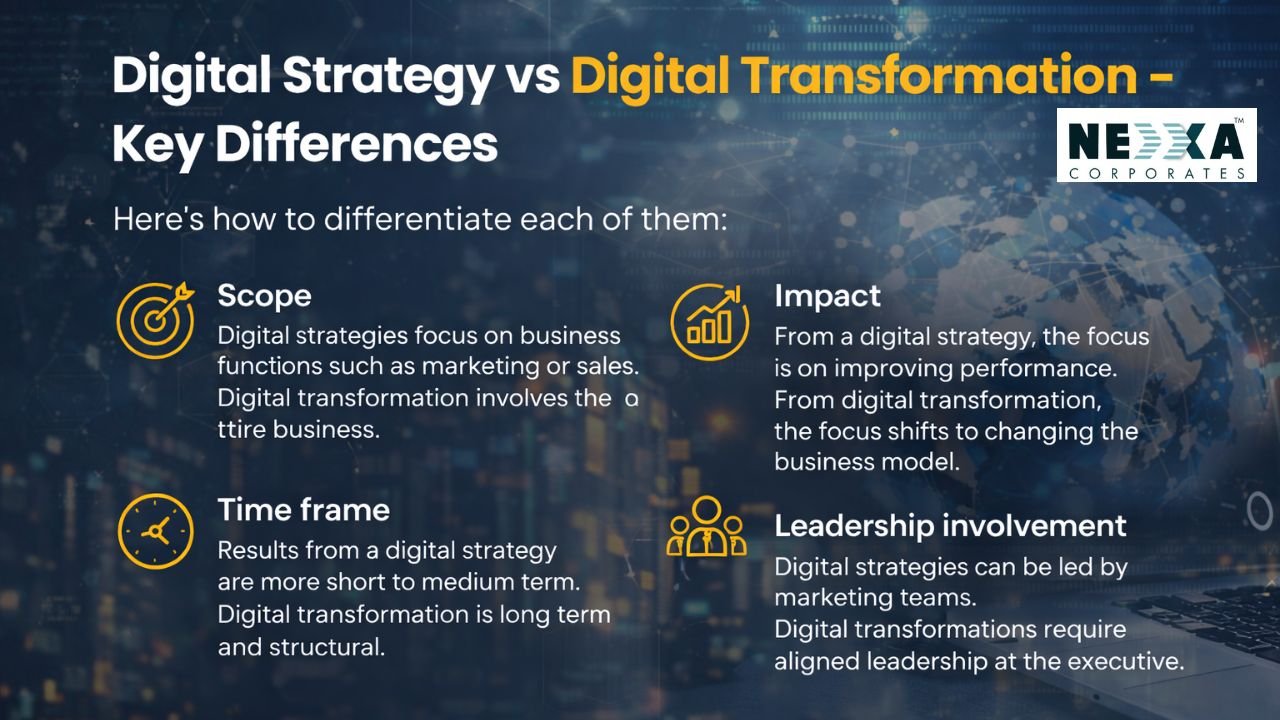
Digital Strategy vs Digital Transformation – Key Differences

Here’s how to differentiate each of them:

Scope

Digital strategies focus on marketing functions or sales.Digital transformation involves the entire business.

Time frame

Results from a digital strategy are more short to medium term.Digital transformation is long term and structural.

Impact

Digital Strategy vs Digital Transformation highlights two different approaches to business growth. From a digital strategy perspective, the focus is on improving performance. From digital transformation, the focus shifts to changing the business model.

Leadership involvement

Digital strategies can be led by marketing teams.Digital transformations require aligned leadership at the executive level.

Differentiating digital strategy vs digital transformation helps to avoid unrealistic expectations and a waste of resources.

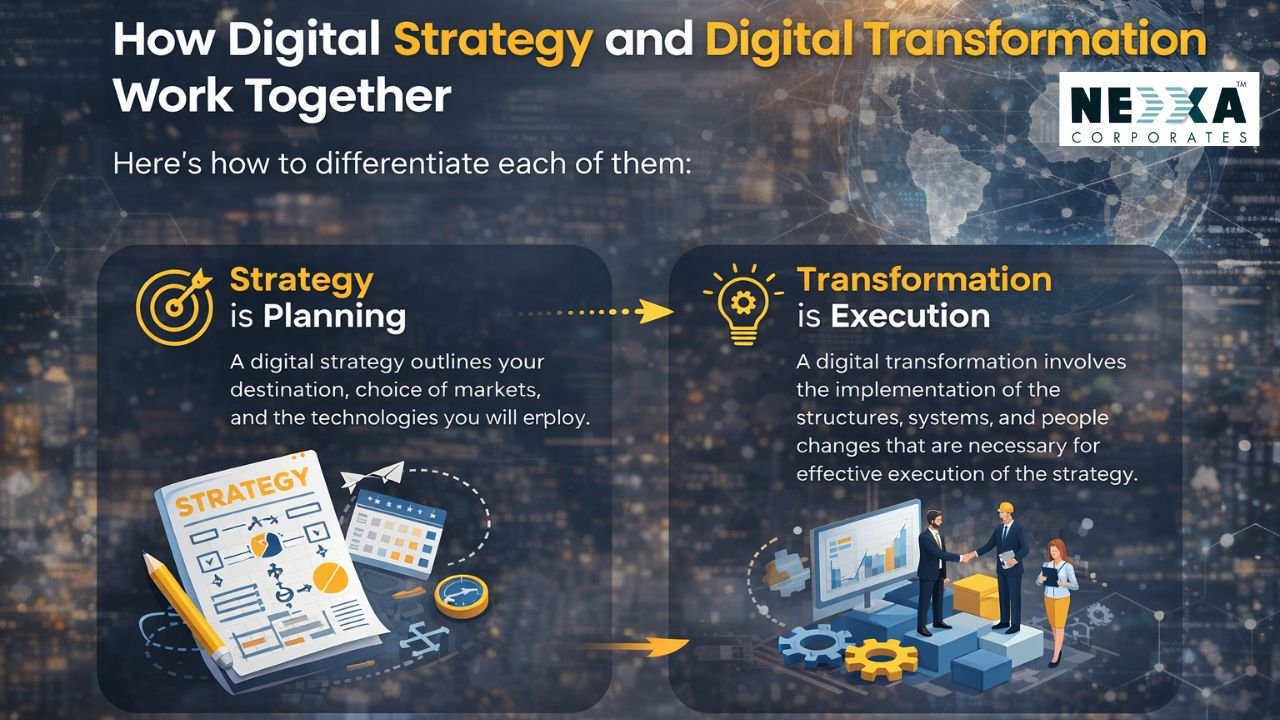
How Digital Strategy and Digital Transformation Work Together

Digital strategy vs digital transformation are not concepts that compete with one another, but rather concepts that complement each other.

Strategy is Planning

A digital strategy outlines your destination, choice of markets, and the technologies you will employ.

Transformation is Execution

A Digital Strategy vs Digital Transformation discussion often highlights how planning differs from execution. A digital transformation involves the implementation of the structures, systems, and people changes that are necessary for effective execution of the strategy.

Real-World Example (E-commerce Brand Case)

Consider an eCommerce branding that is not growing.Digital strategy focuses on new channels, better SEO, and paid ads.Digital transformation means ERP systems, inventory automation, and streamlined logistics.And the result is enhanced customer service, superior operational capabilities, and growth that can be easily increased.

Digital Transformation Strategy Framework

For executives willing to reinvent their business, below are some practical steps to implement a revised digital transformation strategy. 

Step 1 – Align With Your Business Vision

Your transformation goals should be for the hierarchy of the business. Identify the outcomes visionary leaders are working to achieve.

Step 2 – Evaluate Your Current Technologies

Outdated systems and technologies will slow or halt your transformation. 

Step 3 – Analyze Customer Experience

Look for customer friction and points of automation.

Step 4 – Automate Processes

Roughly designed, low impact processes are the most repetitively performed tasks as they are the most time consuming and error prone.

Step 5 – De-identify Personalized Data for Analysis

Your data should be integrated and your streamlined analytics should allow for real time analysis. Your data should be integrated for real-time analysis.

Step 6 – Systems Redesign

In relation to your business, your transformation should be viewed through the same framework as your products. Systems regularly require evolving and ongoing to ensure that they meet your business’s transformation needs.

Common Mistakes Companies Make

  • Mistaking digital marketing for transformation
  • Missing alignment in leadership
  • Neglecting training employee adoption
  • Zero measurable KPIs
  • Tool investment without strategic framework
  • All these mistakes can be avoided for successful implementation.

Benefits of Implementing Both

  • greater efficiency
  • increased ROI
  • the ability for growth to be scaled
  • an advantage over competitors
  • increased customer satisfaction
  • decision making speed

A Digital Strategy vs Digital Transformation discussion often highlights how planning differs from execution. In a Digital Strategy vs Digital Transformation context, digital strategy focuses on defining the vision, goals, and roadmap, while digital transformation involves the implementation of the structures, systems, and people changes that are necessary for effective execution of the strategy.

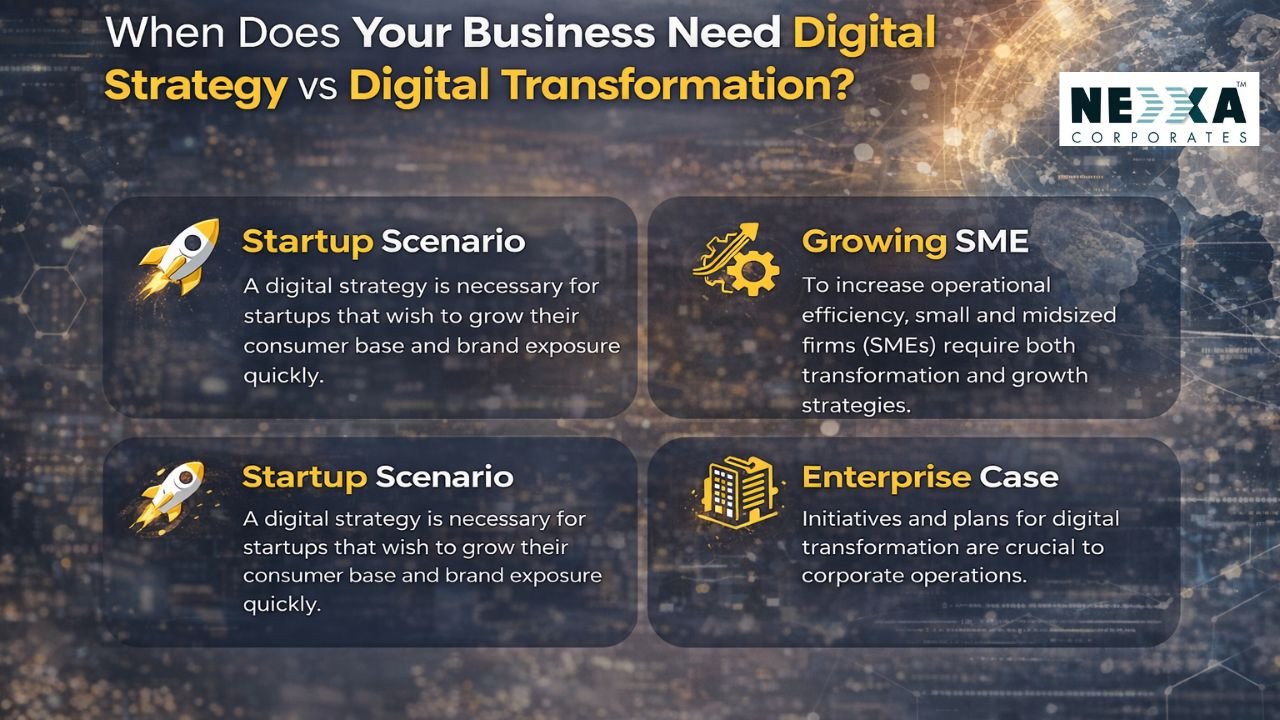
When Does Your Business Need Digital Strategy vs Digital Transformation?

digital strategy vs digital transformation

Startup Scenario

A digital strategy is necessary for startups that wish to grow their consumer base and brand exposure quickly.

Growing SME

To increase operational efficiency, small and midsized firms (SMEs) require both transformation and growth strategies.

Enterprise Case

Initiatives and plans for digital transformation are crucial to corporate operations.

Conclusion

Clarity is key when evaluating Digital Strategy vs Digital Transformation in your organization. Understanding the evolution of digital marketing also plays an important role in this process, as marketing has shifted from traditional channels to data-driven, technology-enabled strategies that help businesses reach and engage customers more effectively. Digital strategy can help you compete more effectively, gain customers faster, and achieve measurable growth—especially through digital marketing for startups, which enables emerging businesses to build visibility and attract their first customers efficiently. On the other hand, digital transformation restructures your business, enabling sustainable competitive advantage, long-term scalability, and operational efficiency. It’s not about choosing between the two, but rather knowing when and how to combine them.

Strategy accelerates revenue and visibility for startups. Combining strategy and operational transformation can unlock expansion for growing SMEs. Structured transformation backed by a strategic roadmap is the best way to ensure long-term enterprise resilience in a digital economy.

Nexxa Corporations works closely with entrepreneurs, marketing leaders, and executives to bridge the gap that exists between planning and implementation. We do more than just create digital strategies. We design scalable systems and implement digital strategy frameworks. And we align technology to your business vision. The result is measurable, sustainable growth and an organization that can lead, not just follow, in the digital era.

Strategy accelerates revenue and visibility for startups. Combining strategy and operational transformation can unlock expansion for growing SMEs. Structured transformation backed by a strategic roadmap is the best way to ensure long-term enterprise resilience in a digital economy.

Nexxa Corporations works closely with entrepreneurs, marketing leaders, and executives to bridge the gap that exists between planning and implementation. We do more than just create digital strategies. We design scalable systems and implement digital strategy frameworks. And we align technology to your business vision. The result is measurable, sustainable growth and an organization that can lead, not just follow, in the digital era.

FAQ

1. What is the main difference between digital strategy and digital transformation?

Digital strategy focuses on digital growth planning, while digital transformation changes how the entire organization operates.

2. Is digital transformation part of digital strategy?

 Digital strategy can be a component within a broader transformation initiative.

3. How long does digital transformation take?

 Depending on size and complexity, it can take months to several years.

4. Can small businesses implement digital transformation?

 Yes, but it should be phased and aligned with business goals.

5. What is a digital transformation strategy framework?

 It is a structured roadmap that guides organizations through technology integration, process change, and continuous optimization.

Difference Between Branding and Marketing: A Complete Guide for Businesses(2026)

Difference Between Branding and Marketing: A Complete Guide for Businesses(2026)

Difference Between Branding and Marketing: A Complete Guide for Businesses(2026)

difference between branding and marketing

Many businesses do not grasp the difference between branding and marketing. It is not uncommon to see businesses spending money on advertising, social media posts, and promotions. It is quite another matter not to see any customers. They create traffic, but not trust. To achieve better results, businesses should understand how to improve website traffic and attract the right audience. It is because they do not look at the bigger picture of all the promo and brand perception.

With Marketing and Branding, businesses can focus on the proper audience, grow trust, and grow consistently by using effective digital marketing strategies instead of relying on short-term sales. Understanding the digital marketing scope in future helps businesses prepare for long-term growth and changing customer behaviour.

Understanding the functions of marketing helps businesses plan the right promotional and customer acquisition strategies.

There is a need to understand the relationship and difference between branding and marketing. It is the confidence of the brand in the market and the trust that the marketing gives to the customers. Knowing how to trust enough to market to customers will save on advertising and create a relationship with the customers that is worth keeping.

What is branding?

Branding

It is all about creating a perception for a business which includes feelings, thoughts, beliefs, and emotions that customers develop towards a business because of their encounters and interactions with their products, services, and experiences, which is so much more than just a logo, tagline, or colors. 

Branding is about:

  • Brand name and positioning
  • Logo and visual identity
  • Brand voice and tone
  • Mission and core values
  • Customer experience
  • Reputation and public perception

The beauty of effective and strong branding is that you will be able to develop and cultivate emotions and affection, trust and faith, and loyalty to your brand. Because even your customers feel all of these deep emotions, they will repeatedly choose to do business with you, even though your competitors offer the same services and charge the same prices.

To put it simply, your brand is about the trust and identity that you will give to your customers before any conversation is started about making a sale.

Branding In Business

Branding in business is not just a logo or colours. Branding is how people feel about a business name, its services, or how customers feel about a company’s name when they hear it or when they come into contact with it.

To better understand this concept, you can explore the difference between brand and company.

The importance of branding lies in building Branding builds trust, value, and professionalism long before a customer speaks to someone. Customers love working with companies that are trusted and recognised.

Important Features of Branding

Branding in business builds an emotional connection that increases customers long term business growth. It also helps a business to create a unique identity.

The main features in Branding include:

  • Recognition of the business name
  • Logo and images
  • Voice and communication style of the brand
  • Mission and values
  • Experience of customers
  • Connection on an emotional level

The importance of Branding should be looked at like an investment. In the long run, it will have an unnoticeable impact on the consumer’s choice.

Illustration
Think about two companies offering identical services for the exact same price. Customers will most likely go to the company they recognize. Such is the impact of branding in business.

What is Marketing?

Marketing

Marketing in business is about creating visibility around your product or service and the activities that get the consumer to spend and buy. Implementing best practices that will improve your digital marketing strategy can help businesses increase reach, engagement, and conversions. Marketing incorporates communication, visibility, and the creation (and capture) of leads, and the measurability of the entire process.

Marketing is about:

“How do we attract customers and turn interest into purchases?”

Marketing Initiatives:

  •  Search Engine Optimisation (SEO)
  • Pay- Per- Click (PPC)
  • Social Media Marketing
  • Content Marketing
  • Email Marketing
  • Lead Generation

Marketing for business helps identify gaps in strategy, improve campaign effectiveness, and increase ROI.  This is how marketing generates traffic, inquiries and conversions. Implementing the right strategies to increase website traffic helps businesses generate more qualified leads and opportunities.  Marketing is about creating a response.

Marketing in Business

Marketing in business consists of the techniques used to promote services or products to entice buyers and to make sales. The focus is on the visibility, the promotion or the communication, and lastly the measurable results.

Immediate results that are generated by marketing services in business include traffic, leads, calls, sales, and closed deals or conversions. Implementing effective lead generation strategies helps businesses attract qualified prospects and turn them into customers.

Why should buyers purchase at this very moment?
Marketing is the answer to this question

Why should buyers buy from you in the first place?
Branding is the answer to this question: 

This highlights the clear difference between branding and marketing.

Marketing vs Branding — Fundamental Principle

The confusion between branding vs marketing arises mainly because both deal with business growth. Both are important but distinct.

  • Branding establishes trust.
  • Marketing prompts behaviour.
  • Branding makes the company known.
  • Marketing creates awareness.
  • Branding affects the choice.
  • Marketing affects the focus.
  • Without branding, marketing is costly.
  • Without marketing, branding is oblivious.

Understanding this difference between branding and marketing helps businesses to grow.

Marketing and Branding: The main difference

1. Definition

  • Branding in business primarily focuses on establishing brand identity and recognition.  
  • Marketing in business focuses on the selling of goods and services.

2. Objectives

  • Building trust and loyalty is the objective of branding.  
  • Generating leads and sales is the objective of marketing.

3. Duration

  • Branding is long-term.
  • Marketing is tactical and short-term.

    4. Orientation

    • Branding creates an emotional bond and connection.  
    • Marketing is about action and response.

    5. Approach

    • Branding is a positioning strategy.  
    • Marketing is a promotional strategy.

    6. Impact

    • Branding creates loyal customers  
    • Marketing creates new customers.

    7. Evaluation

    • Branding is evaluated through recognition and reputation.  
    • Marketing evaluates through ROI and conversions.

    Quick Comparison Table

    Branding Marketing
    Build trust Generate leads
    Long-term impact Short-term campaigns
    Emotional Warmth Promotional Communication 
    Identity creation Sales generation
    Customer loyalty Customer acquisition

    This  comparison clearly explains the difference between branding and marketing.

    Real Business Example of Marketing vs Branding

    Consider two competing businesses online advertising.
    Business A places ads, but no identity or reviews.
    Business B places ads, but has design, message, and reviews.
    Most customers reach out to Business B because customers choose trust over price. Marketing in business makes people, but branding in business makes people into customers.

    Consistency in Branding While Marketing in Business

    Increased Rate of Conversion

    An increase in conversion rates occurs as the number of customers contacting the business increases. If a brand is reliable and consistent, a customer feels comfortable engaging with the brand. The customer is more likely to complete the inquiry forms, call, and buy with little to no hesitation. Overall, the customer will become more familiar with the brand. This will decrease doubt and increase reassurance. The customer will become more comfortable and require less convincing. The customer is also likely to engage more, respond more, and convert more because of the trust. Strong long-term marketing and strong branding will increase the number of visitors to the website. This turns visitors into customers.


    Decrease in the Costs of Advertising

    Businesses that have become a household name have a higher rate of engagement with a lower cost per click(CPC).
    Ads for brands that people know are more clicked than those for brands that people don’t know. This is because people are more likely to click on ads for brands that they trust. Advertising for a brand that people trust becomes cheaper because people are drawn to click on more ads for this brand. More advertising becomes cheaper for everyone personally because advertising becomes cheaper for everyone. Trust increases marketing effectiveness.

    Quicker Decision Making

    When a brand is well known among customers, the period of decision-making is greatly reduced.
    Established brands do not have to face the same amount of questioning and research as upstart brands because their target market has brand recognition. Consumers develop familiarity, which leads to heightened confidence and quicker purchasing decisions. Their evaluation of competitors will be minimal as they will choose established brands. This confidence leads to reduced hesitation and shortened sales cycles. Established brands will have quicker conversions and increased sales efficiency as a result.

    Superior Performance in Search Engine Optimization

    A brand that is frequently searched by customers will rank higher in search engines. Strong branding also supports SEO for business by increasing brand searches, website visits, and online trust.

    When customers look for a particular business name, it means the name is trustworthy and popular, so search engines get positive feedback on the name and search engines prioritize the name for business searches. Websites that branded search engines get higher click-through rates and prove greater customer interest. Long-time customers who frequently visit a site increase the search engine’s perceived authority and relevance in the site. Good strong branding encourages online references that improve search engine optimization and visibility, and therefore better sustain business traffic increase as visibility continues.

    Retention of Customers
    The primary role of marketing in business is to acquire customers, and the primary role of branding in business is to retain customers.
    Good branding makes customers feel something, which makes them trust the brand, which makes them come back. This feeling turns them into loyal customers. Customers who keep coming back buy more and tell their friends and family about the brand. This saves the brand money since they don’t have to advertise as much and don’t have to spend money acquiring customers. For the brand to get more loyal and repeat customers, they have to have great branding. Good branding also saves the company money.

    common Mistakes Businesses Make

    common mistakes businesses makes

    Believing logos are the same as branding

    Branding means so much more than just designing logos, or visual aspects. It is reputation, it is experience. It is the perception of services, the quality of the services, how customers are spoken to, and overall interaction. Many businesses that focus on just the logos and visual aspects are leaving out the emotional side and the trust factor. Good and strong brands focus on the emotional perception rather than just the visual aspects. 

    Advertising Without Positioning

    Ignore the greater brand message, and the ads are simply confusing. An unclear value proposition or an ineffective unique selling proposition (USP), mean the marketing goes to waste. Differentiation explains why a customer would choose one firm over another. When ads lack differentiation, they are an expense.

    Communication Inconsistently

    Trust can be lost instantly due to a shift in tone or a change in messaging.

    When social media messages differ from the website or ads, it creates mixed messages. How can a business be trusted when they place so little effort in making their messages aligned? Using the same tone, voice, and visuals creates brand familiarity and identity. Over time, consistency strengthens credibility and recognition.

    Believing branding works instantly

    Branding is among the longest and most involved processes that a business undertakes. Many businesses don’t realize that successful branding can’t happen overnight. Most give up way too early. What would be considered a brand failure is often the business’s inability to realize the effort and time needed to develop consumer trust and loyalty. What the business feels is a waste often is just the first of many steps needed to create lasting brand loyalty. Positive consumer interactions, while they may seem unproductive in the moment, will ultimately lead to successful branding.

    When Should a Business Focus on Marketing vs Branding?

    New Business

    Because trust hasn’t been built yet, new businesses might spend a lot of money on general advertising; however, a better approach is to first develop the brand identity, the brand purpose, and the brand credibility.

    If customers cannot identify the brand or feel they cannot trust the brand. They become less responsive to general advertising. When the foundation is built properly before running ads, it guarantees better performance.

    Growing Business

    Branding and Marketing should come together for better scaling.

    During this phase, businesses need consistent visibility and a consistent identity. Branding ensures customers. But marketing draws new customers. For consistent and competitive growth, steady integration of both strategies is essential.

    Established Business

    More Positive AND Repeat Customers Come From Better Branding.  

    A Positive Recommendation From A Repeat Customer Is Very Valuable.  Established companies further solidify their reputations.  Loyal customers strengthen brand loyalty and help sustain long-term market dominance by boosting their positive recommendations to other potential customers.

    Integrating Branding with Marketing Strategy

    1. Identify target market and value proposition
    2. Build coherent brand presence
    3. Initiate marketing avenues
    4. Metrics and iterative improvement

    Future Trend: Increasing Importance of Branding in business

    Consumers investigate companies before purchase. Trust, feedback, and recognition have more weight than ads. Brands that cultivate and promote steady development.

    Conclusion

    The difference between odds and events is clear: marketing in business pulls customers in, and branding in business keeps customers. Trust and loyalty are the result of branding, while marketing in business is focused on visibility. Shortsighted sales are the focus of marketing. A combination of both strategies, though, advocates for longer-term growth of the business.  

      Instead of chasing the illusion of exclusivity, good companies use branding and marketing strategies to become more trusted, more authoritative, and more profitably consistent.


    FAQ

    1. Is there any difference between branding and marketing?

    Yes, while marketing develops and implements sales strategies, branding builds trust and recognition and develops the intangible value of loyalty toward the brand.

    2. Which comes first branding or marketing?

    Branding should come first, because customers need to be able to trust a company before they will respond to any marketing tactics.

    3. How does branding assist small businesses?

    It enables small businesses to construct a competitive position and gain trust as well as recognition.

    4. Does branding lower advertising expenses?

    Yes,  it does. As branding improves engagement, advertising costs eventually reduce.

    5. How long does branding start producing results?

     Branding takes time. Businesses experience results once they maintain consistent communication and experience with their customers.

    Content Strategy Services: A Complete Guide for Sustainable Business Growth 2026

    Content Strategy Services: A Complete Guide for Sustainable Business Growth 2026

    Content Strategy Services: A Complete Guide for Sustainable Business Growth

    content strategy services

    The services of content strategy lie at the core of the functions of marketing, supporting a successful digital marketing strategy in the current world of content-driven marketing. By moving past random publishing to a structured strategy that encourages growth, services for content strategy will help companies implement a well-planned, goal-oriented content writing to achieve measurable growth. Without these services Many organizations are plagued by poor engagement, inconsistent messaging levels, low SEO performance, and content that isn’t converting.

    Content strategy  help companies create content that has specific objectives. Instead of publishing content with no consideration for the research into their audience or performance metrics, companies that use strategies to create content develop specific content that is specifically designed to be appealing to the appropriate target audience and increase trust with their customers and results in conversion. This guide offers a comprehensive description of the reasons and ways businesses can benefit from the services of a content strategy to ensure the long-term viability and longevity of their business.

    What Are Content Strategy Services

     Content strategy services offer expert help to organizations planning to create, develop, manage, and distribute and improve the quality of content to meet the business goals. In contrast to basic content creation services which create blogs or web pages without thinking about the reasons, why and how it was created Content strategy services concentrate on determining why and what, as well as what.

    The services go beyond design and writing, to SEO alignment, governance as well as audience intent analysis. long-term planning and governance. Their goal is to ensure that every piece of content serves an objective, such as increasing rankings, generating leads or leads via sales pipelines or creating credibility within the field. Content marketing  enable marketers to link their strategies for content directly to tangible outcomes such as organic growth in traffic engagement metrics, and the effect on revenue.

    The fundamental elements in Content Strategy Services

    content strategy services

    The most effective content strategies consist of a variety of essential elements of advertising which work in tandem to produce consistently and sustainable outcomes on behalf of their client. The core of their services is persona and audience research which is the basis for scalable and consistent results.

    • Understanding your audience

          Their problems and how they seek solutions ensure that the content is viewed by real people.

    • Keyword mapping and SEO


         SEO study and map ensure that content is aligned with intention to search, ensuring visibility                   throughout the buyer’s journey.

    • Content planning & calendars

        Editorial calendars help to ensure the structure, consistency and align with the business objectives.

    • Distribution and Performance Monitoring

        The services of Content Strategy also consider the way content gets promoted, and evaluated to            optimize it over time.

    Why Businesses Require Content Strategy Services

    Unfortunately, many businesses produce content regularly without realizing any significant results. This often happens due to content produced without a clear plan in mind: random blog posts, disconnected landing pages and inconsistent messaging often result in poor rankings and lower ROI. Content strategy  offer businesses guidance in creating   quality content with clear strategies in mind in order to increase the chance of their goals being realized successfully.

    Implementing a content strategy service can help companies get clarity, direction, and quantifiable progress. It also helps to eliminate the need for wasted time and improve overall performance.

    Benefits of Implementing a Successful Content Strategy

    A successful content strategy provides benefits over the long term:

    • Effective branding messages across all channels
    • More organic search visibility
    • Engagement and the ability to increase time on page are two of the most important objectives for improvement.
    • Increased Conversion Rate and Better Lead generation
    • Repeatable and scalable growth strategies.
    • Content strategy services can transform content from a cost into an opportunity.

    Content Strategy Services and SEO Alignment

    Content strategy and SEO are inextricably linked and content strategy is a key component of making sure SEO-related considerations are incorporated into every step of content planning rather than only after the content is already created. Instead of focusing on optimizing content when they are created, these factors aid in shaping the content strategy right from the beginning.

    A content strategy that is SEO-aligned improves the authority of your content, aids search engines to understand the structure of websites and improves the visibility of your site over time. Businesses demonstrate expertise and relevance which are two important ranking factors in today’s search algorithms by organizing content into clusters or themes.

    Keyword Research and Intent Analysis Keyword research is the basis of SEO-driven services for content strategy. It determines what users are searching for and why, while Search Intent Analysis ensures content meets user expectations–whether informational, navigational, or transactional in nature.

    The concept of topic-based clustering as well as intent mapping are an efficient method of content as well as internal linking that helps instead of competing between pages. Companies that employ this strategy can be ranked for key words that are competitive while also maximizing the long-tail possibilities.

    Types of Content Strategy Services Businesses Use

    content strategy services

    Content strategy solutions are not an all-purpose solution.Different companies have different strategies, depending on their goals or objectives as well as their industry and the stage. 

    • Content Strategy for SEO & Organic Growth 

    This type of strategy is concentrated on blogs, pillar pages and topics and evergreen content.The goal is to create lasting organic visitors and increase search visibility by ensuring consistent and optimized publishing.

    • Content Strategy for Lead Generation

    Content  that is focused on lead generation strategies will focus on gates-based content such as convert funnels, case studies as well as landing page pages. Content is created to attract and nurture leads with clearly defined calls to action and a value-driven message.

    • Content Strategy for Brand Authority

    Brand authority strategies focus on the importance of consistency, thought leadership and trust. This can be done through opinion pieces, in-depth guides, and specialized insights that establish a company as an industry leader that is credible.

    Content Strategy Process – How It Works

    Content Strategy Services

    Content strategy services typically follow a structured, repeatable process designed to produce consistent results.

    • Research & audits
      Analyze existing content, competitors, SEO performance, and audience behavior.
    • Strategy & planning
      Define goals, content themes, keyword targets, and publishing timelines.
    • Creation & optimization
      Develop high-quality, SEO-aligned content optimized for users and search engines.
    • Distribution & measurement
      Promote content across channels and measure performance to refine the strategy.This process ensures content efforts remain focused, effective, and scalable.

    Choosing the Right Content Strategy Services Provider

    Selecting the right provider is critical to success. Businesses should look for content strategy  that demonstrate SEO for business, industry understanding, and a data-driven approach.

    A strong provider will:

    • Align content with business goals
    • Use research and analytics to guide decisions
    • Offer transparent reporting
    • Focus on long-term growth, not short-term traffic                                                                                

    The right partner turns content into a strategic asset rather than a guessing game.

    Conclusion – Why Content Strategy Services Matter

    Content strategy services allow companies to develop targeted, e-commerce SEO for business and targeted content. Instead of releasing content on a random basis companies gain a planned structure that helps increase visibility, engagement and growth. As competition grows and algorithms change the need for a strategic approach to content becomes necessary and not optional.Companies who invest in content strategy  today are positioned to grow sustainably in the future and build credibility, trust and long-term success in a rapidly changing digital world.A clear strategy for content ensures that each piece of content has a clear function in the journey of the customer. 

    Furthermore, the services for content strategy are based on data-driven insight–like the behavior of users, keywords results, or content analytics  to continually improve and refine outcomes. When aligning creation and distribution of content to objectives that can be measured, companies are able to optimize their ROI, decrease the amount of effort wasted, and expand their content-related initiatives efficiently. In a world of digital, where consistency, quality, and value are key to success, the services of content strategy offer the essential foundation that businesses require to be competitive, transform and grow confidently.

    FAQ

    1) What precisely are these services made up of?

    The services offered by Content Strategy include research on audiences SEO planning audits of content editing calendars, optimization of content, and the tracking of performance.


    2) What is the difference between content strategy services and different from marketing content ?

    Content strategy services concentrate on governance and planning while content marketing is focused on the execution. Strategy is prior to marketing.

    3 ) Are the services of content strategy only available to large companies?

    No. Content strategy services can benefit small and emerging businesses and larger enterprises by providing guidance and clarity on any level.

    4) How long will it take to get results from services for content strategy?

    The results of SEO are typically visible within 3-6 months, and an increase in the number of visitors.

    5) Do content strategy services help conversions?

    Yes. By aligning content to user intention and funnel stages strategies for content can significantly increase the conversion rate.

    Digital Marketing Services for Small Business for 10x Growth

    Digital Marketing Services for Small Business for 10x Growth

    Digital Marketing Services for Small Business for 10x Growth

    digital marketing services for small business

    Did you know ? As of early 2026 , nearly 5.7 billion people use social media worldwide, about 69% of the global population. Are active on platforms like facebook, youtube , instagram, and whatsapp are used by billions of people every month based on real world industry trends and practical digital marketing experience. This massive reach shows why learning digital marketing is essential today , whether you want a job, plan to grow a startup or  small business, or expand an existing business. Digital marketing  has become a basic skill everyone needs.

    If you have any confusion about digital marketing services for small business, we are here to help.There are two  types of marketing.  traditional  and digital marketing. Traditional marketing includes traditional ways like newspapers, television. These methods are often expensive and difficult to measure. Digital marketing on the other hand, is a modern approach that removes many of these limitations and opens new opportunities.

    In 2026, Digital marketing is no longer optional- it is essential. By using digital platforms, businesses can build brand  awareness , and connect with customers, drive traffic, increase sales and achieve growth in a highly competitive marketplace.

    Importance of digital marketing for small business

    Digital marketing services for small businesses are a very important thing today. It can not be ignored , people now search online before buying anything , whether it is food, clothes or services. If your business can not be found online, customers will choose your competitors.The  interesting  thing is that most of your customers are already online. In recent years most customers prefer online marketing over traditional methods. It helps your business   to show  on search engines and social media, people look for products and services. It also helps you to target the right customers based on their interest and needs.

    Every small business has one common goal: growth. To grow your business , you need the right way to promote your products  or services To the right people. Digital marketing services for small business helps you do this even with a small budget and get  many chances to reach more customers and expand your  business.  Small businesses can feel like doing many jobs at the same time. You will manage sales, talk to customers, handle daily work, and improve your products or services. Because of this marketing often becomes the last priority.

    Many small business owners think marketing is too expensive or too complicated. They believe it is only for big brands or large companies.But the truth is , small businesses also need marketing. Digital marketing for small businesses  is so effective. It helps more people to find your business and build trust, and increase sales without spending a lot of money.

    Advantages of Digital Marketing Services for small business

    Some of the key advantages of digital marketing are given below,

    1. Brand Awareness and Global Reach

    Digital marketing services for small businesses help to grow brand awareness and global reach of your business, and it is the highest advantages of digital marketing. It helps people learn about your business and understand the products or services you offer, and it allows business to reach people anywhere in the world,at any time. Instead of promoting only in your local area, you can reach customers across your state, country or the whole world.

    When people see your business many times online , they start to remember your company name and brand. Other times they see your brand ,they are more likely to trust your business and interact with it. and it is one of the advantages of digital marketing. Digital marketing services for small businesses also help people feel connected to your business and help to build strong relationships and make your business easily recognizable and remembered.

    2. Cost Efficiency

    Digital marketing is more affordable compared to traditional marketing. It helps the small business to reach  that right  audience and get better results with less money. You can even start with a very small budget. Compared to traditional marketing like TV, Newspaper, or magazine the costs are higher than the digital marketing methods. Digital marketing shows the results in real time, and makes changes upon trends and grows your campaigns easily- without wasting money or paying high costs.

    3. Wide Audience Reach

    Wide audience reach in digital marketing for small business allows brands to connect with people worldwide at a lower cost, while traditional marketing is mostly limited to local audiences, in digital marketing for small business the search result, paid ads to target the right people, and social media to share engaging content  by using data and multiple online platforms. Businesses can reach the right audience and increase their brand visibility world wide.

    4. Increased Customer Engagement

    One of the  biggest  advantages of digital marketing is  higher engagement. Digital marketing naturally engagement increases through personalised messages, interactive content, website visit, and regular communication across different platforms helps to build customer trust, brand awareness and sales. When people engage more with a brand online , they are more likely to become loyal customers. Engaging content also helps businesses turn new visitors into regular customers more easily. And also include using chatbots replies, sending emails, active on social media , these are helpful to businesses that can be tracked and measured.

    5. Genuine Feedback

    Real and detailed reviews act as a social  proof. and it means honest and unfiltered opinions that show a user’s real experience, often shared without being asked. Genuine feedback in digital marketing means collecting and using real customers’ opinions to improve brand trust, reputation and product quality. It  helps businesses focus on building relationships, not just selling. Common ways to collect honest  feedback include tracking social media , comments, using short surveys, and sending follow – up emails, after a purchase to understand real customers’ experience, It influences decisions and helps build trust and credibility with potential customers.

    6. More Return on Investment (ROI)

    Return on Investment is one of the highest advantages of digital marketing . and it tracks how  you earn more money than you spend.  helps you make clearer and smarter decisions. By using this, you can understand  which  strategies are working well and which are not. And it helps you plan better in the future. A  good Return on investment  is usually between 3:1 and 5:1 . and you know which  campaigns give good results, you can move more of your budget to those channels. At the same time, you can reduce or stop campaigns that give poor results and focus on other strategies that are working well.

    We can calculate the ROI,

    ROI = (Revenue- Marketing cost/Marketing cost)100

    Efficient Digital Marketing Strategies for small business

    There are several  key components of digital marketing channels that can be used to achieve the marketing goals, Here they are.

    digital marketing services for small business

    1. Search Engine Optimization ( SEO)

    In a simple way , SEO is a powerful strategy and key components of digital marketing that helps to grow your business. It  helps your website to rank higher search results and get more traffic and appear at the top of research results, and it to be easy for people to find and deliver the information, it helps to improve the website content, and solving technical issues, building backlinks, the keyword creates good quality control and improving user experience. Whether you run an online store, local business website, blog ,SEO can help you reach more people and help to grow your success.

    2. Social Media Marketing

    Social media marketing is the use of social media platforms ,where people connect and share information, like facebook , instagram , whatsapp, linkedin, youtube , twitter , to increase  brand awareness, connect with audience , boost sales, and drive traffic to its website.It helps businesses to check the  performance using analytics, collaborate with influencers, and maintain updated, targeted content on their platforms. This helps to interact with existing customers and attract new ones.

    3. Content Marketing

    Do you know , content writing is a game changer for your small business. Content marketing is a strategic approach that mainly focuses on creativity and sharing valuable, relevant and consistent content that attracts, engages and retains a clearly defined audience while during profitable customer actions. This key components of digital marketing, Compared to traditional advertising it builds trust and loyalty by providing helpful information that shows real problems. like  blog posts, learning videos, social media updates and case studies and testimonials from successful campaigns. Digital marketing for small business, applying these strategies, businesses can show that they know what they are doing and can be trusted with their industry, make decisions and build long term customers.

    4. Google business profile

    A  google business profile helps digital marketing for small businesses create and manage their online presence on google search and maps. When customers want to search your business, they can see your business details like contact information, location, reviews, business information, working days, pictures, it is one of the easiest and effective methods to attract more customers for your business.

    5. Email marketing

    Email marketing is to be one of the  key components of digital marketing and it is an effective and widely used marketing method for digital marketing for small business. And it effectively drives the results and offers high return on investment. Although it has been established for a long time, it keeps innovating with new technologies , changing customer expectations and updated business strategies , and it helps to get the best result .

    Email marketing promotes business products or services and builds customer loyalty. It is a direct digital marketing strategy or key components of digital marketing that keeps your audience informed and active. Whether by sharing promotion , services or discount and business news. This method help digital marketing for small business  stay connect with customers,Even when they are not actively shopping.

    How to Choose Right Digital Marketing Agency

    digital marketing services for small business

    Every business needs a strong online presence in the digital competitive market today, whether big or small. Even small businesses can attract more traffic and sales , if they have a strong online presence. So many agencies are available today, it is difficult  to know what factors to consider when choosing the right one for digital marketing for small business. The right agency can  identify  that your business performs well or poorly online. At Nexxa Corporates in Kerala, we offer simple and unique strategies to help your business grow. Now is the right time to choose the right digital marketing agency to grow your business.

    Key points to consider are :

    1. Understand business goals

    Listen, before choosing an agency ,clearly define what you want to achieve, decide what you need SEO, SMM, Content marketing, Performance marketing or branding, it is important to clearly understand your business, so take time to analyze your goal.

    Remember, a digital marketing agency will promote your business online through multiple channels and help to drive traffic and leads, but you must be patient and clearly understand your business structure, goals and strategy. If you understand this , you can choose a digital marketing agency for digital marketing for small business and to review your plan and help you to achieve the right results within your budget.

    2. Verify their online presence and services

    If you are planning to hire an agency for digital marketing for small business, or choose as your partner, don’t  just trust what they say about their results, take time to check their past work and see if they have achieved real success for other clients.

    Do you know ?  Most digital marketing agencies will have a google business profile with reviews and business details, so you can also do a google search to get a clear picture about the agency. Customer reviews and case studies help you check their online authority, higher website traffic, sales rate, search engine ranking. These  results will help you understand the agency’s top skill and know  they are the right  for your business.

    3. Check their experience and Knowledge

    To check a digital marketing agency’s experience and knowledge, review their portfolio and past case studies to see real results, read client testimonials and online reviews.and verify their team’s experience and certifications , Starting with a small trial project can help you ensure they deliver the results you need. You can ask some questions like ,

    • What tools and platforms do you use for your work?
    • Can you share case studies or references?
    • How do you measure the success of a campaign?
    • How many years of experience do you have ?
    • What industries do you specialise in?

    4. Clear and transparent communication

    Working with an agency is more successful when there is genuine and open communication with you, and this  communication and clarity help ensure the work runs easily. A good agency for digital marketing for small business keeps you updated , informed and involved at every stage. And share the report that explains the performance data, what actions they take, regular communication helps keep the agency responsible and focused on achieving your goals.

    5. Understand their strategies

    Each digital marketing agency have different method, so important to choose one that match your business goals with the proven experience.select agency have clear objective, reviewing the case studies, uses of modern tools and technologies, and marketing strategies for your business not common plans and ensuring the clear communication , and check their working style matches your business.

    6. Consider pricing with value

     Yes, price is important for marketing, but that is not the only thing when you decide the agency. Some agencies are providing cheaper charges , you can understand one thing , digital marketing agencies will promote your business that will drive traffic and leads. But this will result in long term results so you must be patient and know about your business structure.

    One of the important things, cheaper agencies may not have experience, while higher prices can make for better service and experience. Choose an agency that gives good value for your goals of digital marketing for small business, and look at the quality of their work ,experience, and potential results. A good digital marketing agency will clearly explain their services , cost, and what results you can expect. A good agency’s prices have a little bit more but the results will be worth it in the future.

    How to Measure the Digital Marketing Performance

    Many businesses do not know if their digital marketing efforts are helping their business growth or not. So it is important to check that your marketing activities are performing well and you need to  require effective measurement tools. Here are some popular tools to measure digital marketing performance.

    1. Observe the Website Traffic

    It means, the number of people  who visit your website in a specific time, the visitors can from search engines, direct visit your website, other websites or social media. Observing website traffic helps you to understand visitors, see which content works well, and it will be easy to understand marketing success.

    2. Check conversion rate

    Conversion rate means, how many visitors take an action on your website like buying a product, filling a form or signup. These will help you to understand visitors who turn into customers.

    3. Verify engagement

    Your content goes here. Edit or remove this text inline or in the module Content settings. You can also style every aspect of this content in the module Design settings and even apply custom CSS to this text in the module Advanced settings.

    4. Return on Investment (ROI)

    ROI is simple to understand, finding out if the money spent on marketing brings profit. It helps you  to see your marketing efforts are worth the cost.

    5. Check Reports Regularly

    checking performance reports often to see how your website or marketing is doing. It helps you understand results and make better decisions.

    Conclusion

    We will believe that, now you can understand the importance of digital marketing services for small business, now you can get a small idea about digital marketing, so we assume that you are feel ready to use to achieve your business goals, Nexxa corporates, a trusted digital marketing agency can help you do this, we have a years of experience and quality experts and our advanced marketing tools to improve your ROI and help you compete with big companies and grow your business.

    FAQ

    1.Why is digital marketing important for small businesses today?

     Digital marketing is important for small business today. Because It helps them to reach more customers at a low cost.  And helps to compete with bigger companies , easily  target the right customers, build brand trust and increase the sales.

    2. Is digital marketing effective for every business?

    Yes, digital marketing is effective for all types of business like small business, start ups, larger firms.

    3. What are the effective key elements of digital marketing for the small business ?

    The elements like SEO, Social Media Marketing, Email Marketing, Content Marketing  these help to improve online presence and target the right customers.

    4. Is digital marketing affordable for small businesses?

    Yes. It is affordable and  important for small businesses. And  control their budget and start with low-cost campaigns like social media ads, SEO, or email marketing that can bring good results.

    5. How to analyse the digital marketing results ?

    The tools help to see the  Return on investment (ROI), Sales, Website traffic and leads.